A Morse code chart is the fastest way to start reading and sending Morse code. One page holds the whole alphabet: every letter next to its pattern of dots and dashes. Print it, pin it above your desk, and you can look up any letter in a second while you practise. This guide gives you a free printable Morse code chart with the full A–Z alphabet, the numbers 0–9, common punctuation, and the timing rules that turn a list of symbols into real messages.
If you want to test a message as you learn, our free Morse Code Translator converts text to Morse code and back instantly, so you can check your work against the chart below.
Free Printable Morse Code Chart: Letters A–Z
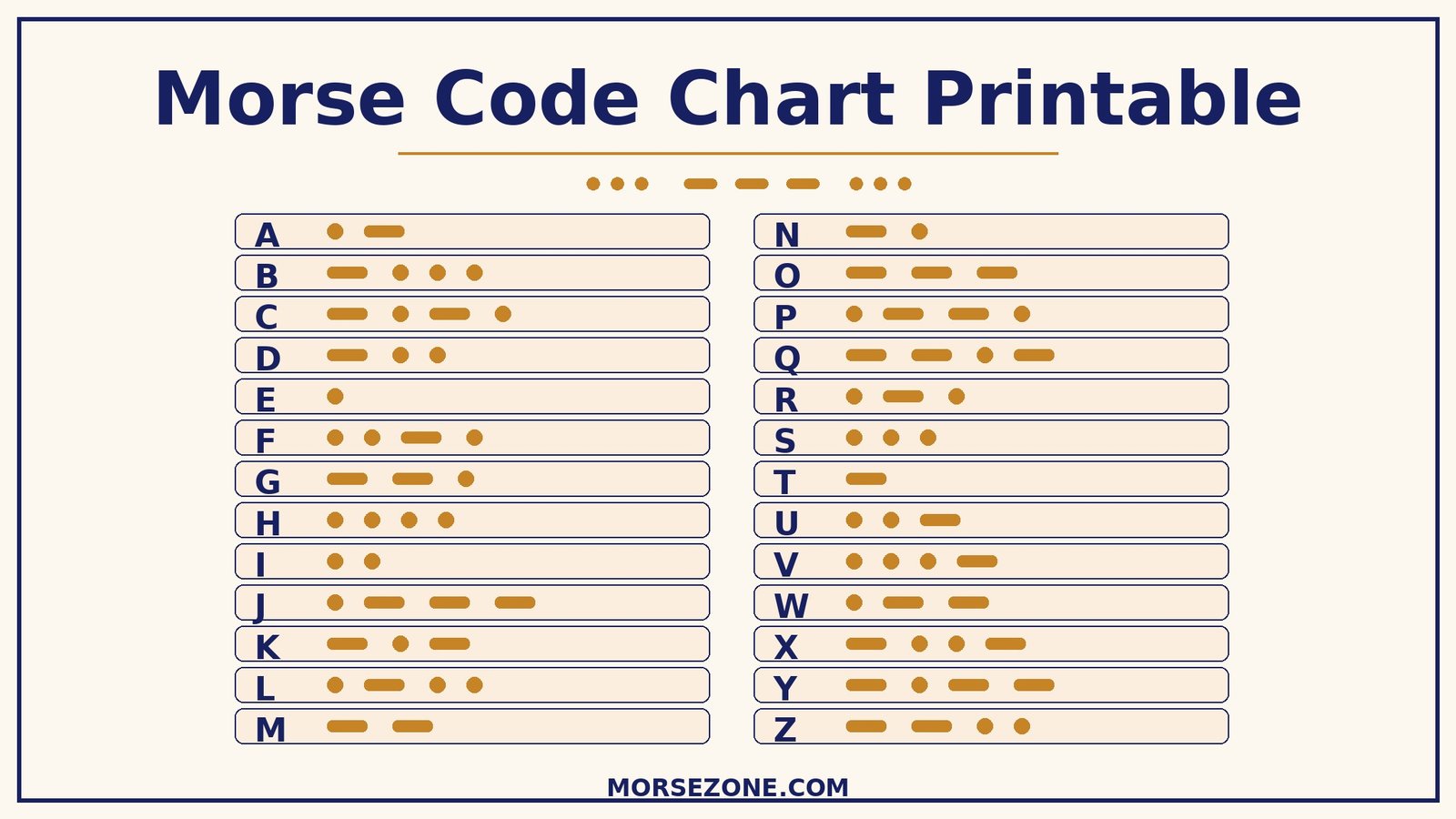
The chart below shows International Morse Code, the standard used worldwide by amateur radio operators, the military, and aviation. Each pattern is built from two signals: a short dit (dot) and a long dah (dash). A dah lasts three times as long as a dit.
| Letter | Morse Code | Letter | Morse Code |
|---|---|---|---|
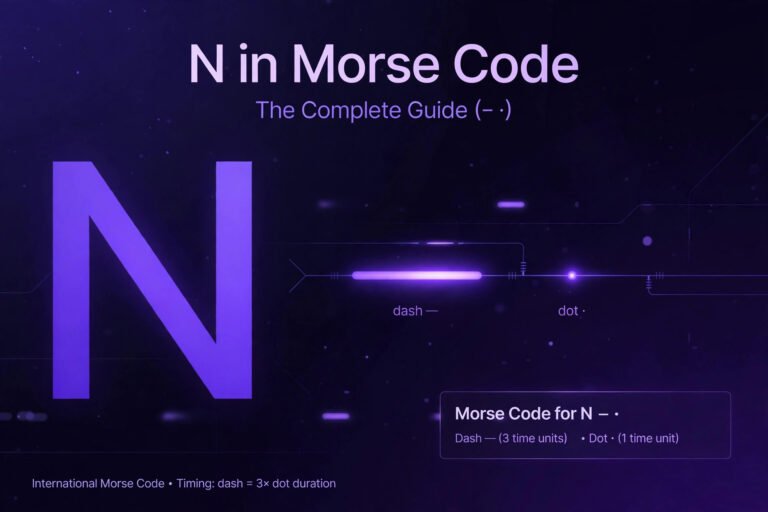
| A | .- | N | -. |
| B | -... | O | --- |
| C | -.-. | P | .--. |
| D | -.. | Q | --.- |
| E | . | R | .-. |
| F | ..-. | S | ... |
| G | --. | T | - |
| H | .... | U | ..- |
| I | .. | V | ...- |
| J | .--- | W | .-- |
| K | -.- | X | -..- |
| L | .-.. | Y | -.-- |
| M | -- | Z | --.. |
Two letters are worth memorising first. E is a single dot (.) and T is a single dash (-) — they are the most common letters in English, which is exactly why Samuel Morse gave them the shortest codes. The famous distress signal SOS is ... --- ...: three dots, three dashes, three dots.
Morse Code Chart: Numbers 0–9
Numbers follow a beautifully logical pattern. Every digit uses exactly five elements, and the count of dots tells you the number: 1 to 5 start with dots, 6 to 0 start with dashes.
| Number | Morse Code | Number | Morse Code |
|---|---|---|---|
| 0 | ----- | 5 | ..... |
| 1 | .---- | 6 | -.... |
| 2 | ..--- | 7 | --... |
| 3 | ...-- | 8 | ---.. |
| 4 | ....- | 9 | ----. |
We have a dedicated guide for every digit in this series, starting with 0 in Morse code and 1 in Morse code, if you want to practise one number at a time.
Punctuation on the Morse Code Chart
A complete chart includes punctuation. These marks are less common in everyday practice, but they appear in real messages and in amateur radio exchanges:
| Symbol | Morse Code | Symbol | Morse Code |
|---|---|---|---|
| Period (.) | .-.-.- | Comma (,) | --..-- |
| Question mark (?) | ..--.. | Exclamation mark (!) | -.-.-- |
| Apostrophe (‘) | .----. | Hyphen (-) | -....- |
| Slash (/) | -..-. | Colon (:) | ---... |
| At sign (@) | .--.-. | Ampersand (&) | . -... |
Each symbol has its own guide on this site, including the question mark in Morse code and the at sign in Morse code.
How to Read a Morse Code Chart
A chart only works if you know the timing rules behind it. Morse code is not just dots and dashes; the spaces between them carry meaning. The International Telecommunication Union (ITU) standard, Recommendation ITU-R M.1677, defines the timing in units:
- Dit (dot): one time unit long.
- Dah (dash): three time units long.
- Gap between elements in one letter: one time unit.
- Gap between letters: three time units.
- Gap between words: seven time units.
Speed is measured in words per minute (WPM). A beginner sending at 5 WPM has generous gaps; an experienced amateur radio operator may copy at 20–30 WPM. Do not rush the gaps: sloppy spacing is the most common reason a message becomes unreadable, even when every letter is correct. The Morse code article on Wikipedia documents the full timing specification and the history of the code, while Britannica’s overview of Morse code covers Samuel Morse and Alfred Vail’s development of the system in the 1830s and 1840s.
American vs International Morse Code
Almost every chart you find today, including this one, shows International Morse Code. The older American Morse Code (used on 19th-century US telegraph lines) had extra intra-character spaces and different patterns for some letters. Unless you are studying telegraph history, learn the international version — it is the one used by radio amateurs, aviation beacons, and every modern reference.
How to Use Your Printable Chart to Learn Morse Code Fast
A printed chart is a learning aid, not a crutch. Used well, it speeds up the first week dramatically. Here is a practical routine that works:
1. Learn by sound, not by sight
From day one, associate each pattern with its sound, not with the dots on the page. Say “di-dah” out loud as you tap the pattern. The Koch method — learning at full speed with just two letters, then adding one letter at a time — is the most proven approach for building real copying skill. Our guide on how to learn Morse code explains the method step by step.
2. Practise in short daily sessions
Fifteen focused minutes a day beats a two-hour weekend cram session. Cover the chart, listen to or tap out five letters, then check yourself against the printout. Add one new letter each day. Most learners can copy the full alphabet slowly within two to three weeks at this pace.
3. Start with real words, not random letters
Once you know E, T, A, O, I, N, S, and H, you can already spell dozens of words: tea, sea, hat, sit, ten. Real words give your brain patterns to hold on to, which is why our phrase guides — like thank you in Morse code — are popular practice material.
4. Put the chart away gradually
After the first week, try copying short messages without looking. Use the chart only to check letters you miss. If you keep the chart in view forever, your eyes will keep doing the work your ears should be learning.
Morse Code Chart for Kids and Classrooms
A printable Morse code chart is a favourite classroom resource: it turns a history lesson about Samuel Morse into a hands-on activity. Kids can tap out their names on a desk, send secret messages across the room, or build a simple telegraph key from a battery, a buzzer, and a strip of metal. For younger learners, start with just five letters — E, T, S, O, and A — and let them spell their own names before introducing the full chart. Our Morse code for kids guide has games and activities built around exactly this approach.
Where Morse Code Charts Are Still Used
Morse code never fully went away. Amateur radio operators still use it daily — the shorthand 73 in Morse code means “best regards” and ends countless radio contacts. Aviation navigation beacons still identify themselves in Morse, and the SOS distress pattern remains recognised worldwide. The code also lives on in puzzles, escape rooms, films, and assistive technology, where its two-signal simplicity makes it one of the most accessible communication systems ever devised. Our round-up of famous messages in Morse code shows how the code marked moments from the Titanic’s distress calls to wartime broadcasts.
How to Print the Chart
- Paper size: print on A4 or US Letter; the chart is designed to stay legible at a single page.
- Orientation: portrait works for the A–Z table; use landscape if you add the numbers and punctuation tables beside it.
- Settings: print at 100% scale (not “fit to page”) and enable background graphics so the row shading prints.
- Durability: laminate the page or slip it into a clear sleeve if it will live in a radio shack, classroom, or go-bag.
- Keep it handy: tape it beside your practice key or keep a folded copy with your amateur radio logbook.
Frequently Asked Questions
Is there a free printable Morse code chart?
Yes — the full A–Z chart, numbers 0–9, and punctuation tables on this page are free to use. Print this page directly, or save the featured chart image above, and you have a complete reference sheet. The tables are also available as a plain-text reference through our Morse Code Translator tool.
What is the Morse code alphabet chart?
It is a reference table pairing each letter A–Z with its International Morse Code pattern of dots (dits) and dashes (dahs). For example, A is .-, B is -..., and C is -.-.. The same chart usually includes numbers 0–9 and common punctuation marks.
How long does it take to learn Morse code with a chart?
Most learners can recognise the full alphabet within two to three weeks of 15 minutes of daily practice, and copy simple messages slowly within a month. The chart speeds up the first week; learning by sound (the Koch method) is what builds lasting speed.
What is SOS in Morse code?
SOS is ... --- ... — three dots, three dashes, three dots. It is easy to remember, easy to send, and recognised internationally as a distress signal. It is also the classic first pattern to learn from any chart.
Is American Morse code different from International Morse code?
Yes. American Morse Code, used on 19th-century US telegraph lines, had different patterns for some letters and used spaces inside characters. International Morse Code, standardised by the ITU, is the version on every modern chart and the one used by amateur radio and aviation today.
Conclusion
A printable Morse code chart puts the entire code on one page: 26 letters, 10 numbers, and the punctuation you need for real messages. Print it, learn the timing rules, practise a few minutes a day by sound, and the chart will soon become a backup you rarely need. When you are ready to check yourself, run your message through the free Morse Code Translator and compare it letter by letter with your chart.