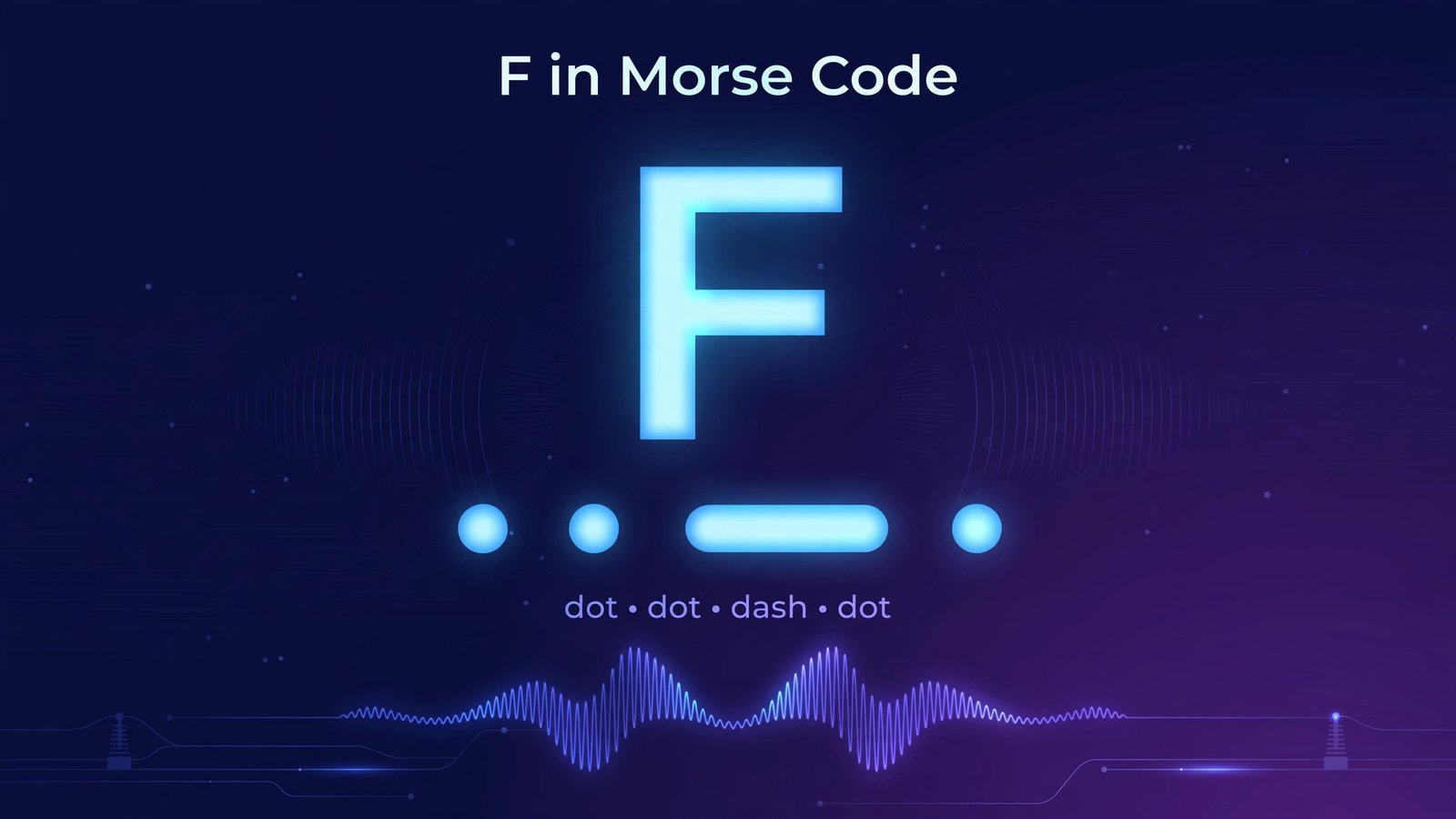
Four elements, two short and one long in the middle: F in Morse code is ··−· — spoken aloud as “di-di-dah-dit”. It is the kind of letter where the code starts to feel like a rhythm rather than a random pattern, and that rhythm is exactly what makes it easy to remember.
In this guide you will learn what F sounds like, why its code is built the way it is, a memory hook that locks the pattern in place, and a set of practice words that drill F into your sending hand. You can hear every pattern as you read with the free Morse Code Translator — just type a letter and press play.
What Is F in Morse Code?
In International Morse Code, the letter F is dit-dit-dah-dit (··−·): two short signals, one long signal, and a final short signal. That is four elements in total, separated by single-unit gaps.
Every character in Morse follows the same timing system, standardised by the International Telecommunication Union (ITU). Breaking F down unit by unit:
| Element | Duration |
|---|---|
| dit | 1 unit |
| gap | 1 unit |
| dit | 1 unit |
| gap | 1 unit |
| dah | 3 units |
| gap | 1 unit |
| dit | 1 unit |
| Total for F | 9 units |
Compare that with E in Morse code, the single dot that costs just one unit: F takes nine times as long to send as E. That gap tells a story about how the code was designed — and why F’s pattern is exactly four elements long. The Morse code article on Wikipedia documents this timing system and the history behind the assignments.
Why Does F Look Like ··−·?
The shape of F’s code is no accident — it is the direct result of Alfred Vail’s frequency-based design from around 1840. Vail estimated how often each letter appears in English text (famously, by counting movable type in the type cases of a local newspaper in Morristown, New Jersey) and gave the shortest codes to the most common letters.
F sits roughly in the middle of the frequency table — it appears in about two percent of English text, far less than E or T but far more than Q, X or Z. So it received a middle-length code: four elements, nine units of time. The logic is the same one that gave E a single dot and burdened the rare letters with long, awkward patterns.
One nuance worth knowing: the F code you see today is the international version. Friedrich Gerke’s 1848 refinement — the “Hamburg alphabet” developed for German railways — changed many of the original codepoints, and the 1865 international standard adopted most of his revisions. Through all of that, only four character codes survived unchanged from Vail’s originals: E, H, K and N. F’s modern di-di-dah-dit form is a product of that international standardisation, maintained today by the ITU as Recommendation ITU-R M.1677-1.
How to Say, Tap and Flash F
Say it: “di-di-dah-dit”
Operators vocalise a dot as “dit” and a dash as “dah” — but when a dit is not the final element of a character, it is shortened to “di”. So F is voiced “di-di-dah-dit”: two clipped syllables, one long syllable, one clipped syllable.
Here is a memory hook that uses that exact rhythm. Say the question “Did you HEAR it?” — did (short), you (short), HEAR (long and stressed), it (short). The natural stress pattern of that phrase is precisely F’s code. Once you feel the rhythm of the phrase, you own the letter.
Tap it: tap-tap-hold-tap
Two quick fingertip taps, one tap held about three times as long, and a final quick tap. Try it on your desk: tap-tap-tap(long)-tap. Keep the gaps between taps short and even — one beat of silence between each element. Type “FFF” into the Morse Code Translator and listen first, then tap along with the playback until your hand matches the sound.
Flash it: blink-blink-hold-blink
For visual signalling with a torch or phone light, F is two short flashes, one long flash (roughly three times the length of a short one), and one more short flash. F is a good letter for flashlight drills because the pattern is distinctive — a listener can pick out the di-di-dah-dit rhythm from a sequence even when the timing is a little rough.
F in Practice: Words to Drill
The fastest way to learn a letter is to send it inside real words. F appears in short, friendly words that make excellent drill material — send these with the translator open, then try them by tap:
| Word | Code | Why it helps |
|---|---|---|
| OF | −−− ··−· | Two letters; contrasts the long O with F |
| IF | ·· ··−· | Shows F after the short, quick I |
| FUN | ··−· ··− −· | F leads the word — great for recognition drills |
| FOR | ··−· −−− ·−· | Three letters, three distinct rhythms |
| OFF | −−− ··−· ··−· | Double F — the pattern repeats back to back |
Start at a slow, steady speed and say “di-di-dah-dit” aloud as you send. When FUN feels effortless, move to FOR and OFF. Ten focused minutes a day beats an hour once a week — Morse is a physical skill, and your sending hand needs the reps.
Where You’ll Meet F Beyond the Chart
In radio culture: “Foxtrot”
In the NATO phonetic alphabet, F is “Foxtrot” — the same system that calls E “Echo”. Hams and aviation operators use both systems side by side: Morse on the key, phonetics on the microphone. Knowing both the Morse pattern and the spoken word keeps you fluent in the two halves of radio culture.
In amateur radio: callsigns starting with F
International callsign prefixes are allocated by the ITU, and the letter F opens callsigns issued to France. So when you copy a callsign like F6CER in the middle of a pileup, you are not just hearing an F — you are hearing a station in France. The F in every French callsign goes out as di-di-dah-dit, thousands of times a day on the HF bands.
In aviation: beacon identifiers
Navigational beacons (NDBs and VORs) transmit their one-to-three-letter identifiers in Morse code continuously, and aviation charts print each identifier next to its symbol. Pilots learn to recognise these identifiers by ear — and F, with its loping two-short-one-long rhythm, is one of the easier letters to pick out of the air. Morse remains quietly alive in aviation today, which is one reason Morse code is still used in specific niches even in 2026.
Frequently Asked Questions
What is F in Morse code?
F in Morse code is ··−· — dit-dit-dah-dit: two short signals, one long signal, and a final short signal. Voiced aloud, operators say “di-di-dah-dit”.
How long does F take to send in Morse code?
F costs 9 time units: 1+1+1+1+3+1+1 (two dits, a dah and three single-unit gaps). That is nine times longer than E’s single dot, which reflects F’s mid-range frequency in English text — common enough for a four-element code, rare enough not to get a shorter one.
What is a good way to remember F in Morse code?
Use the rhythm phrase “Did you HEAR it?” — two quick syllables, one long stressed syllable, one quick syllable — exactly matching di-di-dah-dit. Alternatively, drill the word FUN until the pattern feels automatic.
What is F called in the NATO phonetic alphabet?
F is “Foxtrot” in the NATO phonetic alphabet, used in aviation and amateur radio. Operators often know both the Morse pattern and the phonetic word for each letter.
Is F in Morse code the same as it was in 1844?
No. F’s current form is the international code, standardised in 1865 and refined from Gerke’s 1848 “Hamburg alphabet”. Only four codes — E, H, K and N — are identical to Alfred Vail’s original 1840s assignments.
Conclusion
F is where Morse code stops being a set of marks and starts being a rhythm. Di-di-dah-dit — the same cadence as “did you HEAR it?” — sits at the centre of a letter that bridges the telegraph office of the 1840s and the radio bands of today, from French callsigns to aviation beacons.
Learn it by sending it. Open the free Morse Code Translator, type FUN, and tap along with the playback. Then explore the rest of the series — you have already met E in Morse code, and there is a growing collection of famous messages sent in Morse code where every one of these patterns comes alive in history.