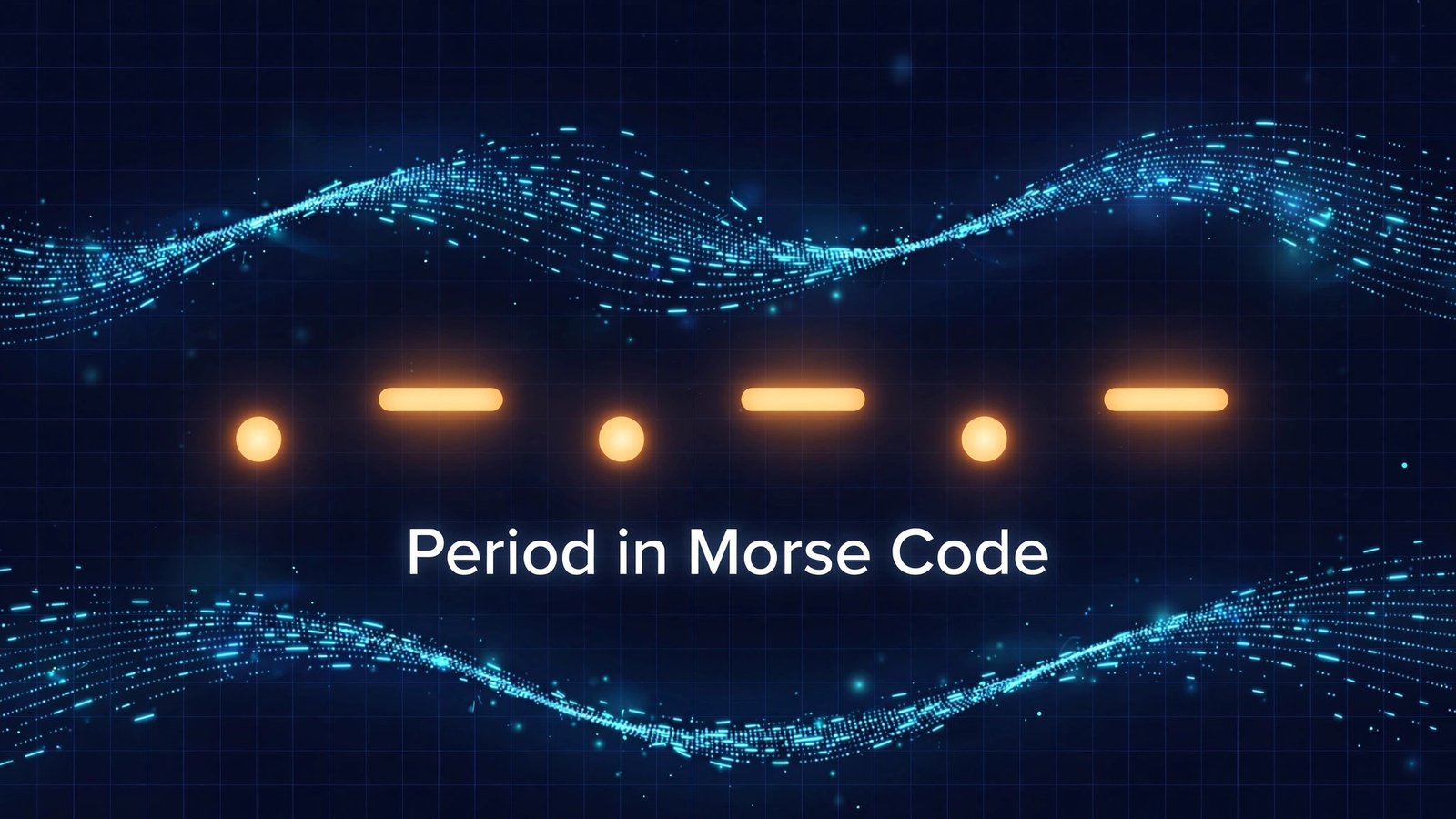
Period in Morse Code (.-.-.-)
The period in Morse code is .-.-.- — dot-dash-dot-dash-dot-dash, three clean repetitions of “didah.” If you already know the letters, punctuation like the period is the natural next step: it is how sentences in Morse code actually end. Type any sentence into the Morse Code Translator and watch the period appear as .-.-.- at the end of every translated line.
What is the period in Morse code?
In International Morse Code, the full stop (period) is sent as six elements: .-.-.-. Say it out loud as “didah-didah-didah” — it is one of the most rhythmic patterns in the whole code, which is exactly why beginners pick it up fast. Unlike letters, punctuation marks were not part of the earliest American Morse used on the 1844 Baltimore–Washington telegraph line; the standardized punctuation set, including the period, came with International Morse Code, the system formalized through the ITU (International Telecommunication Union) and still in use by amateur radio operators today.
Why the period uses this pattern
Morse punctuation is designed to be unmistakable. The period’s alternating dot-dash rhythm makes it nearly impossible to confuse with any letter once you hear it at speed, and it sits in a family of similarly balanced punctuation patterns: the question mark (..–..), the comma (–..–), and the exclamation mark (-.-.–). Samuel Morse and Alfred Vail built the original code around short codes for frequent letters; when the code went international, punctuation received longer, deliberate patterns so operators would never misread a sentence boundary in the middle of a noisy transmission.
How to send a period in Morse code
Sending .-.-.- follows the same timing rules as every other Morse character. If you are tapping it on a key, blinking it with a flashlight, or sounding it with a buzzer, keep these unit lengths in mind:
- Dot: 1 time unit (a short tap or flash)
- Dash: 3 time units (three times as long as a dot)
- Gap between elements of one character: 1 time unit
- Gap between characters: 3 time units
- Gap between words: 7 time units
So a period is: short–long–short–long–short–long, with brief pauses between each of the six elements and a longer pause afterwards. At 20 words per minute (WPM), one unit is about 60 milliseconds, which makes the whole period take roughly a second to send — the same standard timing used by the Morse Code Translator when it plays audio back to you. If you are just starting out, practice at a comfortable speed first; accuracy always beats speed, exactly as our guide on how to learn Morse code fast explains.
Simple tricks to memorize .-.-.-
Three memory hooks that students actually keep using:
- The “stop-stop-stop” rhythm. Think of the period’s job — it stops a sentence — and tap three identical “didah” pairs, like three full stops in a row: stop. stop. stop.
- The keyboard picture. Picture the period key on your keyboard at the end of a sentence, then hear its sound signature: short-long, short-long, short-long. The visual of the dot anchors the sound.
- Pair it with the question mark. Learn .-.-.- (period) and ..–.. (question mark) together as a pair. Statements end with the period’s march; questions end with the question mark’s rising lilt. Practicing both side by side locks in the difference.
Period vs. other Morse punctuation
Here is the period next to the punctuation marks you will meet most often, so you can compare patterns at a glance:
| Punctuation | Morse code | Sound |
|---|---|---|
| Period (.) | .-.-.- | didah-didah-didah |
| Question mark (?) | ..–.. | dididahdahdidit |
| Exclamation mark (!) | -.-.– | dahdidahdahdahdit |
| Comma (,) | –..– | dahdahdididahdah |
Notice the pattern: every one of these is six elements long, and each starts differently. The period is the only one that alternates dot-dash all the way through — that makes it the easiest of the four to recognize by ear.
Practice: the period in real messages
The best way to own a new pattern is to use it in full messages. Try encoding these with the Morse Code Translator, then decode them back:
- “YES.” →
-.-- . ... .-.-.- - “I AM OK.” →
.. / .- -- / --- -.- .-.-.- - “CALL ME.” →
-.-. .- .-.. .-.. / -- . .-.-.-
Notice how the 7-unit word gap separates the words and the period’s 3-unit character gap keeps .-.-.- distinct from the letter before it. Getting the spacing right is what turns a string of beeps into readable sentences — the same spacing discipline that makes numbers like 9 (—-.) and letters like A (.-) unambiguous in real traffic. Ham radio operators live by these gaps every day; if the culture of on-air operating interests you, our piece on what “73” means in ham radio is a good next read.
Common mistakes with the period
Two errors trip up almost everyone. First, rushing the final dash: all three dashes in .-.-.- must be full-length, or the pattern collapses toward something unrecognizable. Second, forgetting the 3-unit gap after the period before starting the next sentence — run the next character in too soon and the receiver hears one long garbled character. Slow down, count the gaps, and the period becomes one of your most reliable characters.
FAQ: the period in Morse code
What is a period in Morse code?
A period (full stop) in International Morse Code is .-.-.-: dot-dash-dot-dash-dot-dash, six elements long. It is the standard way to end a sentence in Morse, defined in the international punctuation set maintained through the ITU.
How do you remember .-.-.-?
Think “didah-didah-didah” — three identical short-long pairs in a row, like three full stops. Pairing it with the question mark (..–..) as a practice duo also helps, since you learn statements and questions as opposites.
Is the period the same in American Morse and International Morse?
No. American Morse (the original 1840s railroad code of Samuel Morse and Alfred Vail) used a different, more complex punctuation system with intra-character spaces. Modern usage everywhere — amateur radio, aviation, scouting, hobby learning — is International Morse Code, where the period is .-.-.-.
Can I type a period into the Morse Code Translator?
Yes. Paste or type any sentence ending with a period into the Morse Code Translator and it will render the period as .-.-.-, play it back in audio, and let you copy the full translation.
What punctuation should I learn after the period?
Learn the question mark (..–..) next, then the comma (–..–) and exclamation mark (-.-.–). Together with the period, these four cover nearly all everyday sentence punctuation in Morse code.
The period is small, but it is doing real work: it is what turns a stream of dits and dahs into sentences a human can read. Master .-.-.-, keep your gaps honest, and practice a few full sentences a day — within a week the “didah-didah-didah” will feel as natural as the dot on your keyboard. For inspiration on what fluent operators can do with the code, browse our collection of famous messages sent in Morse code, from wartime signals to space transmissions.
Sources: the International Morse Code punctuation set is documented on Wikipedia’s Morse code page and in Britannica’s overview of Morse code; international standards are maintained by the International Telecommunication Union (ITU).