7 in Morse Code Is –… (Two Dashes, Three Dots)
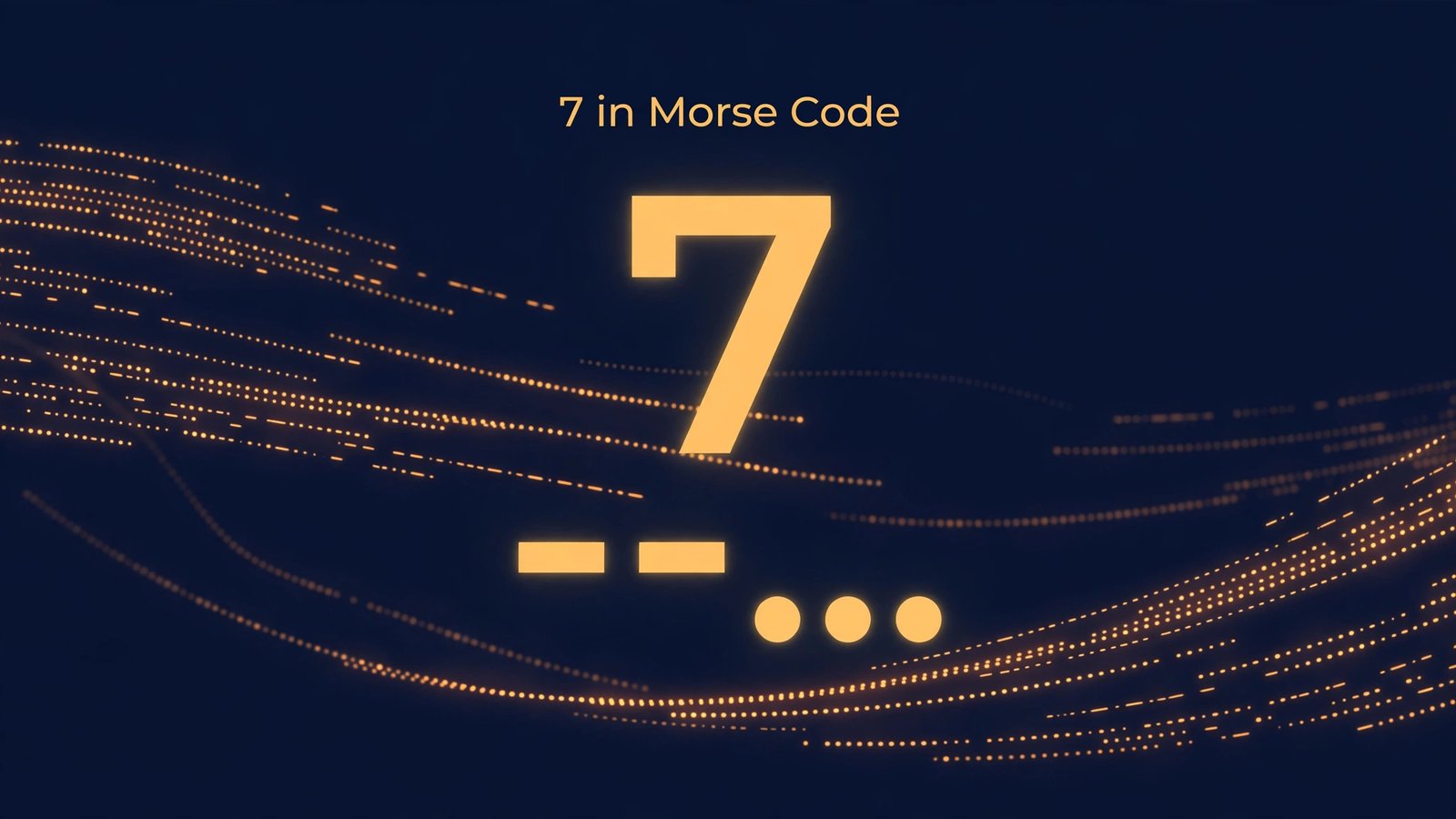
The number 7 in Morse code is sent as –…: two dashes (dahs) followed by three dots (dits). Say it aloud and the rhythm lands naturally: dah-dah-di-di-dit. Of all ten digits, 7 has one of the easiest rhythms to lock into memory, because the two dashes act as a clear “launch” into three light dots.
If you want to hear it straight away, paste –… into the Morse code translator on the homepage and press play. The tool plays the exact timing, so you can listen, repeat, and train your ear before reading further.
Why 7 Is –…: The Digit Pattern Logic
Morse code’s ten digits were not chosen at random. They follow a deliberate counting system designed by Samuel Morse and Alfred Vail so that operators could decode numbers by counting elements:
| Digit | Morse | Structure |
|---|---|---|
| 5 | ….. | five dots (the pivot) |
| 6 | -…. | one dash + four dots |
| 7 | –… | two dashes + three dots |
| 8 | —.. | three dashes + two dots |
| 9 | —-. | four dashes + one dot |
Notice the elegant symmetry: starting at 5 (…..), each step up replaces one dot with a dash from the left. So 7 = two dashes + three dots, and 8 = three dashes + two dots. This design made numbers remarkably easy to learn by touch and sound — you only ever need to count up to five elements.
The International Telecommunication Union (ITU) later standardised these same patterns as part of International Morse Code, which is still the official reference today. You can read our full breakdown of the neighbours in this series: 6 in Morse code, 5 in Morse code, and 0 in Morse code.
How to Send 7: Timing Rules
Correct timing is what separates readable Morse from noise. Every element follows the ITU standard timing rules:
- A dot (dit) = 1 unit of time (the shortest element).
- A dash (dah) = 3 units of time (three times longer than a dot).
- Gap between dots and dashes inside one character = 1 unit.
- Gap between characters = 3 units.
- Gap between words = 7 units.
To send –…, hold the key (or tap) for two long dahs, pause one unit between elements, then tap three short dits. Beginners typically learn at around 15-20 WPM (words per minute); with the Farnsworth method, you learn the character sounds at full speed while keeping generous gaps between characters, which prevents you from counting dots and dashes instead of recognising rhythms.
What 7 Sounds Like
The sound of –… has a distinctive “heavy then light” feel: two solid tones followed by three quick taps. Because the two dahs come first, 7 is easy to tell apart from its mirror image, …– (3), which begins with the light taps instead.
Try this exercise: set a metronome or clap along. Clap “LONG-LONG-short-short-short” — that is 7. Then flip it: “short-short-short-LONG-LONG” — that is 3. Alternating the pair trains your ear faster than drilling 7 alone.
Where 7 Appears in Real Morse Traffic
Amateur Radio and the Famous “73”
In amateur (ham) radio, numbers are everywhere: frequencies (“7.040 MHz” on the 40-metre band), signal reports (“599”), and callsigns. The prosign-style abbreviation “73” (best regards) ends in 3, but 7 appears constantly in callsigns and contest exchanges. Read what 73 means in ham radio to see how numbers weave through everyday QSO exchanges.
Aviation and Emergency Signalling
Aviation identifiers, runways, and frequencies lean heavily on digits. A squawk code, a runway number, or a radio frequency spoken in a noisy cockpit can be tapped out in Morse with the correct digit patterns. And the granddaddy of them all — SOS (… — …) — shares the same digit/letter logic we have been exploring across the numbers series.
Memory Tricks for –…
- The countdown trick: digits 5 to 9 replace one dot with a dash from the left each time. 5 (…..), 6 (-….), 7 (–…) — so 7 is just “two steps up from 5.” If you know 5, count two dahs in and you have 7.
- The visual trick: picture the number 7 written by hand — two strokes, like two dashes — followed by three tiny dots trailing off to the right. The shape of the character itself gives you the pattern.
- The rhythm trick: hum the first bar of a march (“DUN-DUN-di-di-dit”). Two heavy beats, three light ones. Drill it until it is a single sound, not five separate elements.
- The neighbour trick: learn 7 and 8 as a pair (—..). If you send 7 by mistake with an extra dash, you have just sent 8 — so catching that extra dash is the difference between the two.
Common Mistakes With 7
- Confusing 7 (–…) with 8 (—..): the single extra dash is the entire difference. Slow down the dash run and count “one, two” before the dots.
- Confusing 7 (–…) with 3 (…–): same elements, reversed order. Always listen for which end the dahs sit on.
- Running the dots together: three dits in a row can blur into a buzz at speed. Keep the 1-unit gaps crisp so –… never collapses into — followed by an unreadable smear.
Quick Reference: All Digits 0-9
| Digit | Morse code | Digit | Morse code |
|---|---|---|---|
| 0 | —– | 5 | ….. |
| 1 | .—- | 6 | -…. |
| 2 | ..— | 7 | –… |
| 3 | …– | 8 | —.. |
| 4 | ….- | 9 | —-. |
Frequently Asked Questions
What is 7 in Morse code?
7 in Morse code is –… — two dashes followed by three dots (dah-dah-di-di-dit). It is one of the ten ITU-standardised digit patterns.
How do you tap 7 in Morse code?
Tap two long presses (dashes, each about three times the length of a dot), then three short taps (dots), with a brief pause between each element. The whole character should take about 12 timing units at standard spacing.
What is the difference between 7 and 8 in Morse code?
7 is –… and 8 is —.. — the difference is a single extra dash. Count the dahs at the start: two means 7, three means 8.
Is 7 the same in American Morse code?
Modern usage follows International Morse Code (–…). The older American Morse (railroad code) used different patterns and is obsolete; learn the international version for amateur radio and general use. See the Britannica overview of Morse code for its history and standardisation.
How can I practise 7 in Morse code?
Type “–…” into the Morse code translator and play the audio repeatedly, then try keying it yourself with a straight key or phone app at around 15 WPM. Pair it with 8 and 3 in alternating drills until the rhythm is automatic.
Conclusion
The number 7 in Morse code — –… — sits right in the sweet spot of the digit system: two dashes, three dots, a clean “heavy-then-light” rhythm, and a counting logic that makes it almost impossible to forget once you understand the 5-to-9 progression. Add it to your set alongside 6, 5, and 0, and you are down to just 8 and 9 to complete the digits. Keep practising the rhythm, and the whole set will feel like second nature.