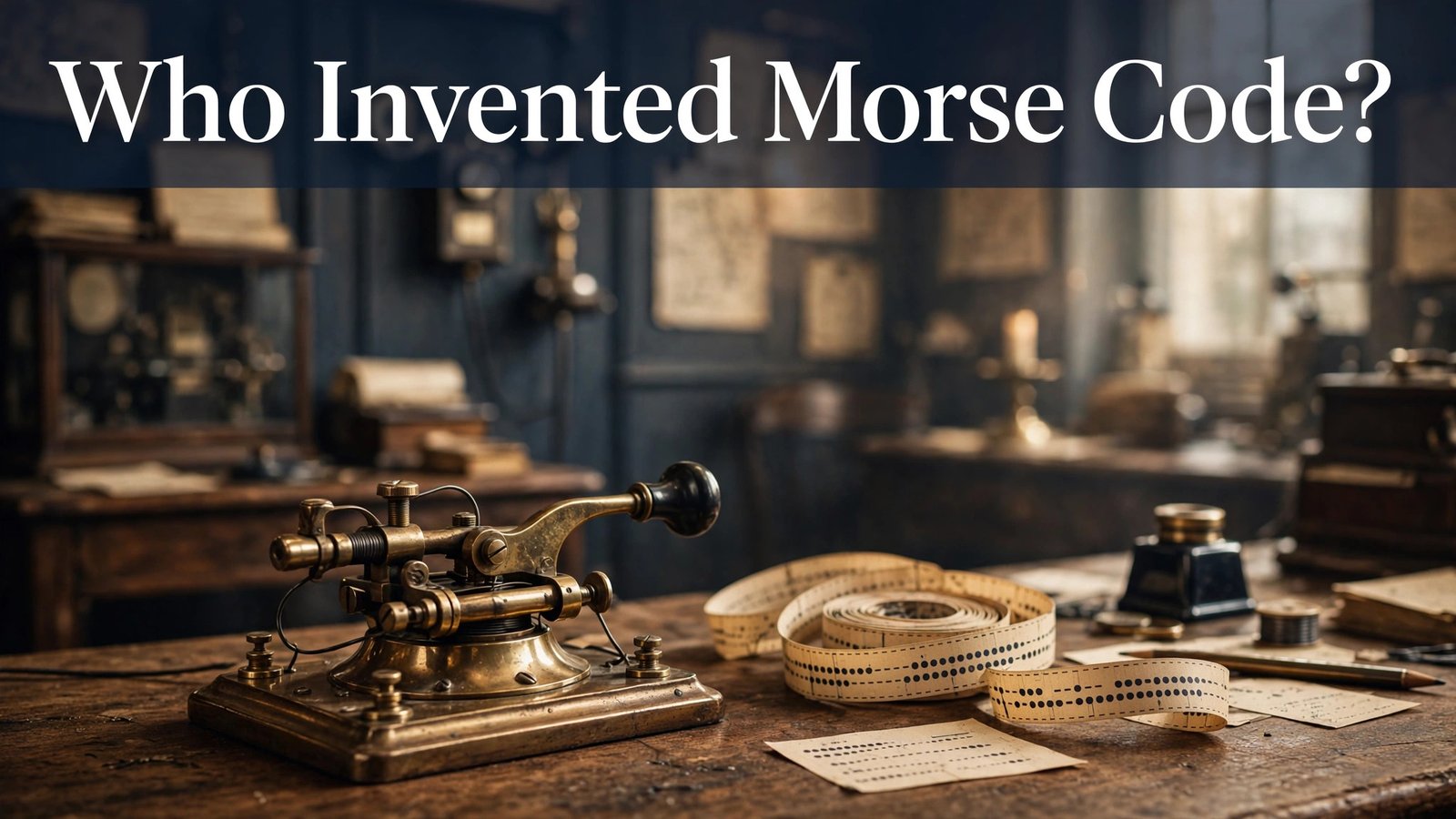
Ask “who invented Morse code?” and most people give you one name: Samuel Morse. That answer is right — but only partly. Morse code was not the work of a lone genius scribbling in a workshop. It was built by a small team, argued over in patent courts, and then rewritten by engineers on another continent before it became the code the world still uses today.
This is the full story: the painter who dreamed up the telegraph, the young machinist who designed the dots and dashes, the scientist whose electromagnet made it possible, and the 1844 message that changed communication forever. If you want to try the code yourself, our free Morse Code Translator turns any text into dots and dashes in seconds.
The Short Answer
Samuel F. B. Morse invented Morse code in the 1830s, together with Alfred Vail. Morse conceived the electric telegraph and the idea of encoding letters as combinations of short and long signals. Vail, his business partner and a skilled machinist, designed most of the actual dot-and-dash alphabet and built the first working sending key. Joseph Henry, a pioneering American physicist, supplied the scientific foundation — the powerful electromagnet that made long-distance signalling possible.
The system was first demonstrated publicly in 1838, and the first commercial telegraph line opened in 1844 between Washington, D.C. and Baltimore, Maryland. Its first message, “What hath God wrought”, was sent by Morse himself on 24 May 1844.
Samuel Morse: The Painter Who Became an Inventor
Samuel Finley Breese Morse (1791-1872) was not an engineer by training. He was one of America’s most successful portrait painters, known for grand historical canvases and portraits of presidents. The turn toward invention came from personal tragedy: in 1825, while painting a portrait in Washington, his wife Lucretia died suddenly at home in New Haven. The news reached him days late, and he arrived home after her funeral.
Morse became obsessed with the idea that messages should travel faster than a horse. On a voyage home from Europe aboard the packet ship Sully in 1832, he fell into conversation with fellow passengers about the new science of electromagnetism. By the end of the voyage he had sketched the rough idea of an electric telegraph in his notebook: a wire, a battery, an electromagnet, and a system of signals that could carry a message.
For the next five years Morse worked in near-poverty on the idea, building crude prototypes in his rooms at New York University, where he taught art. His first apparatus, demonstrated in 1837, could send signals only a few hundred feet — but it proved the concept worked. The biography of Samuel Morse records how he then spent years lobbying Congress for funding, finally winning a $30,000 appropriation in 1843 to build the Washington-Baltimore line.
Alfred Vail: The Man Who Designed the Code
If Morse supplied the vision, Alfred Vail (1807-1859) supplied much of the code itself. Vail was the son of a wealthy New Jersey ironworks owner. In 1837 he visited Morse’s studio, saw the prototype, and offered a deal: his family would fund the work in exchange for a share of the patents, and Vail would join as a partner.
Vail’s contribution was enormous and is often under-credited:
- The code itself. Morse’s original scheme used a dictionary of numbered code words — clumsy and slow. Vail replaced it with a simple alphabet in which each letter is a unique combination of dots and dashes, with the shortest codes given to the most common letters. That is why
Eis a single dot (.) andTa single dash (-). - The sending key. Vail designed the spring-loaded lever key that operators tapped to make dots and dashes — the ancestor of every telegraph key since.
- The first practical equipment. Vail built the register and sounder that made the system usable in a real telegraph office.
Vail later claimed he deserved co-inventor status, and modern historians largely agree: the code as operators actually used it was mostly his design. Morse, however, held the patents in his own name, and the two men quarrelled over credit for the rest of their lives.
Joseph Henry and the Science Behind the Telegraph
Neither Morse nor Vail could have made the telegraph work without Joseph Henry (1797-1878), the physicist who built the first powerful electromagnets. Henry showed that a coil of insulated wire wrapped around an iron core could lift heavy weights when current flowed — and, crucially, that the signal could be boosted along a long wire with relay stations.
Morse knew almost nothing about electricity when he started. He consulted Henry repeatedly, and Henry freely shared his findings. When Morse’s patent application later claimed the electromagnet as part of his invention, Henry was furious — but the Supreme Court’s landmark 1854 decision in O’Reilly v. Morse limited Morse’s patent claims while still upholding his core telegraph patent.
The First Telegraph Line: “What Hath God Wrought”
The Washington-Baltimore line was built in the spring of 1844, with wires strung on poles along the Baltimore & Ohio railroad. On 24 May 1844, from the Supreme Court chamber in the Capitol, Morse tapped out the first official message to Vail, waiting in Baltimore:
.-- .... .- - .... .- - .... --. --- -.. .-- .-. --- ..- --. .... -
“What hath God wrought” — a phrase suggested by Annie Ellsworth, daughter of the Commissioner of Patents, taken from the Book of Numbers. Vail immediately sent the message back, confirming the line worked. Within a decade, telegraph wires crossed the United States, and by 1866 a transatlantic cable linked America and Europe.
The first message is one of the most famous ever sent. Our guide to famous messages in Morse code covers it alongside SOS, the Titanic’s distress calls, and other historic transmissions.
American Morse Code vs. International Morse Code
Here is a twist most people miss: the code Morse and Vail invented is not the code used today. Their original system, now called American Morse code or “railroad Morse”, had a complicated set of rules — dots, dashes, long dashes, and pauses inside letters. It was hard to learn and hard to send quickly.
In 1851, a conference in Europe adopted a cleaner version developed by German telegraph engineer Friedrich Clemens Gerke. This International Morse code used only short dots and long dashes with uniform spacing, and it was far easier to learn. The International Telecommunication Union (ITU) standardised it in 1865, and it gradually replaced the American system everywhere except on some US landlines, where American Morse survived into the twentieth century.
So the code you learn today — the one in our printable Morse code chart — is Gerke’s refined alphabet, built on Morse and Vail’s original idea. If you want to learn to read it by ear, our beginner’s guide to reading Morse code walks through the process step by step.
Timeline: How Morse Code Was Invented
| Year | Event |
|---|---|
| 1825 | Morse’s wife dies; the delayed news sparks his interest in fast communication. |
| 1832 | On the ship Sully, Morse sketches the idea of an electric telegraph. |
| 1837 | Morse demonstrates a working prototype; Alfred Vail joins as partner and funder. |
| 1838 | First public demonstration of the telegraph and the dot-dash code. |
| 1843 | Congress approves $30,000 to build the Washington-Baltimore line. |
| 1844 | First message, “What hath God wrought”, sent on 24 May 1844. |
| 1851 | Europe adopts Gerke’s simplified code — the ancestor of International Morse. |
| 1854 | US Supreme Court rules on Morse’s patents in O’Reilly v. Morse. |
| 1865 | ITU standardises International Morse Code worldwide. |
| 1999 | Morse code retired from international maritime distress use, replaced by GMDSS. |
Who Really Deserves the Credit?
Historians still debate the split of credit, and the honest answer is that invention here was a team effort:
- Samuel Morse had the idea, drove the project through years of failure and lobbying, and put his name and fortune on the line. Without him there is no telegraph.
- Alfred Vail designed the practical code and the key, and his family’s money kept the work alive. Without him the code would have been slow and unusable.
- Joseph Henry supplied the electromagnet science. Without him the signal would not have travelled.
- Friedrich Gerke created the version of the code the world actually adopted.
Even the famous “What hath God wrought” message was a group product — the words came from Annie Ellsworth. Morse code is a reminder that big inventions are rarely solo acts.
Morse Code Today
The telegraph is long gone, but the code survives. Amateur radio operators still use it daily — it cuts through weak signals better than voice, and the prosign 73 (“best regards”) remains a friendly sign-off; see our explainer on what 73 means in ham radio. Pilots hear it in navigation beacons, the military still trains with it, and it has found a new life as an accessibility tool: people with limited movement can type with a single switch, tapping dots and dashes. It is also a favourite first project for children learning about communication — our Morse code for kids guide makes it a game.
For the full background on the system itself, the history of Morse code on Wikipedia traces its development from the 1830s to the ITU standard, and Britannica’s biography of Samuel Morse covers his double life as artist and inventor.
Frequently Asked Questions
Who invented Morse code?
Samuel F. B. Morse invented Morse code in the 1830s with his partner Alfred Vail, who designed most of the dot-and-dash alphabet. Joseph Henry provided the electromagnet science that made the telegraph possible, and Friedrich Gerke later refined the code into the International Morse code used today.
When was Morse code invented?
Morse conceived the telegraph in 1832 and demonstrated a working system in 1837-38. The first commercial line opened in 1844, when the message “What hath God wrought” was sent from Washington to Baltimore on 24 May 1844.
Did Samuel Morse invent the telegraph alone?
No. Morse conceived the telegraph, but Alfred Vail designed the code and the sending key, Joseph Henry supplied the electromagnet research, and the Vail family funded the work. The code in use today is a European refinement by Friedrich Gerke, standardised by the ITU in 1865.
What was the first message sent in Morse code?
The first official message was “What hath God wrought”, sent by Samuel Morse from Washington, D.C. to Alfred Vail in Baltimore on 24 May 1844. The phrase, from the Book of Numbers, was suggested by Annie Ellsworth.
Is Morse code still used today?
Yes. Amateur radio operators use it every day, aviation navigation beacons broadcast identifiers in Morse, and it is used as an assistive communication method. It was retired from international maritime distress signalling in 1999, but it remains a living skill with a large global community.
Conclusion
Samuel Morse invented Morse code — but the full credit belongs to a team. Morse had the vision, Alfred Vail built the code, Joseph Henry supplied the science, and Friedrich Gerke made the version the world kept. From a sketch on a ship in 1832 to a global standard still tapped out by radio amateurs today, Morse code is one of history’s great examples of collaborative invention.
Ready to try it yourself? Type any message into our free Morse Code Translator and hear it played back — or start with the alphabet in our printable Morse code chart.