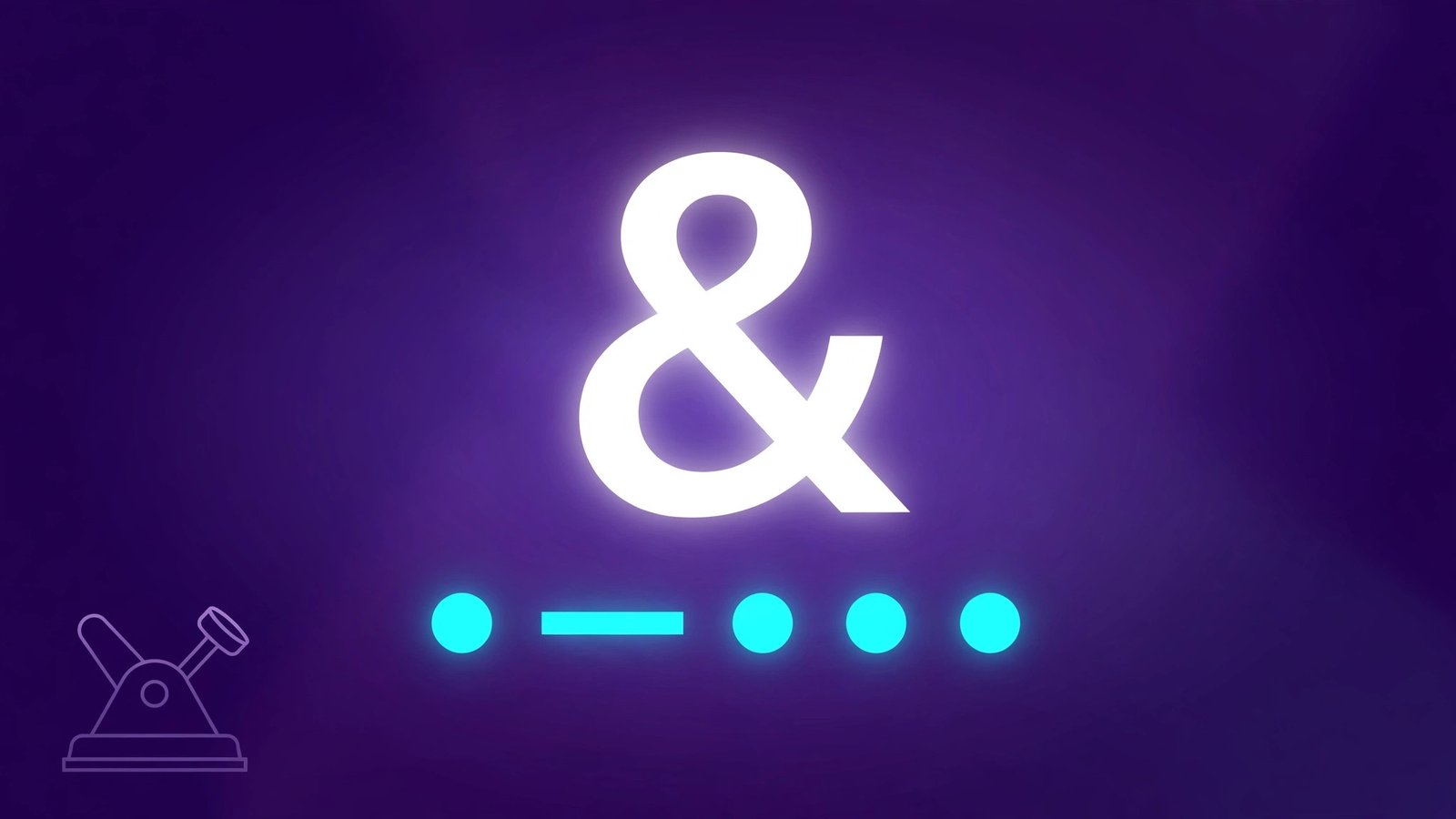
The ampersand (&) is the little symbol that means “and” — and in Morse code it is sent as . -... (di-dah-di-di-dit). It is one of the more surprising characters in the code, because the pattern it uses is not officially in the international standard at all, and it is identical to a well-known procedural signal. In this guide you will learn how to send and read the ampersand, why radio operators usually avoid it, and the 250-year-old story behind the symbol itself.
If you want to hear the pattern before you read on, type & into the Morse Code Translator on our homepage and press play — you will hear one short beep, one long beep, then three short beeps.
What Is the Ampersand in Morse Code?
The ampersand in International Morse Code is . -...:
| Character | Morse code | Sound | Length |
|---|---|---|---|
| & (ampersand) | . -... | di-dah-di-di-dit | 11 units |
Five elements make up the pattern: a dot, a dash, and three dots. At standard timing, a dot lasts one unit, a dash lasts three units, and the one-unit gaps between the elements inside the character add four more units — 1 + 3 + 1 + 1 + 1, plus four internal gaps, gives a total of 11 units. That makes the ampersand one of the longer single characters in Morse code, which is part of the reason operators rarely send it.
For comparison, the letters it is built from are much shorter: E is a single dot (.), L is . -.., and S is three dots (...). The ampersand sits in the same family as the punctuation marks we have covered in this series — the question mark, the period, and the colon — all of which use five or six elements.
How to Send the Ampersand in Morse Code
Sending the ampersand is straightforward once you know the rhythm. Tap it out slowly at first, counting the timing out loud, and speed up only when the pattern feels automatic.
- Dot — one short press of the key (one unit). Say “di” as you tap it.
- Dash — one long press, three times as long as the dot (three units). Say “dah”.
- Dot, dot, dot — three short presses, each one unit, with a one-unit pause between each element.
- Pause — leave a three-unit gap before the next character, so the receiver knows the ampersand has ended.
The spoken rhythm is “di-dah-di-di-dit”. A useful memory hook is to think of the pattern as the letter A (. -) followed by the letter S (...) run together — because that is exactly what it is. In fact, that is no coincidence: the code . -... is the digraph of A and S joined without a gap, and radio operators know it under a different name, which we will come to below.
If you are still building your sending speed, our guide on how to learn Morse code fast covers the timing rules and practice routines that make patterns like this one stick.
How to Read and Recognise the Ampersand
When you hear . -... on the air, the sound to listen for is a short beep, a long beep, and then three quick beeps — “di-dah-di-di-dit”. The challenge is that this exact sound has two meanings, and only the context tells you which one the sender intended.
- As a character: the ampersand, meaning “and”, inside ordinary text — for example in a company name such as “Smith & Co”.
- As a prosign: the signal <AS>, meaning “wait” or “stand by”, used between transmissions in amateur radio and military procedure.
Prosigns are procedural signals sent as single characters with no gap between their letters, and <AS> is one of the most common. If you hear . -... at the start of a transmission, or on its own between exchanges, it almost certainly means “wait”. If you hear it in the middle of a sentence where the word “and” belongs, it is the ampersand. Operators learn to tell the two apart from context, the same way English readers tell apart “read” and “read” from the sentence around them.
The Twist: the Ampersand Is Not in the ITU Standard
Here is the detail most Morse code charts quietly skip. The international standard for Morse code is ITU-R Recommendation M.1677-1, published by the International Telecommunication Union, and it defines the letters, digits, and a set of punctuation marks — but the ampersand is not among them. The same is true of the exclamation mark and the dollar sign: informal conventions exist for all three, but none of them is officially codified.
The code . -... for the ampersand is a convention rather than a standard, and it is the convention that virtually every translator, chart, and training app uses. The Morse code chart at morsecode.live, which checks every character against ITU-R M.1677-1, lists the ampersand as “common usage, not ITU” and notes the collision with the <AS> prosign. The International Morse Code reference at morsecode.world likewise places it under non-standard punctuation.
This matters for two practical reasons. First, if you are preparing for an amateur radio examination, know that the ampersand is rarely tested, because it is not part of the official character set. Second, if you send it on the air, some operators will read it as “wait” rather than “and” — which is why experienced operators usually avoid it altogether.
Why Ham Radio Operators Say “ES” Instead of the Ampersand
Ask a radio amateur how to send “and” in Morse code and they will almost never reach for the ampersand. Instead they send “ES” — the letter E (.) followed by the letter S (...) — which sounds like “di-di-di-dit”. It is shorter, it is unambiguous, and it is universally understood on the air.
This habit goes back to the earliest days of telegraphy. In American Morse code, the system used on the railroads and commercial wires of the nineteenth century, the ampersand had its own code, and it was very close to the code for “ES”. Operators carried the shortcut over into International Morse, and it stuck: “ES” is slightly quicker than the ampersand, it can never be mistaken for the “wait” prosign, and every operator recognises it instantly.
You will see “ES” everywhere in ham radio shorthand. A typical exchange might read “RIG HR ES ANT R OK” — “rig here and antenna are OK”. The number 73, which operators send as a friendly sign-off, is another piece of the same shorthand tradition; we explain it in our guide to what 73 means in ham radio. Learning these abbreviations is part of learning to operate, not just learning the code.
Where the Ampersand Comes From
The ampersand is older than Morse code by centuries. It began as a ligature — two letters written together — of the Latin word “et”, meaning “and”. Scribes writing quickly joined the “e” and the “t” until the two letters merged into a single flowing symbol. That is why the ampersand still looks like a looped “e” crossed with a “t” in many typefaces.
The name itself is a piece of English history. When children recited the alphabet in the 1800s, they ended with the words “and per se and” — Latin for “and, by itself, and” — to show that the symbol stood for the word “and”. Over time “and per se and” slurred together into “ampersand”. The symbol was so common that it was once considered the 27th letter of the alphabet.
By the time Samuel Morse and Alfred Vail developed their electric telegraph in the 1830s and 1840s, the ampersand was everywhere in business writing — in company names, in telegrams, and in newspaper copy. The early code had to handle it somehow, and the convention of joining A and S survived into the International Morse system used today. For the full story of the inventors and the first telegraph lines, see our guide to famous messages in Morse code, which starts with “What hath God wrought” — the first message sent from Washington to Baltimore in 1844.
Ampersand vs Other Symbols: a Quick Comparison
The ampersand is easy to confuse with its neighbours in the punctuation set. Here is how it compares with the symbols around it:
| Symbol | Morse code | Sound | Status |
|---|---|---|---|
| & ampersand | . -... | di-dah-di-di-dit | Convention, not ITU |
| @ at sign | . -- . - . | di-dah-dah-di-dah-dit | ITU standard since 2004 |
| : colon | ---... | dah-dah-dah-di-di-dit | ITU standard |
| / slash | -..-. | dah-di-di-dah-dit | ITU standard |
| ‘ apostrophe | .----. | di-dah-dah-dah-dah-dit | ITU standard |
| ! exclamation mark | -.-.-- | dah-di-dah-di-dah-dah | Convention, not ITU |
Notice how different the ampersand is from the colon and the slash: the colon starts with three dashes, while the ampersand starts with a single dot. That opening dot is your best clue when you are decoding by ear. The at sign, by contrast, was only formally added to the ITU standard in 2004 — a reminder that the code is still evolving, and that today’s conventions can become tomorrow’s standards.
Practice: Try the Ampersand Yourself
The best way to remember . -... is to use it in real words. Try these on the Morse Code Translator and listen to each one:
| Phrase | Morse code |
|---|---|
| rock & roll | .-. --- -.-. -.- / . -... / .-. --- .-.. .-.. |
| fish & chips | ..-. .. ... .... / . -... / -.-. .... .. .--. ... |
| Tom & Jerry | - --- -- / . -... / .--- . .-. .-. -.-- |
| salt & pepper | ... .- .-.. - / . -... / .--. . .--. .--. . .-. |
Then try the operator’s shortcut: send the same phrases with “ES” instead of the ampersand and notice how much quicker they feel. “Rock ES roll” is .-. --- -.-. -.- / . ... / .-. --- .-.. .-.. — the same meaning, in noticeably fewer beeps.
Common Mistakes to Avoid
- Sending it as two letters. The ampersand is one character: five elements with no gap in the middle. If you pause between the A and the S, the receiver hears the letters A and S, not the ampersand — or worse, the prosign <AS>.
- Using it where “ES” belongs. On the air, “ES” is the standard way to say “and”. Sending the ampersand in a live QSO risks being read as “wait”, which will confuse the station you are talking to.
- Forgetting the dash. Without the dash,
. ...is simply the letters E and S — the very shortcut operators use instead. The single dash in second position is what makes the pattern an ampersand. - Assuming it is official. The ampersand is a convention, not an ITU standard. That does not make it wrong — nearly every chart and translator uses it — but it explains why you will not find it in the official ITU character table, and why some strict references leave it out.
Frequently Asked Questions
What is the ampersand in Morse code?
The ampersand (&) in Morse code is . -... — one dot, one dash, and three dots, spoken as “di-dah-di-di-dit”. It is a widely used convention, although it is not part of the official ITU-R M.1677-1 character set.
Is the ampersand the same as the AS prosign?
Yes. The pattern . -... is also the prosign <AS>, which means “wait” or “stand by” in amateur radio procedure. Context decides the meaning: on its own between transmissions it means “wait”, while inside a sentence it means “and”.
Why do hams send “ES” instead of the ampersand?
“ES” — the letters E and S — is shorter than the ampersand, cannot be mistaken for the “wait” prosign, and has been the standard radio abbreviation for “and” since the days of American Morse telegraphy. Almost every operator uses it.
How long does the ampersand take to send?
Eleven units: the dot is one unit, the dash is three, the three dots are one unit each, and the four gaps between the elements add four more units. At 20 words per minute, one unit is 60 milliseconds, so the ampersand takes about two-thirds of a second to send.
Conclusion
The ampersand is a small symbol with a surprisingly rich story: a Latin ligature that became the 27th letter of the alphabet, a Morse pattern that is also a prosign, and a convention that never quite made it into the official standard. Its code, . -..., is easy to send and easy to remember once you know it is simply A and S run together — but on the air, the operator’s shortcut “ES” will serve you better almost every time.
Keep working through the punctuation series — the apostrophe, the question mark, and the colon are all live on the site — and try the pattern on the Morse Code Translator until “di-dah-di-di-dit” feels as natural as the word “and” itself.