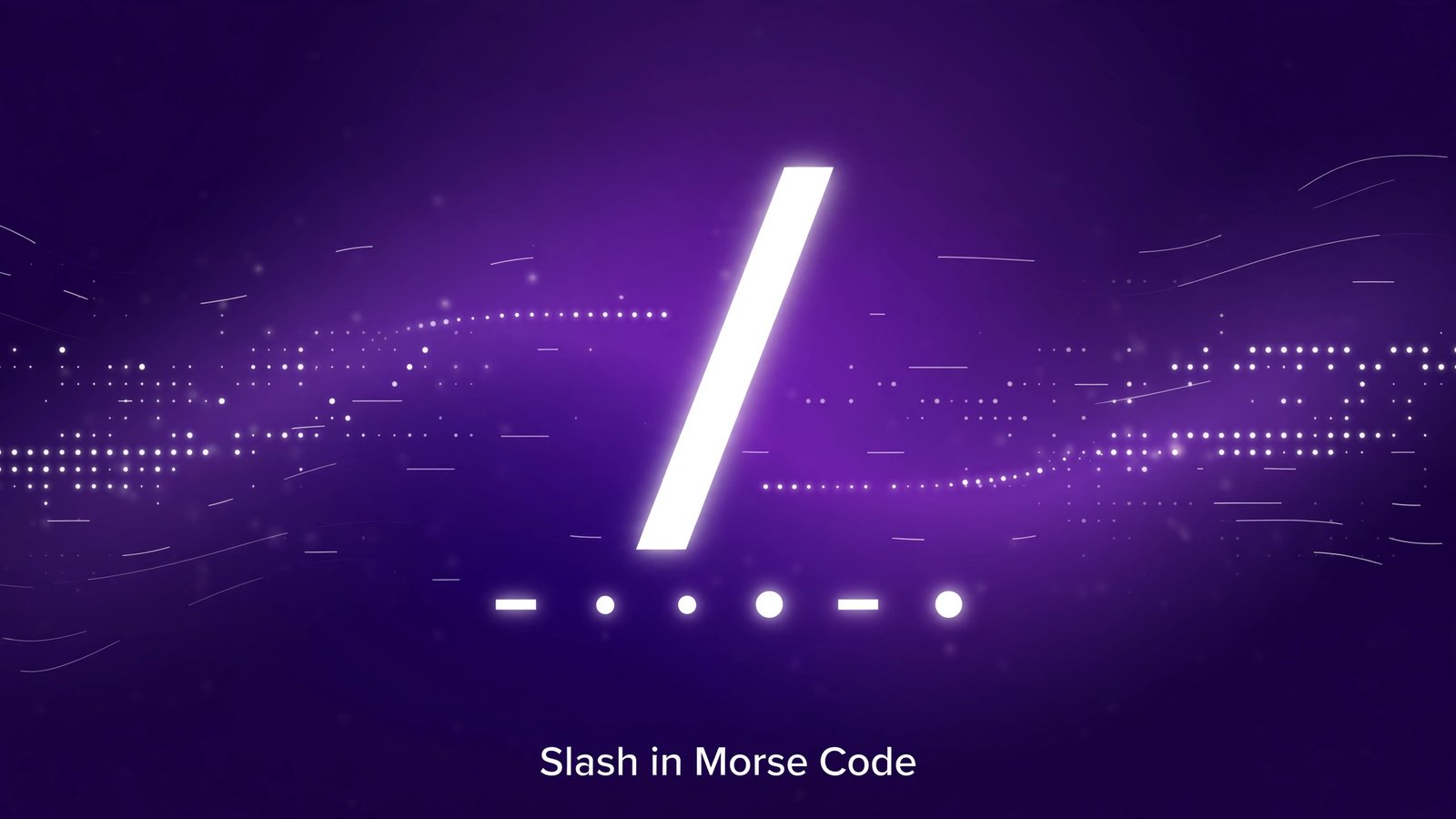
The slash is one of the busiest characters in everyday writing. It separates the day from the month in a date, divides numbers in a fraction, splits the folders in a web address, and marks a portable station in an amateur radio call sign. Because it turns up so often, International Morse Code gives it a code of its own — and once you learn its rhythm, it is one of the easiest punctuation marks to recognise by ear.
In this guide you will learn the slash in Morse code, how to send it on a key, how to remember it, where it is actually used, and how it differs from the punctuation marks that sound almost like it. You can follow along and check your work with the Morse Code Translator on the Morse Zone homepage.
What Is the Slash in Morse Code?
The slash character / is written in International Morse Code as -..-. — one dash, two dots, one dash, one dot. Spoken aloud, operators read it as “dah-di-di-dah-dit”.
| Character | Morse code | Signal pattern | Elements |
|---|---|---|---|
| / (slash) | -..-. | dash · dot · dot · dash · dot | 5 |
Timing is what turns those five elements into a readable character. In standard Morse timing, a dot lasts one unit, a dash lasts three units, and the gap between elements inside a character is one unit. So the slash takes 13 units from start to finish: dash (3) + gap (1) + dot (1) + gap (1) + dot (1) + gap (1) + dash (3) + gap (1) + dot (1).
The slash is sometimes called a “slant” or “solidus” in older radio and telegraph manuals. The name “solidus” comes from the Roman coin of the same name, because early printers used the slash to separate shillings from pence. Whatever you call it, the code is the same in every country that uses International Morse Code, which is maintained as a standard by the International Telecommunication Union (ITU).
How to Send the Slash on a Morse Key
Sending the slash is a good test of your key control, because it mixes long and short elements in a pattern that punishes rushing. Follow these steps:
- Settle your hand. Rest your wrist lightly and hold the key knob between thumb and two fingers. Tension in your arm is the most common cause of sloppy dashes.
- Send the first dash. Press and hold for three dot-lengths, then release cleanly. Count “one-two-three” in your head if you are still learning the rhythm.
- Send two dots. Two short, crisp taps with a one-unit gap between them. Do not let the second dot run long — that is how a slash starts sounding like something else.
- Send the second dash. Another three-unit hold, exactly like the first.
- Finish with a dot. One short tap, then leave a three-unit gap before your next character so the receiving operator hears where the slash ends.
If you use an electronic keyer with paddles instead of a straight key, the pattern is the same and the keyer handles the element spacing for you. Many learners find the slash easier on a keyer, because the machine keeps the two dashes the same length.
Listen to yourself as you send. The slash has a distinctive rolling rhythm — dah-di-di-dah-dit — that sounds almost musical once it clicks.
How to Remember the Slash Code
Five-element codes are harder to memorise than short letters, so it helps to anchor the slash to patterns you already know. Try these memory hooks:
- The “L and X” trick. The letter L is
.-..and the letter X is-..-. The slash-..-.is simply X with one extra dot on the end. If you know X, you know the slash. - The rhythm trick. Say the word “slash” out loud and tap the pattern with it: SLASH (dash) i (dot) i (dot) slash (dash) i (dot). The word itself carries the rhythm.
It also helps to learn the slash alongside its lookalikes, so you can tell them apart by ear. The characters most often confused with the slash are:
| Character | Morse code | How it differs from the slash |
|---|---|---|
| X | -..- | Same start, but no final dot |
| P | .--. | Starts with a dot, not a dash |
| L | .-.. | Starts dot-dash, ends with two dots |
| Question mark (?) | ..--.. | Six elements, starts with two dots |
| Hyphen (-) | -....- | Six elements, four dots in the middle |
Notice that the question mark in Morse code and the hyphen in Morse code both have six elements, while the slash has five. That single missing element is the difference your ear has to catch, which is why slow, accurate practice beats fast, sloppy practice every time.
Where the Slash Is Actually Used
The slash earns its place in Morse code because it does real work in the messages people actually send. These are its most common jobs:
Amateur radio call signs
This is the slash’s most famous use. Radio amateurs add a suffix after a slash to say where or how they are operating. A station operating away from home adds /P for portable, /M for mobile, /MM for maritime mobile, and /AM for aeronautical mobile. A visiting operator in another country sends their home call sign, a slash, and the prefix of the country they are in — for example, a British station operating in the United States might sign G4ABC/W1. The slash is what makes that extra information readable, and it is one of the reasons the character survived in Morse long after other punctuation faded. If you have ever wondered what the numbers in ham radio shorthand mean, our guide to what 73 means in ham radio covers the most famous example.
Dates and fractions
Before email and texting, telegrams carried dates and prices as numbers separated by slashes — 06/11/2026 or 1/2 — and the code made that possible. The same habit survives in radio traffic today, where a date sent in Morse still uses the slash as its separator. Try sending today’s date in Morse and you will use the slash twice before you finish.
Web addresses and file paths
Every web address is full of slashes, and Morse operators who exchange URLs on air need the character to spell them out. A link like morsezone.com/blog would be sent letter by letter, with the slash marking the break between the domain and the page. It is slow, but it works — and it is a good party trick at a radio club.
Slash vs Other Morse Punctuation
Punctuation is where Morse learners make the most mistakes, because the codes are long and several of them share the same building blocks. Here is how the slash compares with the other punctuation marks in our series:
| Punctuation | Character | Morse code | Elements |
|---|---|---|---|
| Period (full stop) | . | .-.-.- | 6 |
| Comma | , | --..-- | 6 |
| Question mark | ? | ..--.. | 6 |
| Exclamation mark | ! | -.-.-- | 6 |
| Apostrophe | ‘ | .----. | 6 |
| Hyphen | – | -....- | 6 |
| Slash | / | -..-. | 5 |
The slash is the only common punctuation mark with five elements — every other one has six. That makes it slightly faster to send than its neighbours, and it is a useful clue when you are copying a message by ear: if a character feels shorter than the punctuation around it, it is probably the slash. The period in Morse code and the comma in Morse code both end sentences and clauses, while the slash connects and divides — different jobs, different rhythms, and worth learning as a set rather than one at a time.
Common Mistakes When Sending the Slash
- Rushing the gaps. The most common error is running the elements together, so
-..-.collapses into something that sounds like X followed by a stray dot. Keep the one-unit gaps honest, especially between the second dot and the second dash. - Uneven dashes. If your first dash is longer than your second, the receiver may hear two different characters. Practise the pair of dashes alone until they match.
- Forgetting the final dot. Drop the last dot and you have sent X instead of a slash. In a call sign, that changes the meaning completely —
W1AW/7is a portable station, while a missing dot turns the suffix into nonsense. - Sending a backslash. There is no Morse code for the backslash character (
\). If you mean the slash that leans to the right,-..-.is the only code you need. - Using American Morse. The older American Morse code used by landline telegraph operators had different codes for many characters, and its punctuation set was not the same. International Morse Code is the worldwide standard for radio, and it is the version used by the Morse Code Translator and in this guide.
Practice Drills for the Slash
Five minutes a day is enough to make the slash automatic. Try these drills in order:
- Flashcard drill. Write
/on one side of a card and-..-.on the other. Shuffle it in with your letter cards and test yourself until the answer comes without thinking. - Call-sign drill. Write out five imaginary call signs with portable suffixes — for example
M0ABC/P,K2XYZ/M,VK3DEF/MM— and send each one in full, slash included. This is the context where the slash matters most. - Date drill. Send today’s date in Morse, slashes included. Then send your birthday, then the date of a famous event. Dates force you to switch between numbers and the slash, which is exactly the skill you need on air.
- Listening drill. Use a Morse trainer app or the Morse Zone translator to play the slash at increasing speeds, mixed in with X, P, and L. When you can pick it out of the mix at 15 words per minute without hesitating, it is learned.
- Sentence drill. Send short sentences that use the slash naturally: “open 24/7”, “meet at 6/11”, “and/or”. Real sentences teach your ear the character in context, which is how you will actually hear it.
For longer practice texts, try our famous messages in Morse code, including the SOS distress call every operator should know.
Frequently Asked Questions
What is the slash in Morse code?
The slash / in International Morse Code is -..-. — dash, dot, dot, dash, dot. It is the only common Morse punctuation mark with five elements; the rest have six.
How do you say the slash in Morse code out loud?
Operators read it as “dah-di-di-dah-dit”, where “dah” is a dash and “di” or “dit” is a dot. Saying the rhythm aloud is one of the fastest ways to memorise it.
Is the slash used in ham radio?
Yes — constantly. Amateurs use the slash to add portable, mobile, maritime mobile, and aeronautical mobile suffixes to call signs, and to show the country they are operating from when visiting abroad. A call sign like G4ABC/W1 would be unreadable without it.
What is the difference between the slash and X in Morse code?
X is -..- and the slash is -..-. — the slash is X with one extra dot at the end. That single dot is easy to drop when you are sending quickly, so slow down and make the final dot deliberate.
Does Morse code have a backslash?
No. International Morse Code has no code for the backslash character (\). The slash -..-. is the only “slash” character in the code, and it always leans to the right.
Conclusion
The slash may be a small character, but it carries a lot of weight in Morse code. Its five-element pattern -..-. is short, distinctive, and easy to learn once you anchor it to X and practise it in the contexts where it actually appears — call signs, dates, and web addresses. Learn it alongside the rest of the punctuation set and your copying speed will jump, because punctuation is what turns a string of letters into a readable message.
Ready to test yourself? Open the Morse Code Translator, type a date or a call sign with a slash in it, and listen to the result. Then try sending it back on your key. When dah-di-di-dah-dit rolls off your fingers without thinking, the slash is yours.