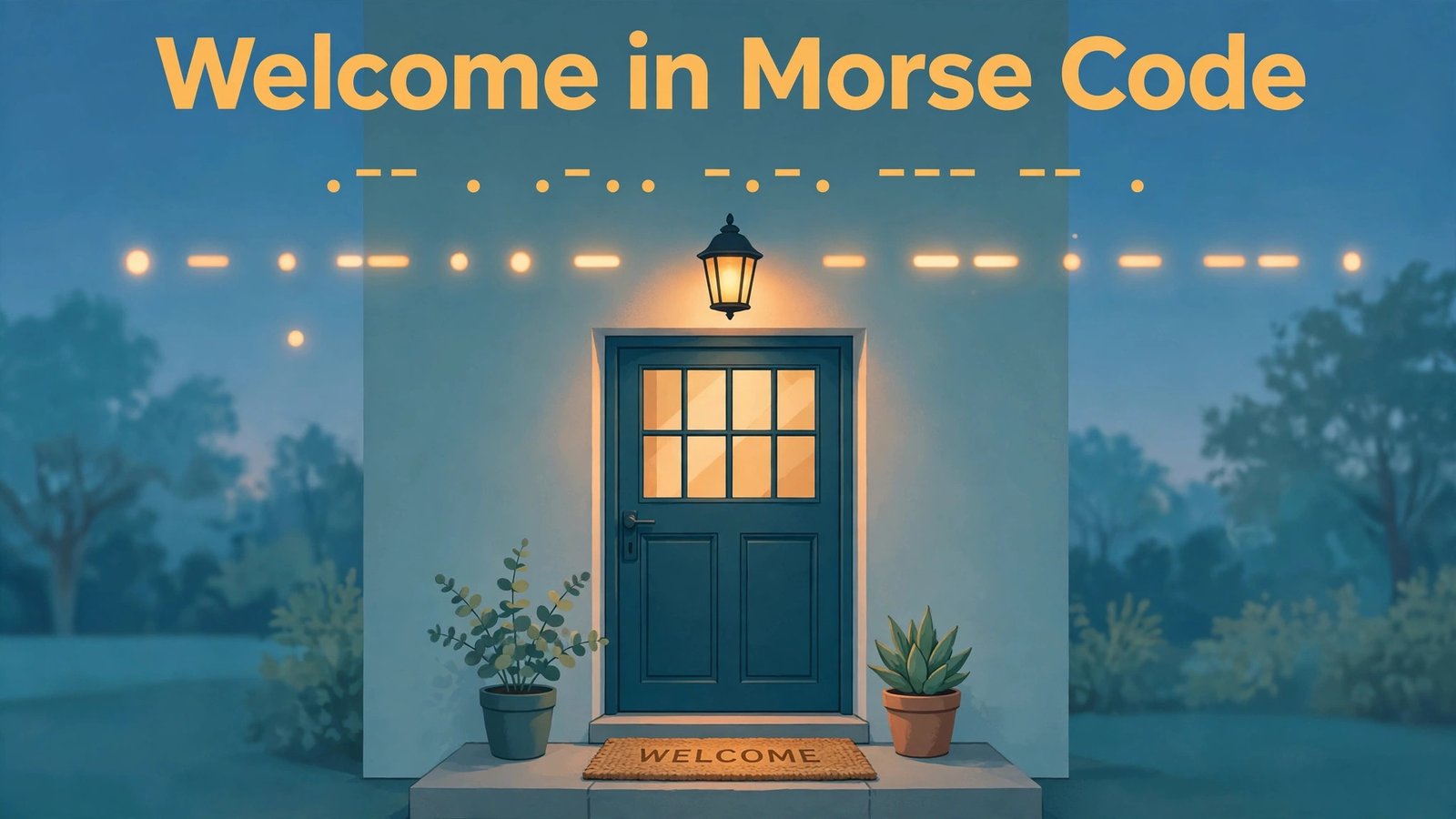
Some words open doors. Welcome is one of them. It is the first thing a host says to a guest, the word on the mat by the front door, and the greeting that turns a stranger into a friend. So it is no surprise that people look up welcome in Morse code: sending it in dots and dashes turns a familiar greeting into a small puzzle, a keepsake, and a nod to more than 180 years of signalling history.
In this guide you will learn the full code for welcome, see it broken down letter by letter, practise it with a simple rhythm, and find fun ways to send it by sound, light, or text. Whether you want to tap it out at the door, stitch it into a welcome sign, or copy and paste it into a message, you will leave knowing it by heart.
Welcome in Morse Code
Welcome in Morse code is:
.-- . .-.. -.-. --- -- .
That is seven letters, each separated by a short pause. Read it slowly, one letter at a time, and it stops looking like a wall of dots and dashes. The word breaks naturally into two friendly chunks: .-- . .-.. (WEL) and -.-. --- -- . (COME). Practise each chunk on its own, then join them together.
If you want to hear how it sounds or check your timing, try it on our free Morse Code Translator — type the word, listen to the audio, and tap along with the rhythm.
Welcome in Morse Code: Letter-by-Letter Breakdown
Every letter in International Morse Code has its own pattern of short signals (dots) and long signals (dashes). Here is the complete table for welcome, so you can learn it one letter at a time.
| Letter | Morse Code | Signal |
|---|---|---|
| W | .-- | dot dash dash |
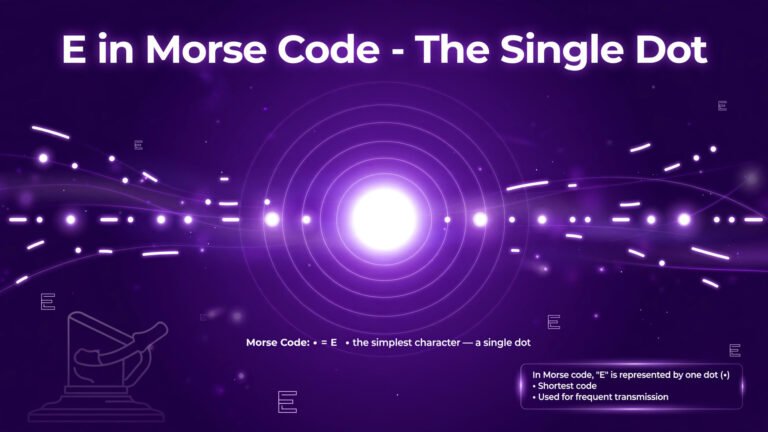
| E | . | dot |
| L | .-.. | dot dash dot dot |
| C | -.-. | dash dot dash dot |
| O | --- | dash dash dash |
| M | -- | dash dash |
| E | . | dot |
Notice how much of the word you may already know. E is the simplest pattern in the whole code — a single dot — and O and M are just two and three dashes. If you have already worked through the alphabet, only W, L, and C are new here, and if you want to build up your alphabet first, our guide on how to learn Morse code walks through the whole system step by step.
A memory trick for the tricky letters
Two letters in welcome cause most mistakes. W is .-- and M is -- — W is simply M with a dot in front, so learn them as a pair. C is -.-., the mirror image of the letter R (.-.) with a dash at the front. L is .-.., R with one extra dot at the end. Say the signal names out loud as you practise — “dot dash dash” for W — and the rhythm sticks far faster than silent reading.
How to Send Welcome in Morse Code
Sending the word is simple once you know the timing rules. Morse code is built on one basic unit of time, and everything else is a multiple of it:
- A dot lasts one unit.
- A dash lasts three units.
- The gap between signals inside one letter lasts one unit.
- The gap between letters lasts three units.
- The gap between words lasts seven units.
Start slowly. At a relaxed pace of about 12 words per minute, the whole word takes roughly eight seconds to send. At a confident 20 words per minute, it takes about five seconds. Speed does not matter at all when you are learning — clean spacing matters far more. The most common beginner error is running letters together, so exaggerate the three-unit gap between letters until it feels natural.
Four easy ways to send it
Tap it out. Knock on a door, tap a table, or clap. Short taps are dots, longer taps are dashes. This is the easiest way to practise anywhere, and it is how many people first fall in love with the code.
Flash it with light. A torch, a phone flashlight, or even a lamp switch works. Short flashes are dots, long flashes are dashes. It is a party trick that genuinely impresses guests, and it doubles as a fun way to practise the Morse code for kids style of learning — short, playful, and hands-on.
Hum or beep it. Use your voice, a whistle, or a simple buzzer app. Short sounds are dots and long sounds are dashes. Amateur radio operators have sent messages this way for over a century, and the rhythm of the code is really a kind of music.
Type it as text. Copy the pattern .-- . .-.. -.-. --- -- . into a message, a card, or a social media post. It looks mysterious to anyone who cannot read it, which is half the fun — the other half is watching them decode it.
Fun Ways to Use Welcome in Morse Code
The code turns an ordinary greeting into a small puzzle, and that is what makes it memorable. Here are some ideas that actually work in real life:
- Welcome signs and doormats: paint or print the dots and dashes on a wooden sign or a doormat, with the translation in small print underneath. Guests will stop, decode it, and smile before they even knock.
- Housewarming cards: write the pattern on the inside of the card for friends moving into a new home. It becomes a keepsake instead of a card that gets recycled.
- New team member or new student: send it as a text or a chat message on someone’s first day. It stands out in a feed full of identical “Welcome aboard!” messages.
- Weddings and hospitality: print the pattern on place cards, gift tags, or a welcome board at the entrance. Guests who love puzzles and secret messages will keep it forever.
- Craft projects: bead the pattern into a bracelet, stitch it into embroidery, or paint it onto a mug — dots as small beads, dashes as long ones. It is a personal gift that carries a hidden message.
- Classroom or scout activities: teach a group to tap it out together, then let them welcome a visitor with it. It is a brilliant icebreaker for learning the code.
- Social media: post the pattern with a photo of a new home, a new office, or a reunion, and let your followers decode it in the comments.
For celebrations, the same trick works beautifully with our congratulations in Morse code guide and our happy birthday in Morse code guide, and if you want a gentler message for a difficult moment, sorry in Morse code and please in Morse code follow the same friendly format.
Welcome vs Similar Greetings in Morse Code
Welcome is not the only friendly word worth knowing. Here is how it compares with a few close cousins, so you can pick the right one for the moment:
| Phrase | Morse Code | Best for |
|---|---|---|
| Welcome | .-- . .-.. -.-. --- -- . | Greeting a guest, a new arrival, a new home |
| Hello | .... . .-.. .-.. --- | Any first greeting, in person or in writing |
| Good morning | --. --- --- -.. -- --- .-. -. .. -. --. | Starting the day, morning messages |
| Thank you | - .... .- -. -.- -.-- --- ..- | Gratitude after help or a gift |
| Goodbye | --. --- --- -.. -... -.-- . | Parting, farewells, end of a visit |
“Hello” is shorter and quicker to send, which makes it a good first word to learn after welcome. “Thank you” is the most useful of all — our full thank you in Morse code guide covers it in the same letter-by-letter style. And when the visit ends, our goodbye in Morse code guide closes the circle.
Common Mistakes to Avoid
Running the letters together. Without the three-unit gap between letters, .-- (W) followed by . (E) can blur into nonsense. Pause deliberately between letters — it feels slow, but it is exactly what makes the message readable.
Mixing up W and M. As noted above, W is .-- and M is --. W is M with a dot in front. Double-check those two before you send anything important, like a sign or an engraved gift.
Mixing up C and G. C is -.-. and G is --.. They look similar at a glance, but C has four signals and G has three. If your message also uses G, check both patterns carefully.
Rushing the dashes. A dash is three times as long as a dot. Beginners often make dashes barely longer than dots, which turns the whole word into mush. Count “one-two-three” in your head for each dash until the rhythm is automatic.
Forgetting the word gap. If you send “welcome” as part of a longer message, leave a full seven-unit gap before the next word. Without it, the listener cannot tell where one word ends and the next begins.
A Little History: Why We Still Send Morse Code
Morse code was developed in the 1830s and 1840s by Samuel Morse and Alfred Vail, and the first public telegraph line — between Washington and Baltimore — carried its famous first message, “What hath God wrought,” in 1844. The version we use today, International Morse Code, was standardised by the International Telecommunication Union, and its patterns are still the same ones operators learned more than a century ago.
The code survived because it is brilliantly simple: it needs nothing more than a way to make two different lengths of signal. It carried the distress call SOS (... --- ...) across the oceans, it guided ships and aircraft, and it is still used daily by amateur radio operators around the world. Ham radio culture even has its own shorthand — the number 73 means “best regards”, as explained in our guide to what 73 means in ham radio. Learning a welcoming word like welcome is a small step into that long tradition, and it connects a modern doormat or housewarming card to the very first days of electric communication. For the full story of the code and its inventors, see the Morse code article on Wikipedia and the ITU standard ITU-R M.1677.
Frequently Asked Questions
What is welcome in Morse code?
Welcome in Morse code is .-- . .-.. -.-. --- -- .. Each group of dots and dashes is one letter: W is .--, E is ., L is .-.., C is -.-., O is ---, M is --, and E is ..
How do you tap welcome in Morse code?
Tap short for a dot and long for a dash, keeping a short pause between signals in the same letter and a longer pause between letters. Learn it in two chunks — WEL (.-- . .-..) and COME (-.-. --- -- .) — and practise each chunk until it flows before joining them together.
How long does it take to send welcome in Morse code?
At a comfortable sending speed of 20 words per minute, the whole word takes about five seconds. At a relaxed learner pace of 12 words per minute, it takes around eight seconds. The exact time depends on your speed, but clean spacing between letters matters far more than speed.
Can I copy and paste welcome in Morse code?
Yes. Copy this pattern exactly: .-- . .-.. -.-. --- -- .. It works in text messages, cards, emails, and social media posts, and you can check it or hear it spoken aloud with a Morse Code Translator.
What is the difference between welcome and hello in Morse code?
They are two different greetings with different patterns. Welcome is .-- . .-.. -.-. --- -- ., while hello is the shorter .... . .-.. .-.. ---. Welcome suits greeting a guest or a new arrival; hello suits any first greeting.
Conclusion
Welcome is one of the warmest words in the English language, and in Morse code it becomes something more: a small puzzle, a piece of history, and a message that took real effort to send. Learn the pattern .-- . .-.. -.-. --- -- ., practise it in two chunks, and try it out the next time someone arrives at your door. Tap it, flash it, bead it, or simply copy and paste it — however you send it, the person on the receiving end will know you went the extra mile. And if you enjoyed decoding this one, our guides to famous messages in Morse code, collected in famous messages in Morse code, are a great next stop.