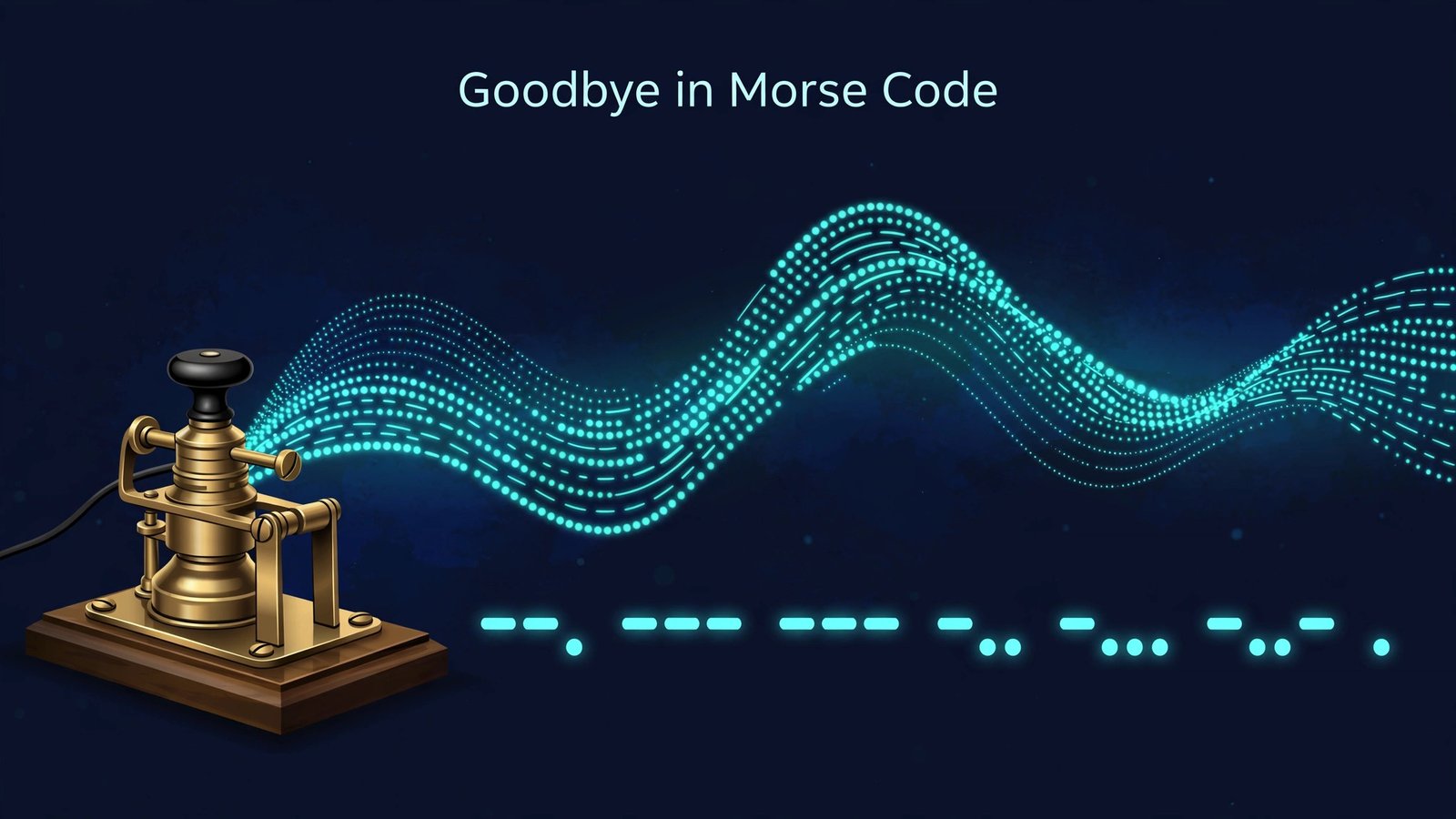
Saying goodbye is one of the first things most people want to learn in Morse code. Whether you are signing off a radio contact, tapping a farewell on a table, or flashing a light to a friend across a campsite, goodbye in Morse code is --. --- --- -.. -... -.-- . — seven letters, twenty-two elements, and one of the most satisfying phrases to send once you have the rhythm down.
In this guide, we break the word down letter by letter, explain the timing that makes it readable, show you how to send it with a telegraph key, a flashlight or an app, and compare it with the radio operator’s classic sign-off, 73. If you are just starting out, try the pattern on our Morse Code Translator first — type “goodbye”, listen to the audio, and tap along.
Goodbye in Morse Code at a Glance
The International Morse Code pattern for GOODBYE is:
--. --- --- -.. -... -.-- .
Each group of dots and dashes is one letter. Read from left to right: G is --., O is --- (twice), D is -.., B is -..., Y is -.--, and E is a single dot ..
Goodbye Letter by Letter
| Letter | Morse Code | Sound | How to Remember It |
|---|---|---|---|
| G | --. | dah-dah-dit | Think “good grief” — two long beats, one short |
| O | --- | dah-dah-dah | Three long beats, like a long “ohhh” |
| O | --- | dah-dah-dah | Same as the first O — the word has two in a row |
| D | -.. | dah-dit-dit | One long, two short — “dog did it” |
| B | -... | dah-dit-dit-dit | One long, three short — “be a good boy” |
| Y | -.-- | dah-dit-dah-dah | Long-short-long-long, the trickiest letter here |
| E | . | dit | A single short beep — the easiest letter in the code |
The double O in the middle is a gift for beginners: once you can send --- once, you simply repeat it. The real challenge is Y, -.--, which mixes long and short elements in a pattern that trips up new learners. Practise Y on its own a few times before you try the whole word at speed.
Timing: What Makes Goodbye Readable
Morse code is not just dots and dashes — the silences between them carry meaning. The International Morse Code standard, maintained by the International Telecommunication Union (ITU), defines timing in units:
- A dot (dit) lasts one unit.
- A dash (dah) lasts three units.
- The gap inside a letter (between dots and dashes of the same letter) is one unit.
- The gap between letters is three units.
- The gap between words is seven units.
At a gentle learning speed of about 5 words per minute (WPM), one unit is roughly 240 milliseconds, so a dash lasts about three-quarters of a second. Counting in your head helps: say “dit” for a dot and “dah” for a dash, and leave a clear pause between letters. If your letters run together, the listener hears a meaningless string of beeps instead of GOODBYE.
A good way to practise is to send the word slowly and evenly rather than quickly and unevenly. Speed comes later; clean spacing is what makes you understood. Our guide on how to learn Morse code explains how to build up speed with the Koch method, starting with just two letters at full speed.
How to Send Goodbye in Morse Code
With a Telegraph Key
The classic way is a straight key: press down briefly for a dot and hold for about three times as long for a dash. Keep your wrist relaxed and let the key spring back fully between elements. Send --., pause, ---, pause, ---, pause, -.., pause, -..., pause, -.--, pause, . — and you have said goodbye the way Samuel Morse and Alfred Vail intended when they developed the code in the 1830s and 1840s.
With a Flashlight or Lamp
Light works exactly like sound: a short flash is a dot, a long flash (three times as long) is a dash, and darkness is the gap. This is how sailors and soldiers have signalled across distances for over a century, and it is a great party trick on a camping trip. Aim the light steadily, keep your flashes even, and remember the three-unit gap between letters so your audience can tell where one letter ends and the next begins.
By Tapping, Blinking or Clicking
Anything that makes a short and a long signal works — tapping a table, clicking a pen, blinking a torch, or even tapping someone’s arm. This is the same principle behind the famous examples in our famous messages in Morse code article, where people have communicated with nothing but taps and blinks. For a quiet farewell, tap the pattern on a friend’s shoulder: two long taps and a short one for G, and so on.
With an App or Online Translator
The fastest way to hear GOODBYE correctly is to type it into a Morse Code Translator and play the audio. Listen several times, then try to copy it by ear before you look at the dots and dashes. Learning by sound — rather than by counting dots on a chart — is how radio operators have trained since the early 20th century, and it is the quickest route to recognising whole letters instead of decoding element by element.
Goodbye vs 73 and Other Radio Farewells
If you spend time around amateur (ham) radio, you will notice operators rarely send the full word GOODBYE. Instead, they use 73, which means “best regards” — a two-character shorthand that has been in use since the days of landline telegraphy. We explain its history in what does 73 mean in ham radio.
There are a few other sign-offs worth knowing:
- 73 (
--... ...--) — “best regards”, the friendly standard ending to a contact. - 88 (
---.. ---..) — “love and kisses”, used between close friends and family. - SK (
...-.-) — the prosign for “end of transmission”, sent as one run-on character with no gap between the letters. - GB (
--. -...) — a shorter “goodbye” used by some operators, just the first and a middle letter of the word.
On a casual radio contact, a typical sign-off sounds like “73 SK” — best regards, end of transmission. In a message to a friend, though, spelling out the full GOODBYE carries more warmth, and it is a much better practice exercise.
Other Ways to Say Farewell in Morse Code
Once you can send GOODBYE, a few related phrases come almost for free, because they reuse the same letters:
- BYE —
-... -.-- .— the last three letters of goodbye. - GOOD NIGHT —
--. --- --- -.. -. .. --. .... -— a classic evening sign-off. - GOOD LUCK —
--. --- --- -.. .-.. ..- -.-. -.-— a warm send-off for someone starting something new. - SEE YOU —
... . . -.-- --- ..-— short, friendly, and easy at low speed.
Pairing goodbye with a thank-you is a natural combination: learn thank you in Morse code next, and you can sign off any conversation gracefully. If you liked the gentle tone of this phrase, you may also enjoy please in Morse code and sorry in Morse code — the small polite words are the most rewarding ones to learn first.
Practice Tips: Make Goodbye Stick
- Learn it as a sound, not a picture. Say “dah-dah-dit, dah-dah-dah, dah-dah-dah, dah-dit-dit, dah-dit-dit-dit, dah-dit-dah-dah, dit” out loud until the rhythm feels like a short song.
- Start slow. Send the word at 5 WPM with generous gaps. Speed up only when you can send it cleanly five times in a row.
- Write it, then hide the chart. Copy the pattern from memory, check it, and repeat. Three short sessions a day beat one long cramming session.
- Send it to someone. Tap it on a friend’s arm or flash it with a torch — using the code for a real farewell is the fastest way to remember it.
- Mix it with other words. Once GOODBYE is solid, alternate it with HELLO, PLEASE and SORRY so you stop reciting one pattern and start reading real code.
Children often pick this word up quickly because the double O gives them an anchor. Our Morse code for kids guide has games and activities that work well for family practice sessions.
Why “Goodbye” Is a Great First Word
GOODBYE teaches almost everything a beginner needs: a two-element letter (G), a three-dash letter (O), mixed patterns (D, B, Y), and the single-dot E — the most common letter in English. It also uses the letter G, which appears in many everyday words, and it gives you a complete, useful phrase after just seven letters. The word itself comes from “God be with ye”, shortened over centuries — a fitting origin for a farewell that has travelled from spoken English to the telegraph key and on to the radio waves.
Morse code was standardised internationally by the ITU, and the letter patterns used today are the same ones operators have used for well over a century. Learning GOODBYE connects you to that history in a very direct way: you are sending the same signals, with the same timing, that telegraph operators sent in the 1840s.
Frequently Asked Questions
What is goodbye in Morse code?
Goodbye in Morse code is --. --- --- -.. -... -.-- . G is --., O is --- (twice), D is -.., B is -..., Y is -.--, and E is ..
How do you say “bye” in Morse code?
“Bye” in Morse code is -... -.-- . — just the last three letters of goodbye. It is shorter and quicker to send, and it is the pattern most people use for a casual farewell.
How long does it take to send goodbye in Morse code?
At 5 words per minute, GOODBYE takes about 15 seconds including the gaps between letters. At 12 WPM, an experienced operator sends it in roughly 6 seconds. The exact time depends on your speed and how cleanly you space the letters.
What is the difference between goodbye and 73 in Morse code?
GOODBYE (--. --- --- -.. -... -.-- .) is the full English word, while 73 (--... ...--) is radio shorthand for “best regards”. Operators use 73 to end a contact quickly; the full word is warmer and better for messages to friends and family.
Can I send goodbye in Morse code with a flashlight?
Yes. A short flash is a dot, a long flash (about three times as long) is a dash, and darkness between flashes marks the gaps. Keep the gap between letters clear — three units of darkness — so the person watching can tell the letters apart.
Conclusion
GOODBYE in Morse code — --. --- --- -.. -... -.-- . — is a friendly, practical first phrase that teaches you the timing, rhythm and letter patterns at the heart of the code. Learn it by sound, practise it slowly, and send it to someone real: that is how a string of dots and dashes becomes a language. And when you are ready for the next phrase, try please, thank you or sorry — together they cover most of polite conversation in just a few dozen beeps.