“Good morning” is one of the first phrases most people want to learn in any new language, and Morse code is no exception. Whether you are a beginner practising your first words, an amateur radio operator greeting a fellow ham at the start of the day, or simply sending a cheerful message to a friend, knowing how to tap out this everyday greeting is a satisfying milestone. In this guide you will learn the full pattern for “good morning” in Morse code, break it down letter by letter, understand the timing that makes it readable, and pick up memory tricks that will help it stick.
Good Morning in Morse Code
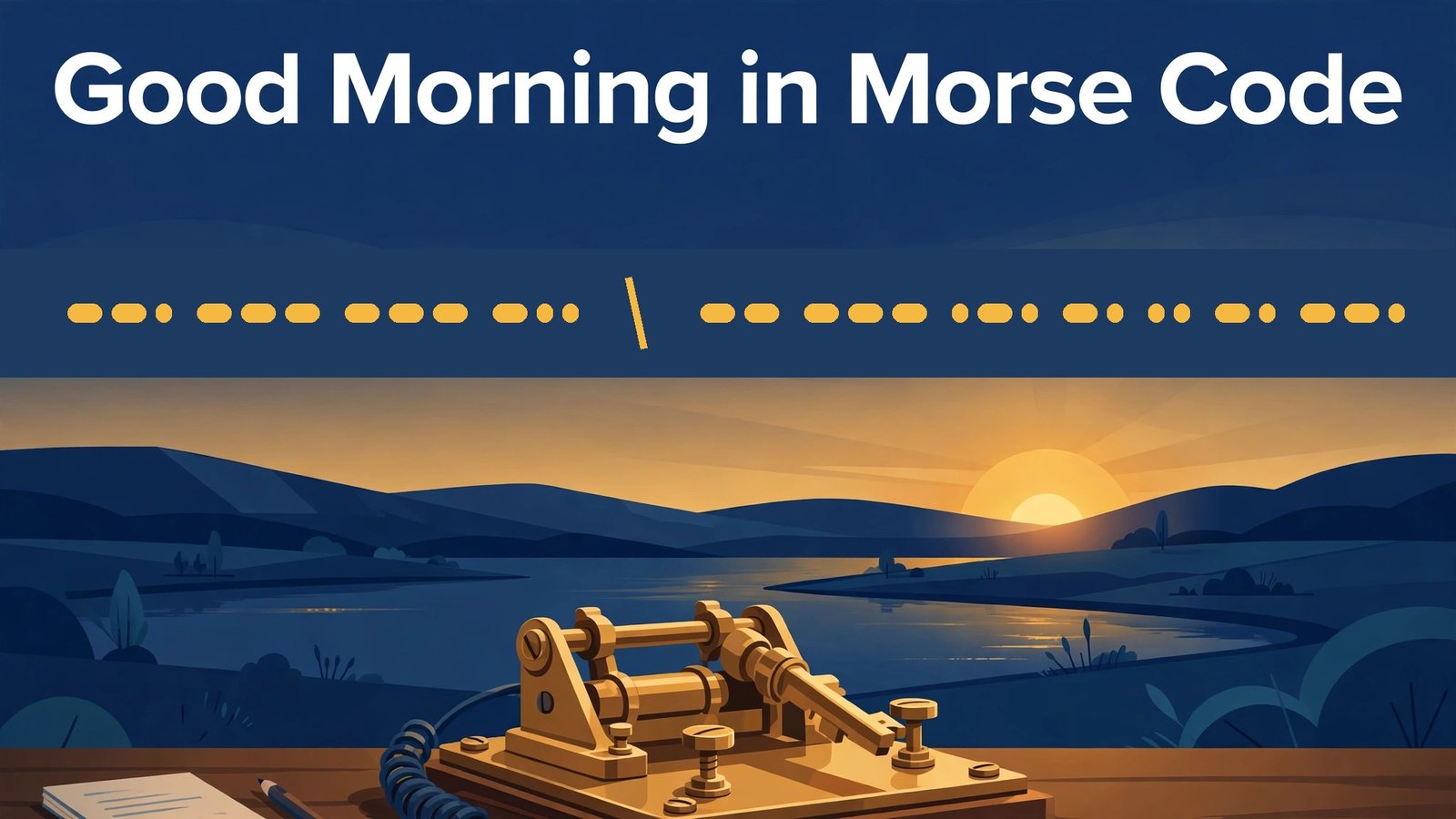
“Good morning” in Morse code is --. --- --- -.. / -- --- .-. -. .. -. --.
That is eleven letters: four for GOOD (--. --- --- -..) and seven for MORNING (-- --- .-. -. .. -. --.), separated by a longer pause that marks the space between the two words. The slash in the written form is simply a visual marker for the word gap; when you send it, you do not tap the slash at all, you just pause for longer.
If you would like to hear it before you try sending it yourself, type the phrase into the Morse Code Translator on the Morse Zone homepage and play the audio. Listening first helps your ear learn the rhythm of the whole phrase rather than eleven isolated letters.
Letter-by-Letter Breakdown
Every letter in “good morning” uses the standard International Morse Code alphabet, the system standardised by the International Telecommunication Union (ITU) and used worldwide by radio amateurs, mariners and military signallers. Here is the full breakdown:
| Letter | Morse Code | Sound |
|---|---|---|
| G | --. | dah-dah-dit |
| O | --- | dah-dah-dah |
| O | --- | dah-dah-dah |
| D | -.. | dah-dit-dit |
| M | -- | dah-dah |
| O | --- | dah-dah-dah |
| R | .-. | dit-dah-dit |
| N | -. | dah-dit |
| I | .. | dit-dit |
| N | -. | dah-dit |
| G | --. | dah-dah-dit |
Notice how the phrase is built from a small set of familiar patterns. The letter O (---) appears three times, G (--.) appears twice, and N (-.) appears twice. Once you know those three letters, you already know seven of the eleven characters. That repetition is one reason “good morning” is such a friendly first phrase to learn: it rehearses a handful of common letters instead of demanding eleven different ones.
The trickiest letter in the phrase is probably R (.-.), because it sits in the middle of “morning” where a listener can easily confuse it with S (...) or A (.-) if the timing is sloppy. Keep the three elements of R evenly spaced and distinct, and the word stays clear. If you have already worked through the single-letter guides, you will recognise G, O, D, M, R, N and I from the alphabet series; the guide to learning Morse code explains how to build that letter knowledge into real words.
How to Send “Good Morning” in Morse Code
Sending Morse code is not just about the right dots and dashes. It is about the spaces between them. The timing rules of International Morse Code are what turn a stream of beeps into readable words:
- A dot (dit) lasts one time unit.
- A dash (dah) lasts three time units.
- The gap between elements of one letter is one time unit.
- The gap between letters is three time units.
- The gap between words is seven time units.
So when you send “good morning”, you tap --., pause for three units, tap ---, pause three units, and so on through the four letters of “good”. Then you pause for a full seven units before starting “morning”. That long pause is the only thing that tells the listener where one word ends and the next begins, so do not rush it. Beginners almost always shorten word gaps, and that is the single most common reason a message becomes hard to read.
At a comfortable learning speed of around 12 to 15 words per minute, the whole phrase takes roughly six to eight seconds to send. At 20 words per minute, the standard speed for many amateur radio contacts, it takes about five seconds. Speed comes later; accuracy comes first. A slowly sent, correctly spaced “good morning” is far more impressive than a fast, garbled one.
Sending It With a Flashlight or Buzzer
You do not need a radio to practise. A flashlight, a phone screen, or a simple buzzer all work. A short flash or beep is a dot, a flash or beep held three times as long is a dash, and the same gap rules apply. Try signalling “good morning” to someone across a room with a torch: the word gap of seven units gives them a clear beat to recognise the break between “good” and “morning”. This is the same technique used in emergency signalling, where Morse code remains a practical fallback when voice and data fail.
How to Remember “Good Morning” in Morse Code
Memorising eleven letters at once is hard. Breaking the phrase into chunks makes it manageable.
Learn it as two words, not eleven letters. Practise “good” (--. --- --- -..) until it flows as one rhythm, then practise “morning” (-- --- .-. -. .. -. --.) the same way. Only then join them with the seven-unit word gap. Your brain stores rhythms far more easily than it stores lists.
Use the “GOD” trick for the first word. The letters G, O and D spell “GOD” with the patterns --., --- and -... Add the second O and you have “good”. Many learners find that the word “GOD” gives them a hook to hang the first three letters on.
Anchor on the double O. “Good” has two O letters in a row, and “morning” has an O as its second letter. Three long --- groups in the phrase are all the same letter. Once you can send --- without thinking, a third of the phrase is already automatic.
Say it as you tap it. Speak “dah-dah-dit, dah-dah-dah, dah-dah-dah, dah-dit-dit” out loud while you tap. This links the sound, the rhythm and the hand movement together, which is exactly how the Koch method and other sound-based learning approaches build fluency. The learn Morse code fast guide covers these techniques in more depth.
Practise little and often. Five minutes a day beats an hour once a week. Send “good morning” to yourself each morning as a daily drill: by the end of a week you will be able to send it without looking at the chart, and the letters G, O, D, M, R, N and I will be locked in for every other word you learn next.
Other Morning Greetings in Morse Code
“Good morning” is the most common morning greeting, but it is not the only one. Ham radio operators often shorten it to “GM”, the two-letter abbreviation for “good morning”, sent as --. --. You will hear “GM” at the start of countless morning contacts on the amateur bands, usually followed by the operator’s call sign. It is the Morse equivalent of a quick wave, and it appears alongside other classic abbreviations such as 73, which means “best regards” and is explained in our guide to what 73 means in ham radio.
Other greetings in the same family follow the same patterns you have just learned. “Goodbye” shares the G, O, O, D opening of “good”, and you can compare the two phrases in our guide to goodbye in Morse code. “Please” (.--. .-.. . .- ... .) and “sorry” (... --- .-. .-. -.--) are equally useful everyday phrases, covered in our guides to please in Morse code and sorry in Morse code. And if you want a warm follow-up after your greeting, “thank you” is always welcome, as shown in our guide to thank you in Morse code. Together these five phrases cover most of the polite conversation a beginner will ever need.
Where You Will Hear “Good Morning” in Morse Code
The phrase turns up in more places than you might expect. On the amateur radio bands, morning is the busiest time for Morse code contacts, and “GM” opens a huge share of them. Operators exchange greetings, signal reports and names before moving on to the substance of the contact, and a clean, well-spaced greeting is a small mark of a good operator. The tradition goes back to the earliest days of wireless telegraphy, when Samuel Morse and Alfred Vail demonstrated their electric telegraph in 1844 and operators soon developed a whole culture of abbreviated greetings and sign-offs.
Morse code also survives in aviation, where navigation beacons still identify themselves in Morse code, and in maritime and emergency signalling, where its simplicity makes it almost impossible to break. The International Morse Code standard, maintained by the ITU, is the reason a greeting sent in one country can be read in any other. For the history behind that standard, the Wikipedia overview of Morse code and the ITU recommendation M.1677-1 are authoritative references, and Britannica’s Morse Code entry gives a concise account of how the system developed.
For younger learners, “good morning” makes a lovely classroom exercise. A teacher can tap it out on a desk or flash it with a torch, and children love decoding a greeting they already know. Our Morse code for kids guide has more ideas for turning the alphabet into a game, and the famous messages in Morse code collection shows how the same dots and dashes carried some of history’s most dramatic moments, from SOS distress calls to the first transatlantic wireless signals.
Practice: Send “Good Morning” Yourself
The best way to lock in this phrase is to use it. Here is a simple five-minute practice routine:
- Listen first. Type “good morning” into the Morse Code Translator and listen to the audio three times, following along with the pattern
--. --- --- -.. / -- --- .-. -. .. -. --. - Tap it back. Tap the phrase on a desk or with a telegraph key app, saying “dah” and “dit” out loud as you go.
- Write it down. Copy the pattern from memory, then check it against the table above. Pay attention to R (
.-.), the letter most learners get wrong. - Send it to someone. Text a friend the pattern, or flash it with a torch. Teaching the phrase to someone else is the fastest way to remember it yourself.
- Repeat tomorrow morning. Make it your first Morse code exercise of the day. A greeting you practise every morning becomes automatic within a week.
Frequently Asked Questions
What is “good morning” in Morse code?
“Good morning” in Morse code is --. --- --- -.. / -- --- .-. -. .. -. --. The word “good” is --. --- --- -.. and “morning” is -- --- .-. -. .. -. --., with a seven-unit pause between the two words. The slash marks the word gap and is not tapped.
How do you say “good morning” in Morse code with a flashlight?
Use short flashes for dots and flashes three times as long for dashes, with the same timing rules as audio Morse code: one unit between elements, three units between letters, and seven units between “good” and “morning”. The long pause between the words is what makes the greeting readable to whoever is watching.
Is there a shorter way to say good morning in Morse code?
Yes. Amateur radio operators use the abbreviation “GM”, sent as --. --, which is simply the first letters of “good” and “morning”. It is a standard greeting on the ham bands, much like 73 is used for “best regards” at the end of a contact.
How long does it take to send “good morning” in Morse code?
At 20 words per minute it takes about five seconds, and at a learning speed of 12 to 15 words per minute it takes roughly six to eight seconds. The exact time depends on your speed and on keeping the correct gaps: one unit within a letter, three units between letters, and seven units between the two words.
What is the difference between “good morning” and “good day” in Morse code?
The first word is the same (--. --- --- -..), but “day” is -.. .- -.-- while “morning” is -- --- .-. -. .. -. --. “Good day” is shorter and is used as a general daytime greeting in some countries, while “good morning” is specific to the morning and is the more common greeting in English-speaking amateur radio contacts.
Conclusion
“Good morning” in Morse code, --. --- --- -.. / -- --- .-. -. .. -. --., is one of the most rewarding first phrases to learn. It rehearses seven different letters, teaches the all-important word gap, and gives you a greeting you can actually use on the radio, with a flashlight, or in a message to a friend. Learn it as two rhythms rather than eleven letters, keep your spacing honest, and practise it for a few minutes each morning. Within a week it will feel automatic, and the letters you mastered along the way will make your next phrase, whether it is “goodbye”, “please” or “thank you”, noticeably easier. Try it now in the Morse Code Translator, and start tomorrow with a greeting sent in dots and dashes.