“Please” is one of the first words most of us learn — and one of the most useful. It softens a request, shows respect, and turns a demand into a conversation. In Morse code, the same little word carries the same weight, whether you are tapping it out on a telegraph key, flashing it with a torch, or practising with a Morse Code Translator.
In this guide you will learn the exact Morse code for “please”, how to send it letter by letter, a simple way to remember it, and the everyday phrases it appears in — including “please help” and “please help me”.
What Is “Please” in Morse Code?
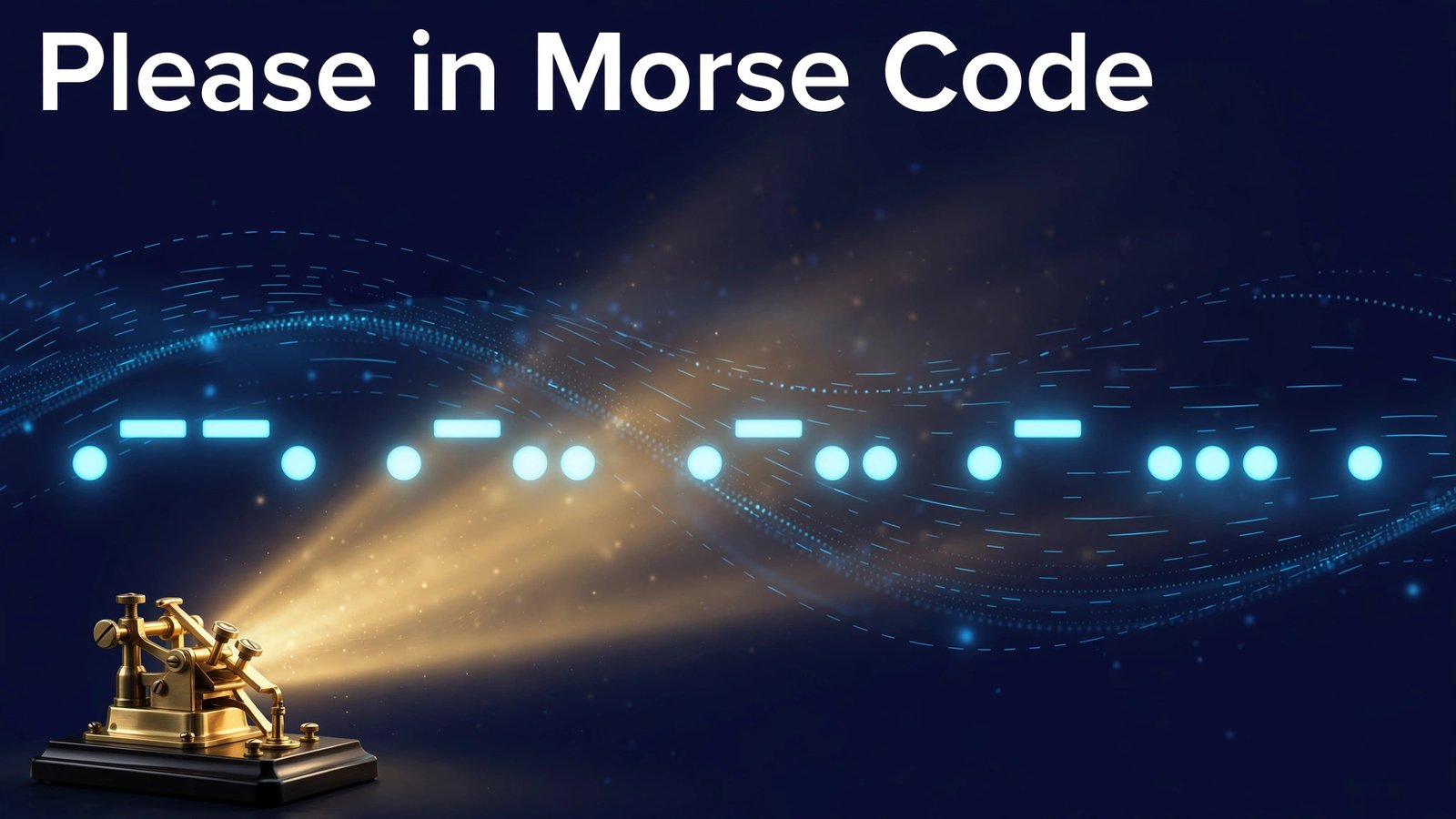
“Please” in Morse code is:
.--. .-.. . .- ... .
That is six letters, made up of 18 elements in total — dots and dashes in a fixed order. Each letter has its own code, and the letters are separated by a short pause so the listener can tell where one ends and the next begins.
| Letter | Morse Code | Sound |
|---|---|---|
| P | .--. | dit-dah-dah-dit |
| L | .-.. | dit-dah-dit-dit |
| E | . | dit |
| A | .- | dit-dah |
| S | ... | dit-dit-dit |
| E | . | dit |
Read the whole word aloud as: dit-dah-dah-dit, dit-dah-dit-dit, dit, dit-dah, dit-dit-dit, dit. The two single dots — the E at the start of the second half and the E at the very end — are the easiest parts of the word. The letters P and L, with their four-element patterns, are the ones that take a little practice.
Like every letter in International Morse Code, these patterns were standardised by the International Telecommunication Union (ITU), so the same code for “please” works everywhere in the world — from amateur radio operators in the United States to learners in Australia, the United Kingdom and Canada. You can read the full standard in the ITU recommendation for International Morse code.
How to Send “Please” in Morse Code
Sending “please” is a matter of rhythm. Morse code is built on three timing rules: a dash lasts three times as long as a dot, the gap between elements inside a letter is one dot long, and the gap between letters is three dots long.
Step 1: Learn the rhythm of each letter
Start by clapping or tapping each letter slowly, leaving a clear pause between letters:
- P — short, long, long, short:
.--. - L — short, long, short, short:
.-.. - E — one short tap:
. - A — short, long:
.- - S — three short taps:
... - E — one short tap:
.
Step 2: Put the letters together
Send the letters in order, pausing for three dot-lengths between each one. At a slow practice speed of about 5 words per minute (WPM), the whole word takes roughly 12 seconds. As you get faster, the pauses shrink and the word starts to flow as a single musical phrase — experienced operators recognise the shape of a word by its rhythm rather than by counting every dot and dash.
Step 3: Practise on different tools
You do not need a telegraph key to practise. Try any of these:
- On a key or paddle: press down briefly for a dot and hold for three counts for a dash.
- By tapping: tap a table or your phone screen — short tap for a dot, long tap for a dash.
- With a flashlight: a short flash is a dot, a long flash is a dash. This is the same technique used for signalling in the dark.
- By sound: say “dit” for a dot and “dah” for a dash, or use an audio tone.
- With our translator: type “please” into the Morse Code Translator, listen to the audio, and copy the rhythm.
The method does not matter — the pattern is the same. What matters is keeping the timing even, because sloppy timing is the most common reason a listener misreads a word.
How to Remember “Please” in Morse Code
Six letters is a lot to hold in your head, so it helps to break the word into two chunks: PLE and ASE.
- PLE —
.--. .-.. .— the “polite” opening. P is the tricky letter here: think of the phrase “Please, politely” — both start with P, and P’s pattern,.--., is the longest in the word. - ASE —
.- ... .— the easy ending. A is a simple two-element pattern, S is three quick dots (the same pattern as the first letter of SOS), and the final E is a single dot.
Another trick is to learn the word as a rhythm rather than as letters: dit-dah-dah-dit dit-dah-dit-dit dit — dit-dah dit-dit-dit dit. Say it out loud a few times and it starts to sound like a little tune. This is exactly how learners are taught in the Koch method, where you memorise the sound of whole characters at full speed instead of counting dots — a technique covered in our guide on how to learn Morse code fast.
If you already know the Morse code alphabet, “please” is a friendly word to practise because it reuses letters you have probably met: P and L from the middle of the alphabet, A and E from the very start, and S, one of the shortest codes there is.
“Please” in Everyday Morse Code Phrases
“Please” rarely travels alone. It usually appears at the start or end of a request, and the phrases below are the ones learners ask for most. According to SEMrush, the most searched variations of this keyword are “help me please in Morse code”, “please help in Morse code” and “please help me in Morse code” — so here they are, worked out letter by letter.
| Phrase | Morse Code |
|---|---|
| Please | .--. .-.. . .- ... . |
| Please help | .--. .-.. . .- ... . / .... . .-.. .--. |
| Please help me | .--. .-.. . .- ... . / .... . .-.. .--. / -- . |
| Help me please | .... . .-.. .--. / -- . / .--. .-.. . .- ... . |
| Thank you | - .... .- -. -.- / -.-- --- ..- |
A slash (/) between groups marks the gap between words — in real sending, that gap is seven dot-lengths long. “Help” is .... . .-.. .--. (H-E-L-P) and “me” is simply -- . (M-E), so once you know “please” and “help”, “please help me” is just a matter of joining the pieces.
Pairing “please” with thank you in Morse code gives you the two most polite words in the language — a good foundation for any learner. And if you want to express the opposite feeling, our guide to sorry in Morse code covers the other essential social word.
Why “Please” Matters in Morse Code
Morse code is often associated with emergencies and military signals — SOS is the famous example — but most of the Morse code still sent today is ordinary conversation. Amateur radio operators, known as hams, chat in Morse code every day, and politeness is part of the culture. Operators exchange “73” (best regards) at the end of a contact, say please and thank you, and follow a code of conduct that goes back to the earliest days of radio. Our post on what 73 means in ham radio explains that tradition in detail.
Samuel Morse and Alfred Vail, who developed the system in the 1830s and 1840s, designed it for telegraph messages — short, practical communications that often began with a request. A telegraph operator sending “please send the report” was doing exactly what a radio amateur does today: using a shared code to make a polite request across a distance. Morse code was never only about emergencies; it was a working language for everyday business, and “please” was part of its vocabulary from the start.
For modern learners, “please” is also a useful practice word. It is long enough to test your timing, it mixes dots and dashes in every combination, and it is a real word you will actually use — unlike the random letter strings in many practice drills. Children learning Morse code for fun often start with words like “please”, “thank you” and “hello” for exactly this reason, as we explain in our Morse code for kids guide.
Common Mistakes When Sending “Please”
Most errors with “please” come down to two letters: P and L. They are the longest patterns in the word, and they are easy to confuse.
- Mixing up P and L. P is
.--.(dot-dash-dash-dot) and L is.-..(dot-dash-dot-dot). They start the same way, so rushing the middle of the letter turns one into the other. Slow down on the second element of each. - Running the letters together. If you skip the three-dot pause between letters, “PLE” can blur into an unreadable stream. The pauses are part of the code, not optional gaps.
- Making dashes too short. A dash must last three times as long as a dot. If your dashes are only twice as long, the listener may hear a string of dots and misread the word entirely.
- Forgetting the word gap. In “please help”, the pause between the two words should be seven dot-lengths — noticeably longer than the pause between letters. Without it, “pleasehelp” is one long puzzle instead of two words.
The fix for all four mistakes is the same: practise slowly, exaggerate the pauses, and only speed up once the slow version is automatic. Speed built on sloppy timing is much harder to correct later than speed built on clean timing.
Frequently Asked Questions
What is “please” in Morse code?
“Please” in Morse code is .--. .-.. . .- ... . — P (.--.), L (.-..), E (.), A (.-), S (...) and E (.). It has 18 elements in total.
How do you say “please help” in Morse code?
“Please help” in Morse code is .--. .-.. . .- ... . / .... . .-.. .--.. “Help” is H (....), E (.), L (.-..) and P (.--.). Leave a seven-dot gap between the two words.
How do you say “please help me” in Morse code?
“Please help me” is .--. .-.. . .- ... . / .... . .-.. .--. / -- .. Add “me” — M (--) and E (.) — after “please help”, with a word gap before it.
Is there a single Morse code symbol for “please”?
No. Unlike SOS, which is treated as a single prosign (...---...), “please” has no shortcut symbol. It is always sent letter by letter, as six separate characters. That is true for almost every ordinary word in Morse code — only a handful of special signals, like SOS and the prosigns, have their own combined codes.
How long does it take to send “please” in Morse code?
At a slow practice speed of 5 words per minute, “please” takes about 12 seconds to send. At 12 WPM, a comfortable conversational speed, it takes around 5 seconds. The exact time depends on your speed and how strictly you keep the standard timing rules for dots, dashes and gaps.
Conclusion
“Please” in Morse code — .--. .-.. . .- ... . — is a small word with a big job. It is polite, practical, and a genuinely useful piece of practice: six letters that test your timing, your memory and your rhythm all at once. Break it into PLE and ASE, practise it slowly, and pair it with “thank you” and “sorry” to cover the essentials of polite conversation in Morse code.
Want to hear it? Type “please” into the Morse Code Translator, listen to the audio, and tap along. Then try “please help me” — and you will have sent your first real request in a code that has been connecting people since the 1840s. For more famous examples of the code in action, see our collection of famous messages in Morse code.