“Thank You” in Morse Code — The Full Pattern
Here is the complete pattern, exactly as a telegraph operator would have written it:
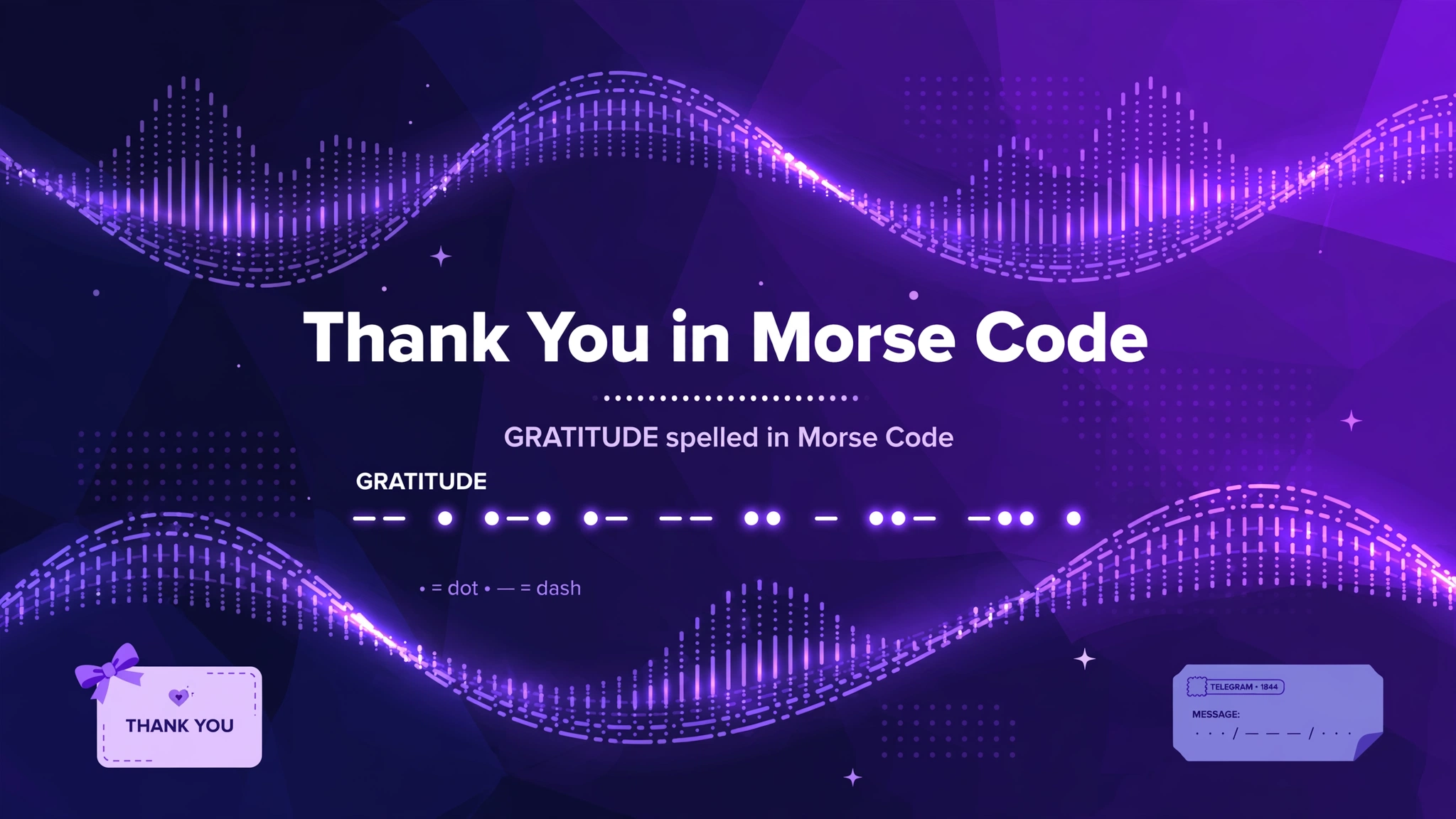
− ···· ·− −· −·− / −·−− −−− ··−
The slash in the middle represents the word gap — a pause seven units long that separates THANK from YOU. Without it, the two words run together and the message becomes much harder to read at speed. Think of the slash as punctuation: you would not write it on a gift tag, but you would leave a visibly wider space between the two words.
Letter-by-Letter Breakdown
“Thank you” uses eight distinct letters. Here is how each one breaks down in International Morse Code:
| Letter | Morse Code | Rhythm (say it) |
|---|---|---|
| T | − | dah |
| H | ···· | di-di-di-dit |
| A | ·− | di-dah |
| N | −· | dah-dit |
| K | −·− | dah-di-dah |
| (word gap) | / | (longer pause) |
| Y | −·−− | dah-di-dah-dah |
| O | −−− | dah-dah-dah |
| U | ··− | di-di-dah |
A few observations make this phrase memorable. T is a single dash and H is four dots — opposites that sit right next to each other. A and N are mirror images (·− versus −·), a lovely detail that helps beginners remember them. And YOU ends with O, three long dashes — the same −−− that anchors SOS.
How to Say It Out Loud
Morse code was never meant to be read silently from a chart; it was meant to be heard. Operators say short signals as “dit” and long signals as “dah.” Strung together, “thank you” sounds like this:
dah di-di-di-dit di-dah dah-dit dah-di-dah (pause) dah-di-dah-dah dah-dah-dah di-di-dah
Try saying it out loud at a steady pace. You will notice it has a natural cadence — almost musical. That musicality is no accident. Skilled operators, especially amateur radio “hams,” recognise whole words by their rhythm rather than by decoding letter by letter, the same way you recognise a familiar song from its first few notes. Say “thank you” a few times and the rhythm will lodge itself in your memory.
The Timing Rules That Keep It Readable
The difference between gibberish and a clear message is not the dots and dashes — it is the spaces. International Morse Code runs on a simple timing system built around one unit of time:
- A dot lasts 1 unit
- A dash lasts 3 units
- The gap between signals within one letter is 1 unit
- The gap between letters is 3 units
- The gap between words is 7 units
For “thank you,” the word gap is the one that matters most. Compress it and THANK and YOU blur into a single stream: −····−·−·−−·−−−−−··−. Technically still decodable, but at listening speed the missing seven-unit pause is what tells the ear “new word.” Beginners almost always rush the gaps while getting the signals right — so when you practise, exaggerate the pauses. Slowing down is the fastest way to get faster.
The Ham Radio Shortcut: “TU”
Ask an amateur radio operator how to say thanks in Morse code and they probably will not spell out all eight letters. On the air, gratitude travels in shorthand. TU (−·− ··−) means “thank you,” and TKS or TNX means “thanks” — abbreviations that date back to the days when every dot cost time and, on commercial circuits, money.
You will hear TU constantly in a CW (continuous wave) contact. A typical exchange ends with something like “73 TU” — that is, best regards, thank you — and the frequency goes quiet. The number 73 is itself a relic of telegraph shorthand, a numeric code for “best regards” standardised long before radio existed. So if you want the authentic operator’s version of gratitude, skip the full phrase and send −·− ··−. Two letters, one sentiment, zero wasted keystrokes.
A Short History of Gratitude Over the Wire
Morse code was developed in the 1830s and 1840s by Samuel Morse and Alfred Vail, who needed a way to represent letters as electrical pulses on a telegraph wire. On 24 May 1844, Morse sent the first long-distance message — “What hath God wrought” — from Washington, D.C. to Baltimore, and a new era of communication began.
Politeness followed the technology almost immediately. Telegraph offices, railway stations, and newsrooms ran on Morse code for decades, and operators developed their own culture of courtesies — quick acknowledgements, shorthand pleasantries, and sign-offs that kept long sessions of keying civil. When the code was standardised internationally (first at Berlin in 1851, then by the International Telegraph Union in Paris in 1865 — the body that became today’s ITU), those habits travelled with it.
Morse code eventually faded from commercial use: maritime Morse watchkeeping ended in 1999, and licensing authorities including the US FCC stopped requiring Morse proficiency for amateur licences in 2007. But the code never died — amateur radio operators still key it daily, scouts still teach it, and enthusiasts celebrate Morse Code Day every 27 April, Samuel Morse’s birthday. Saying “thank you” in dots and dashes connects you to that unbroken chain.
7 Creative Ways to Use “Thank You” in Morse Code
1. Thank-You Cards with a Secret
Write the code across the top of a card — − ···· ·− −· −·− / −·−− −−− ··− — and let the recipient decode it. Include a tiny key at the bottom for beginners. Teachers especially love this; it turns a routine thank-you into a mini-lesson.
2. Gift Tags
A plain kraft gift tag becomes a puzzle with a line of Morse code on it. Works beautifully for housewarming gifts, host gifts, and holiday presents.
3. Morse Code Bracelets
The craft world has embraced this: round beads for dots, long tube beads for dashes, strung to spell a hidden message. “Thank you” in bead form makes a genuinely touching appreciation bracelet — and a brilliant rainy-day activity for kids learning the code.
4. Engraved Jewellery and Keychains
Jewellers can engrave the dot-dash pattern on pendants, cuff bracelets, and keyrings. The code is compact, so it fits where words cannot — a discreet, permanent “thank you” that most people will never decode, which is rather the point.
5. Wedding Favours and Party Cards
Couples slip Morse-coded messages into wedding favours and place cards; it is personal without being obvious. “Thank you” is the natural choice for favour tags, and guests enjoy the moment of realisation.
6. Secret Notes and Escape Rooms
The phrase is short enough to hide in plain sight: tapped on a table, blinked with a flashlight, or written as dots and dashes in a scavenger-hunt clue. Scout troops and escape-room designers use it for exactly this — gratitude as a puzzle.
7. A Playful Email Sign-Off
A line of Morse under your signature — with the translation beneath — is a memorable way to end a thank-you email. Just make sure the key travels with it, or your gratitude will read as a printer malfunction.
Common Mistakes to Avoid
Shrinking the word gap. This is mistake number one. The seven-unit pause between THANK and YOU is what makes the phrase parse correctly. When in doubt, pause longer than feels natural.
Uneven dot-to-dash ratio. A dash should last three times as long as a dot — not twice, not five times. Wobbly ratios blur the letters together, especially in dash-heavy words like YOU.
Learning from a chart alone. Visual memorisation is a start, but real Morse code is an audio skill. Say the dits and dahs, tap them, or play the audio on a translator so your ear learns the rhythm. If you only know what the code looks like, you will struggle to recognise it at speed.
Rushing. Speed comes from accuracy, never the reverse. Practise at a comfortable pace with correct spacing, and let speed arrive on its own.
Practise It in Five Minutes
- Write out the full pattern on paper: − ···· ·− −· −·− / −·−− −−− ··−
- Read it aloud in dits and dahs, slowly, three times.
- Tap it on the table — quick taps for dots, longer presses for dashes — remembering the pauses.
- Type “thank you” into the free translator at morsezone.com and press play. Listen to the real timing, then tap along with it.
- Try the ham shortcut too: TU (−·− ··−). You now know the authentic on-air version as well.
If you get curious about the whole alphabet after that, the Morse code alphabet chart is the natural next stop — every letter, number, and punctuation mark in one place.
Frequently Asked Questions
What is “thank you” in Morse code?
“Thank you” in International Morse Code is − ···· ·− −· −·− / −·−− −−− ··−. The slash marks the word gap between THANK and YOU. When sending by sound or light, replace the slash with a pause about seven dots long.
Is there a shorter way to say thanks in Morse code?
Yes — amateur radio operators use TU (−·− ··−) for “thank you” and TKS or TNX for “thanks.” These CW abbreviations date back to commercial telegraphy and remain standard on the air today.
What does the slash mean in written Morse code?
The slash represents the word space — a pause of seven time units. Dots and dashes show the signals; the slash shows the silence. If you write the code on a card or gift, you can replace the slash with a visibly wider gap between the words.
How do I send “thank you” with a flashlight or by tapping?
Use short flashes or taps for dots and longer ones for dashes — a dash lasts about three times as long as a dot. Pause briefly between letters and longer between the two words. Keep the rhythm steady; consistency matters more than speed.
Can I put Morse code on a thank-you gift?
Absolutely. It works on cards, gift tags, bracelets (beads for dots and dashes), and engraved jewellery. Include a small key or translation so the recipient can decode your gratitude instead of guessing at it.
Conclusion
“Thank you” might be the friendliest phrase in the English language — and in Morse code it becomes something more: a rhythm you can tap, flash, bead, or engrave. Whether you spell out all eight letters or flash the operator’s shortcut TU, you are joining a tradition of coded courtesy stretching from Morse’s first telegraph line to the ham operators keying it today.
So the next time someone deserves your thanks, skip the ordinary. Send it in dots and dashes — and let them decode how much you mean it.