If you are learning Morse code, the letter A is one of the friendliest places to start. Its pattern is ·− — a single dot followed by a single dash, spoken aloud as “dit-dah.” It is short, musical, and teaches you the most important idea in all of Morse code: the contrast between a short signal and a long one. Once your ear can tell dit from dah, the whole alphabet starts to open up.
What Is A in Morse Code?
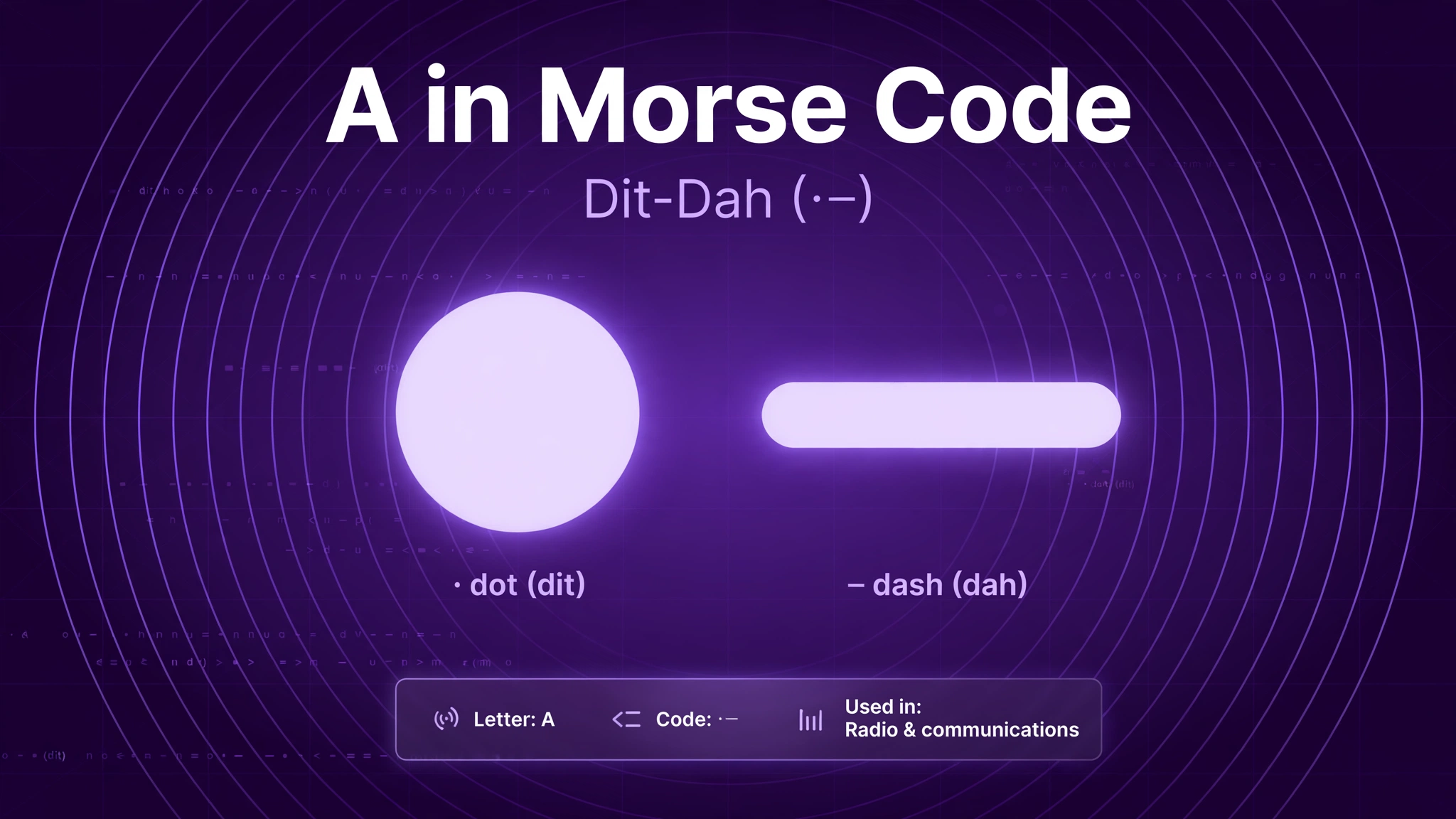
The letter A in International Morse Code is ·−:
- One dot (also called a dit) — a short signal
- One dash (also called a dah) — a long signal, about three times the length of a dot
When spoken, operators say “dit-dah.” Written on a chart you will sometimes see it as .- , and in many fonts the dash renders as an en-dash or a longer stroke.
A is the first vowel of the alphabet, and it appears in a huge number of English words — names, places, everyday phrases. That makes it practical from day one: you will be decoding or sending A constantly, so the two-signal rhythm will lodge itself in your memory without much deliberate effort.
How to Say It: Dit-Dah
Morse code was designed to be heard, not just read. The terminology operators use is simple:
- Dit = a dot, one time unit
- Dah = a dash, three time units
So A sounds like “dit-dah” — a quick rise from short to long. Try saying it out loud a few times. Then clap it: a light clap, then a longer one. That short-then-long rhythm is the letter.
This rhythm direction matters. The reverse pattern — long, then short — is a completely different letter. Getting comfortable with the direction now saves you confusion later.
A vs N: The Mirror Pair Beginners Mix Up
Here is the single most useful trick for remembering A: pair it with N.
| Letter | Morse Code | Rhythm (say it) |
|---|---|---|
| A | ·− | dit-dah (short, then long) |
| N | −· | dah-dit (long, then short) |
A and N are mirror images. A tiny timing error can turn one into the other when decoding names, initials, or short messages. When you practise by sound, say “dit-dah” for A and “dah-dit” for N until the two characters feel different without counting the marks.
Once this pair clicks, you have actually learned a pattern that unlocks more letters. Many beginner curricula teach letters in mirror pairs on purpose — E/T, A/N, I/M, S/O — because comparing opposites is how the ear learns fastest.
The Timing Rules in One Place
Every Morse character follows the same simple timing system, standardised by the ITU (International Telecommunication Union). A is the perfect example:
- A dot lasts 1 unit
- A dash lasts 3 units
- The gap between signals within one letter is 1 unit
So sending A takes: dot (1 unit) → tiny gap (1 unit) → dash (3 units). Five units total — one of the shortest letters you can send.
The most common beginner mistake is getting the signals right but the gaps wrong. Say the dash a full three times the length of the dot. An A rushed into “dit-dit” is no longer A at all.
Where You’ll Meet A First
Because A is the first letter of the alphabet and one of the most common in English, it shows up in your early learning everywhere:
- Callsigns and initials — amateur radio callsigns are full of A’s, and operators say them as “Alpha” (from the NATO phonetic alphabet) when confirming them by voice
- SOS (··· −−− ···) — the famous distress signal starts with S, but the first time you decode a practice message, A is rarely far behind
- Classroom and scout worksheets — A is a popular first letter in decoding exercises because the dit-dah pattern is so easy to recognise
- Monograms and initials — anyone encoding a first initial in jewellery, engraving, or tattoos loves A: two marks stay readable even at tiny sizes
Try typing your own name into the free Morse code translator at morsezone.com and listen to the rhythm — count how many times the dit-dah of A appears.
A Short History of Dit-Dah
Morse code was developed in the 1830s and 1840s by Samuel Morse and Alfred Vail, who needed a way to represent letters as electrical pulses on a telegraph wire. Their clever idea was to give the most-used letters the shortest codes — which is why the single dot went to E, the single dash to T, and the simple two-signal ·− to A.
On 24 May 1844, Morse sent the first long-distance message — “What hath God wrought” — from Washington, D.C. to Baltimore. The code was first standardised internationally at Berlin in 1851 and then by the International Telegraph Union in Paris in 1865 — the body that became today’s ITU. Through all of that, the pattern for A never changed.
A fun historical footnote: the original American Morse code (used on US landlines) had a different pattern for A. When International Morse Code took over in the early 1900s, ·− became the universal A — the version you learn today.
5 Memory Tricks That Make A Stick
1. The alphabet position trick
A is the 1st letter and it has 2 signals. Short code, early letter — Morse and Vail designed it that way on purpose.
2. The N-mirror drill
Alternate between A (dit-dah) and N (dah-dit) out loud for a minute. Your ear will start to “hear” the direction before your brain counts the marks. This is the drill that fixes most A/N mix-ups permanently.
3. The tap test
Tap A on a table: quick tap, then a longer press. Do it with your eyes closed. Recognition by feel transfers directly to recognition by ear.
4. Link it to a word
Some learners remember “dit-dah” as a rhythm inside words: “alpha” spoken with a strong first syllable has a similar short-long feel. Pair the sound with the letter A in your head.
5. Use it in a real word
Learn “and” next: ·− −· −··. Practising A inside a real word teaches your ear the letter gap (3 units) at the same time as the letter itself — two lessons in one.
Common Mistakes to Avoid
Reversing it into N. Saying dah-dit instead of dit-dah gives you N. If you keep mixing them, drill the mirror pair until they feel like opposites.
Making the dash too short. A dash is three dots long, not one-and-a-half. A stubby dash makes A sound like a stumble rather than a clean letter.
Skipping the internal gap. The 1-unit silence between the dot and the dash is part of the character. Without it, the two signals blur into one long blob.
Learning from a chart alone. Visual memorisation is a start, but real Morse code is an audio skill. Say the dits and dahs, tap them, or play the audio on a translator so your ear learns the rhythm of dit-dah — not just the picture of ·−.
Practise A in Five Minutes
- Write ·− on paper and say “dit-dah” out loud, three times.
- Tap it on the table — quick tap, longer press — five times, then do N the same way and feel the difference.
- Type the word “and” into the Morse code translator at morsezone.com, press play, and listen for the dit-dah at the start.
- Flash it with your phone’s torch: quick flash, longer flash. You have just sent A the way signal lamps do it.
- Tomorrow, check the full Morse code alphabet chart and learn A’s neighbour on the chart.
Frequently Asked Questions
What is A in Morse code?
A in International Morse Code is ·− — one dot followed by one dash, spoken as “dit-dah.” The dash lasts three times as long as the dot, with a 1-unit gap between the two signals.
How do you say A in Morse code out loud?
Operators say “dit-dah” — “dit” for the short signal, “dah” for the long one. Try it at a steady pace: a quick “dit,” then a slightly drawn-out “dah.”
What is the difference between A and N in Morse code?
A is ·− (dit-dah: short, then long) and N is −· (dah-dit: long, then short). They are mirror images — the same two signals in opposite order. Mixing up the direction is the most common beginner error.
How long does it take to send A in Morse code?
Five time units: 1 for the dot, 1 for the internal gap, 3 for the dash. At 20 words per minute — a comfortable amateur radio speed — A flashes by in about half a second.
Did the letter A always have this Morse pattern?
Not exactly. The original American Morse code used on 19th-century US landlines had a different code for A. The ·− pattern became the universal standard with International Morse Code, adopted worldwide in the early 20th century.
Conclusion
A = ·−. One dot, one dash, a little burst of “dit-dah.” It is the first vowel, one of the shortest letters, and the perfect lesson in the idea that makes Morse code work: short versus long.
Learn A well and you have really learned two things — the letter itself, and how to hear rhythm direction, which is half of the entire code. Flash it on your torch, tap it on your desk, bead it into a bracelet. Dit-dah is yours now — and N is just its mirror.