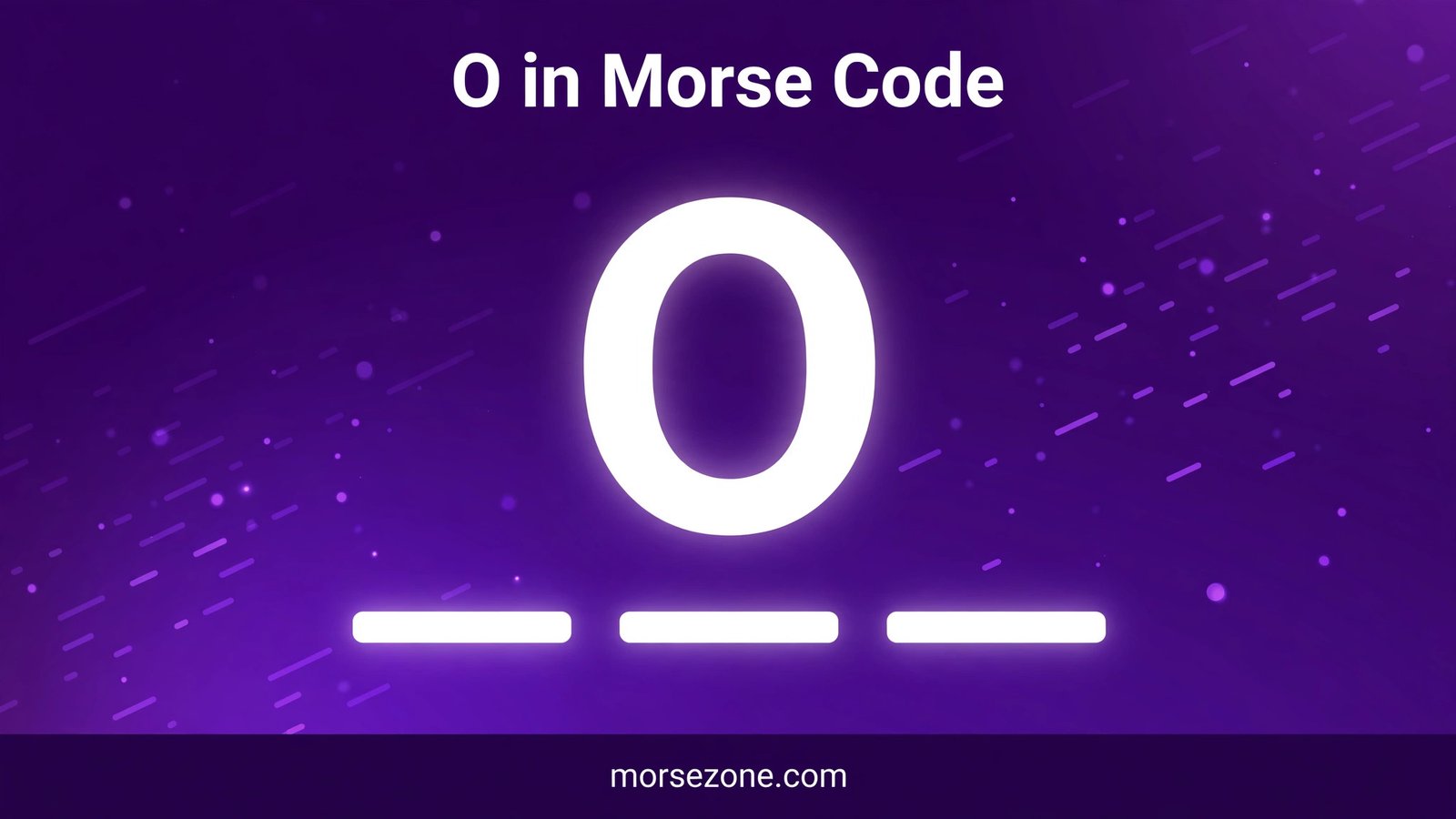
The letter O in Morse code is three dashes: − − −. It is one of the simplest codes in the entire International Morse Code alphabet — three identical long signals, evenly spaced — and it sits at the centre of the most famous distress call in history, SOS. In this guide, you’ll learn how to write, sound out and remember O, how it fits into common words, and how to practise it with the Morse Code Translator on Morse Zone.
What Is O in Morse Code?
O is transmitted as three dashes (dahs) in a row, with no dots at all:
| Letter | Morse code | Spoken rhythm | NATO phonetic word |
|---|---|---|---|
| O | − − − | dah dah dah | Oscar |
In International Morse Code, a dash is three times as long as a dot. Because O uses three identical signals, its rhythm is unmistakable: long, long, long. Among the 26 letters, O is one of only three that are made of a single repeated element — the others are E (a single dot) and T (a single dash).
O is also one of the most useful letters to learn early. It ranks as the fourth most common letter in written English (after E, T and A in most frequency counts), so it appears constantly — and its simple code makes it one of the quickest letters to recognise by ear.
How to Send O on a Telegraph Key
A dash is one “unit” multiplied by three: if your dot lasts one unit of time, each dash of O lasts three. Here’s the timing:
- Press and hold the key for 3 units (dash one).
- Release for 1 unit (the gap between signals).
- Hold again for 3 units (dash two).
- Release for 1 unit.
- Hold for 3 units (dash three).
On a straight key, beginners tend to rush dashes and make them sound like dots. A practical fix: count “one-and-two” silently for each dash while you hold the key. On a paddle keyer, the dash paddle sends the same signal — you just hold it a moment longer. You can test your own timing on our free Morse code translator tool and listen back to how O should sound.
What Does O Sound Like?
Spoken out loud by operators, O is simply “dah dah dah” — three even, weighty tones. Unlike letters that mix dots and dashes, O has no syncopation; its rhythm is a steady pulse, which is exactly why it works so well as the middle of the SOS distress signal.
To train your ear, try this drill: tap three slow, even beats on a table — tap … tap … tap — keeping each tap the same length and the gaps equal. That’s O. Then try hearing it inside words: the SOS pattern (··· −−− ···) is the classic example, and once your ear locks onto the three long tones in the middle, you’ll never confuse O with any other letter again.
Why O Is Unforgettable: The SOS Connection
The letter O owes much of its fame to the international distress signal SOS, which is sent as three dots, three dashes and three dots (··· −−− ···). The three dashes in the middle are the O.
Here are the real facts about SOS, because several myths surround it:
- SOS was first introduced in German government maritime radio regulations that took effect on 1 April 1905.
- It became the worldwide standard at the first International Radiotelegraph Convention in Berlin, signed on 3 November 1906 and effective from 1 July 1908.
- SOS is not an acronym. It doesn’t officially stand for “save our souls” or “save our ship” — those phrases were invented later as mnemonics.
- In modern radio terminology, SOS is a “procedural signal” (prosign): formally it’s sent as one continuous sequence with no gaps between the letters.
This history is documented on the Wikipedia article on the SOS signal, which confirms that three dashes make the letter O in International Morse Code. Fun footnote: in the older American Morse Code, three dashes stood for the numeral 5 — so early American operators sometimes read the distress signal as “S 5 S”.
O also shows up constantly in everyday radio and emergency signalling, because it’s easy to send even with improvised equipment — a torch, a whistle, a horn. Three long flashes, three long blasts. That simplicity is why it sits at the heart of the world’s most recognisable call for help.
O in Words: Common Examples
Seeing O inside real words cements the pattern. Here are everyday words spelled out in Morse code — read them left to right and listen for the three-dash pulse of O:
| Word | Morse code |
|---|---|
| SOS | ··· −−− ··· |
| NO | −· −−− |
| ON | −−− −· |
| ONE | −−− −· · |
| WHO | ·−− ···· −−− |
| MOON | −− −−− −−− −· |
| LOVE | ·−·· −−− ···− · |
| HELLO | ···· · ·−·· ·−·· −−− |
Notice how O anchors words like MOON — three dashes, three dashes — giving them a drumbeat rhythm that’s easy to pick out even at speed.
Memory Tricks: How to Remember O
O has one of the easiest memory hooks in Morse code:
- “Oh! God, No!” — three stressed syllables match the three dashes. Say it with emphasis on each word and you’re saying the rhythm of O.
- Visual: the letter O is round, and its Morse code is three identical horizontal bars — simple and symmetrical, like the letter itself.
- Association: O is the centre of SOS. If you can remember the distress signal, you already know the code for O (and S).
- NATO phonetic: in the spelling alphabet used by aviation and amateur radio, O is “Oscar”. Pairing the two (“Oscar = −−−”) links the spoken and signalled forms.
If you’re working through the alphabet systematically, O pairs naturally with its neighbours — compare it with N in Morse code (−·), which has a single dash plus a dot, and notice how much simpler O’s three-dash shape feels by comparison.
O in the Bigger Picture of Morse Code
The International Morse Code we use today was standardised by the ITU (International Telecommunication Union), building on the code that Samuel Morse and Alfred Vail developed for the electric telegraph in the 1840s. One of Vail’s cleverest ideas was assigning the shortest codes to the most common letters — that’s why E gets a single dot, T a single dash, and O, one of the most frequent letters in English, gets the simplest three-signal code possible.
You’ll find the full set of letter codes on the Morse code alphabet chart, where you can see how O’s three dashes sit alongside longer, mixed patterns like P (·−−·) or Q (−−·−). Spotting these patterns is a proven way to speed up learning — and if you’re serious about it, the Koch method teaches letters by sound rather than by memorising dots and dashes on paper.
And O isn’t only a learning milestone — it remains genuinely useful. Ham radio operators send O in call signs every day, and the ham tradition of “73” (best regards, explained in our guide to what 73 means in ham radio) lives in the same world of on-air shorthand that O belongs to.
Practice O Right Now
- Type “O” into the Morse Code Translator and play the audio — listen to the three even dashes five times.
- Tap the rhythm on a table while saying “dah dah dah” out loud.
- Send “SOS” (··· −−− ···) slowly, then gradually build up speed.
- Spell your own name in Morse and count how many O’s you send — they’re the easiest beats in the whole message.
- When three dashes feel automatic, move on to the next letter in the series: N in Morse code (−·) is a good follow-up.
Frequently Asked Questions
What is O in Morse code?
O in Morse code is three dashes: − − −. In operator shorthand it’s written as three dahs, spoken “dah dah dah”.
How do you write O in Morse code by hand?
Draw three short horizontal lines with small, even gaps between them: − − −. Keep the three lines the same length — a dash is three times longer than a dot — so your O doesn’t get mistaken for a string of dots.
Is the O in SOS actually the letter O?
Effectively yes, but technically SOS is a prosign — a procedural signal sent as one continuous sequence (···−−−···) with no letter gaps. In International Morse Code, three dots form the letter S and three dashes form the letter O, which is why the signal is remembered as “SOS”. It doesn’t officially stand for any phrase.
What does O sound like in Morse code audio?
Three long, even tones: dah — dah — dah. Each dash is three times the length of a dot, with one-unit silences between them. You can hear it exactly on our Morse Code Translator.
What’s the NATO phonetic word for O?
O is “Oscar” in the NATO/ICAO spelling alphabet. Note that the spelling alphabet and Morse code are separate systems — Oscar is how you say the letter on voice radio, while −−− is how you signal it in Morse.
O is one of those letters that rewards you for learning it: three dashes, endlessly useful, and the beating heart of SOS. Keep practising with the Morse Code Translator, and three dashes will soon feel like second nature.