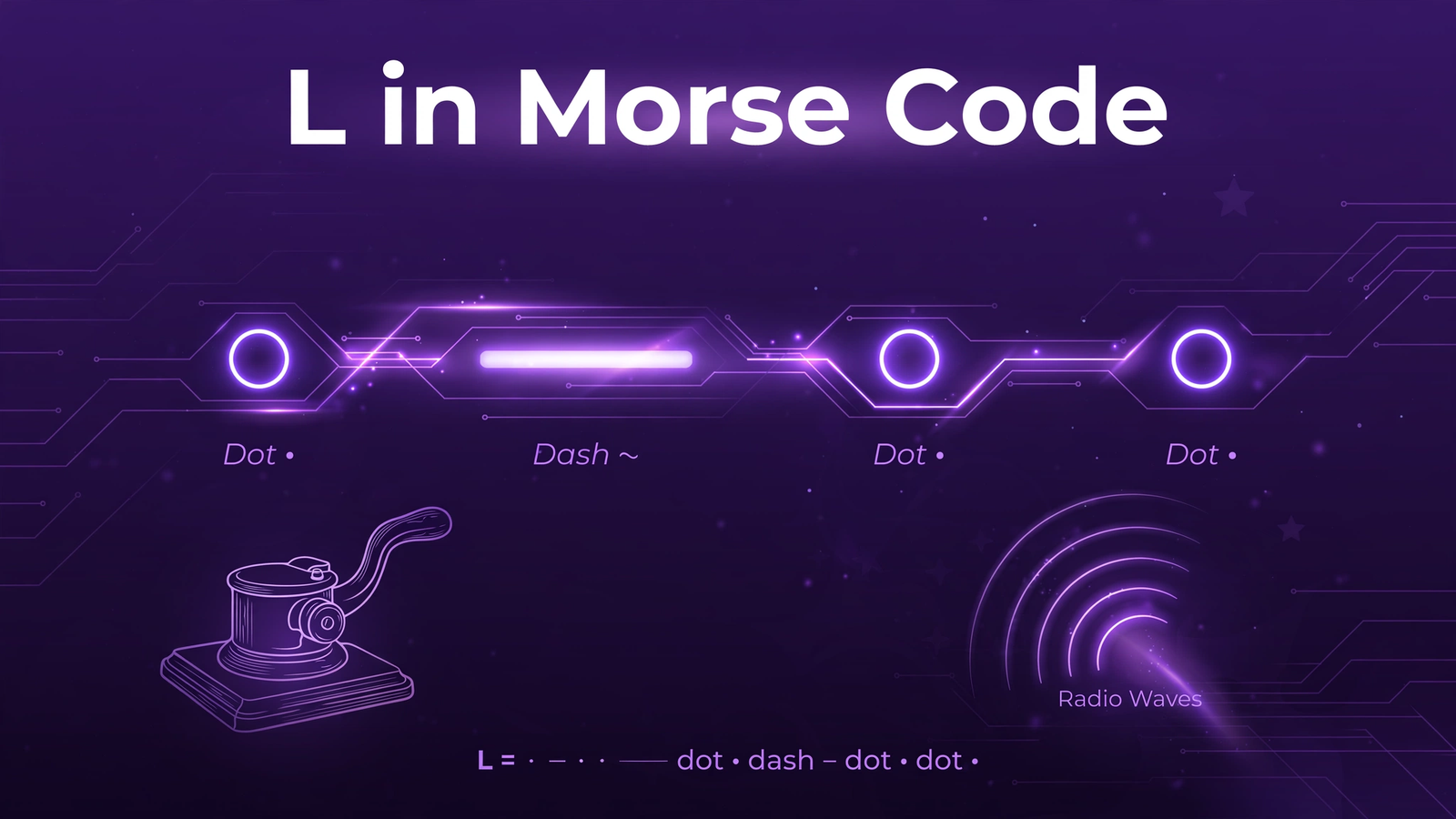
Looking for L in Morse code? The letter L is ·−·· — spoken as “di-dah-di-dit”: a short dot, a long dash, then two short dots. It is one of the most useful letters to learn early, because L shows up constantly in everyday English — in words like hello, love, live and learn. In this guide you will learn exactly how to write it, say it, time it correctly, tell it apart from its tricky lookalike F, and practise it with real words.
What Is L in Morse Code?
In International Morse Code — the global standard maintained by the ITU — every letter has a fixed pattern of dots and dashes. Here is the letter L at a glance:
| Letter | Morse code | Spoken as | Signal pattern |
|---|---|---|---|
| L | ·−·· | di-dah-di-dit | dot – dash – dot – dot |
Written with plain keyboard characters, L is .−.. (period, hyphen, period, period). The pattern is the same everywhere in the world — on amateur radio, in aviation beacons, in films, and in every Morse Code Translator tool — because International Morse Code is a single shared standard.
How to Say and Write L in Morse Code
Saying Morse code out loud is the fastest way to memorise it. For L, say “di-dah-di-dit” in one smooth breath:
- di — a short, sharp sound (the “dit”)
- dah — a noticeably longer sound, about three times the length of a dit
- di-dit — two more short sounds to finish
Getting the rhythm right matters more than speed. Morse code runs on a simple timing system where everything is measured in units:
- A dot (dit) lasts 1 unit
- A dash (dah) lasts 3 units
- The gap between the dots and dashes inside one letter is 1 unit
- The gap between letters is 3 units, and between words 7 units
So L (·−··) takes 1 + 1 + 3 + 1 + 1 + 1 + 1 = 9 units of sound and silence. Try tapping it on a table: tap — TAAAP — tap — tap. Slow and even beats fast and sloppy every time. If you want to hear it instead of imagining it, type the letter L into our free Morse Code Translator and press play — the audio uses exactly these timings.
How to write L by hand
On paper, most learners write L as .−.. or draw it as ·−··. Either is fine for notes. The classic beginner error is writing the dash too short so it looks like another dot — make your dashes clearly about three times longer than your dots and the pattern stays readable.
Why Does L Sound Like That?
Morse code was developed in the 1830s–1840s by Samuel Morse and Alfred Vail for the electric telegraph. One of their cleverest design decisions was giving the most frequently used letters the shortest codes — that is why E is a single dot. L is a fairly common letter in English (it sits inside the well-known frequency order ETAOIN SHRDLU), so it received a compact four-signal pattern rather than a long one.
The version used today is International Morse Code, standardised internationally through the ITU and documented in references such as the Morse code article on Wikipedia. It replaced earlier national variants and is the system every modern learner, radio amateur and translator tool uses.
L vs F: The Classic Mix-Up
Ask any Morse learner which two letters cause the most trouble, and L and F top the list. Compare them:
| Letter | Morse code | Spoken as |
|---|---|---|
| L | ·−·· | di-dah-di-dit |
| F | ··−· | di-di-dah-dit |
They are mirror images: the dash sits in second position for L and third position for F. Beginners constantly swap them, especially at speed. Two tricks help:
- Say them back to back: “di-dah-di-dit, di-di-dah-dit.” Hearing the pair a few times locks in which is which.
- The position rule: in L, the long dash comes early (second); in F, it comes late (third). “L is early, F is late.”
We covered F in detail in our guide to F in Morse code — reading both pages together is the quickest way to stop confusing the pair.
Practice Words With L
Letters stick when you use them inside real words. Here are five common words that all contain L — try writing each one out in full Morse, then check yourself against the complete Morse code alphabet chart:
| Word | Morse code |
|---|---|
| HELLO | …. . .−.. .−.. — |
| LOVE | .−.. — …- . |
| LIVE | .−.. .. …- . |
| LEARN | .−.. . .- .-. -. |
| LIGHT | .−.. .. –. …. – |
Notice HELLO — the most practised word in all of Morse — contains L twice. If you can send HELLO cleanly, you already own the letter L.
Bonus: “ILY” in Morse code
A popular search right now is “i l y in morse code” — the texting shorthand “ILY” (I love you). Letter by letter it is:
.. .−.. −.−.
I L Y
Three letters, three gaps of 3 units between them. It makes a great first “message” to send to a friend who is learning with you.
Try L on the Morse Code Translator
Reading about dots and dashes only goes so far — hearing them is what makes them stick. Open the free Morse Code Translator on our homepage, type any word containing L (try your own name), and listen to the audio playback. Watch how the tool separates the dot-dash-dot-dot of L from the letters around it with the 3-unit letter gap. Then try decoding in reverse: paste .−.. into the translator and see it turn back into L.
Quick Practice Drill (5 Minutes)
- Listen (2 min): play L in the translator five times, eyes closed, and say “di-dah-di-dit” along with it.
- Tap (2 min): tap L on your desk — tap, TAAAP, tap, tap — then tap F right after it. Feel the difference the dash position makes.
- Write (1 min): write HELLO and LOVE in full Morse from memory, then check the alphabet chart.
Do this drill once a day for a week and L will become automatic — most learners find the whole alphabet follows faster once the first few letters are solid. If you are starting from the very beginning, our guide to E in Morse code (a single dot — the simplest letter of all) is the ideal warm-up.
Frequently Asked Questions
What is L in Morse code?
L in Morse code is ·−·· — dot, dash, dot, dot — spoken as “di-dah-di-dit”. It is part of International Morse Code, the worldwide standard.
How do you write L in Morse code?
Write it as .−.. using a period for each dot and a hyphen for the dash, or draw it as ·−··. Keep the dash clearly longer than the dots so the pattern stays readable.
How can I remember L in Morse code?
Learn the rhythm “di-dah-di-dit” by saying it aloud, and use the mirror trick: L’s dash sits in second position while F’s dash sits in third (“L is early, F is late”). Practising the two letters back to back cements the difference.
What is “ILY” in Morse code?
“ILY” (I love you) in Morse code is .. .−.. −.−. — I (..), L (.−..), Y (−.−.), with a 3-unit gap between each letter.
Is L the same in American Morse code?
No — the old American (railroad) Morse code used different patterns and is no longer in active use. ·−·· is the International Morse Code pattern, which is the global standard used by radio amateurs, aviation and all modern learning resources.
Conclusion
L in Morse code — ·−··, “di-dah-di-dit” — is a short, rhythmic pattern that appears in some of the most-practised words in the code, from HELLO to LOVE. Learn its timing, keep it distinct from its mirror image F, and drill it inside real words rather than in isolation. Then head to the Morse Code Translator and start sending — the letter L is a small step that makes the whole alphabet feel closer.