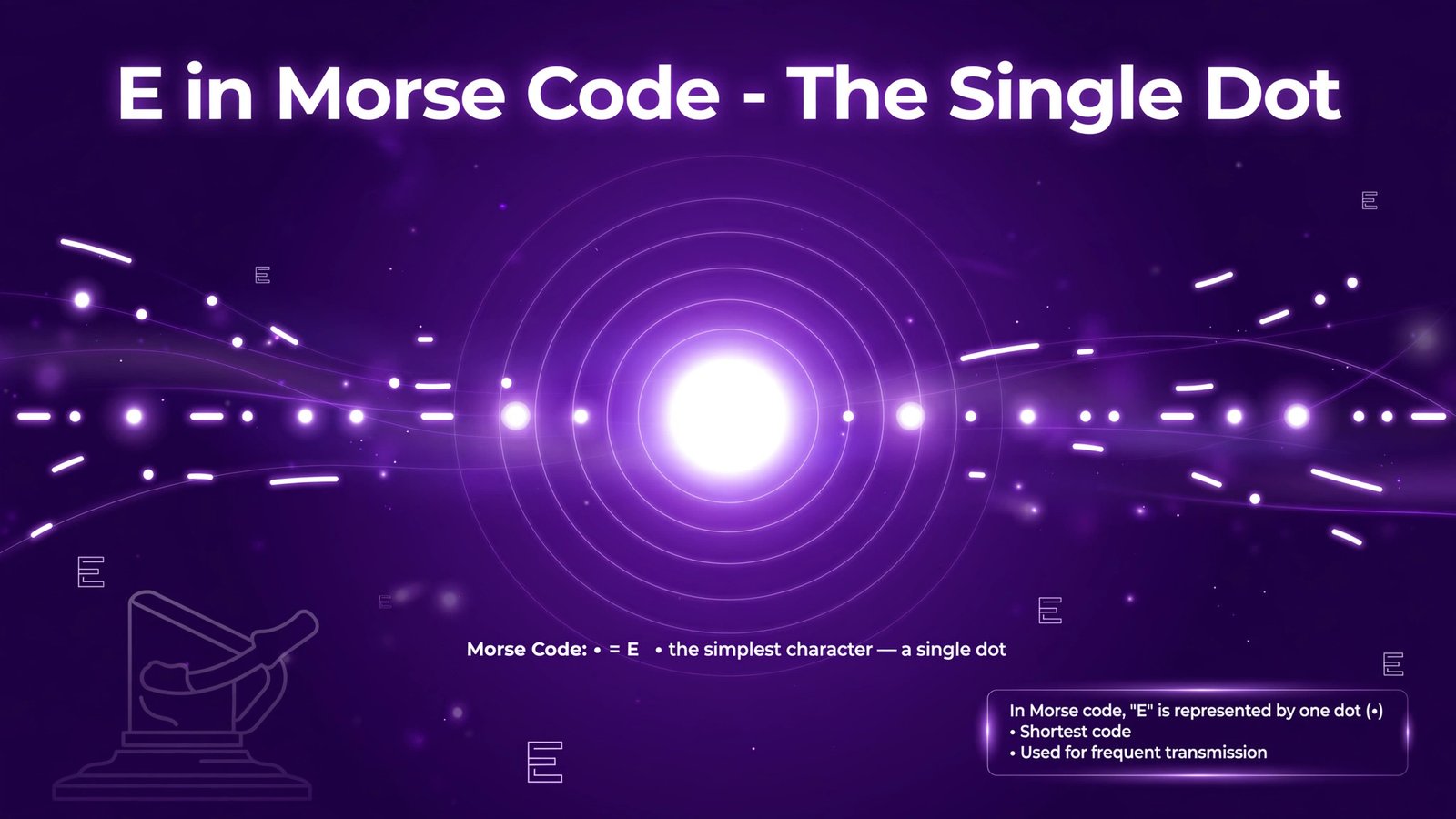
One dot. That is the entire letter E in Morse code — the shortest signal in the whole system, and quietly the most important one. E is the most common letter in written English, which is exactly why it was given the simplest code of all: a single short pulse, called a “dit” by operators.
In this guide you will learn what E sounds like, why it earned the shortest signal in the alphabet, how to send it with a key, a tap or a flashlight, and where it shows up in history’s most famous transmissions. You can hear every pattern as you read with the free Morse Code Translator — just type a letter and press play.
What Is E in Morse Code?
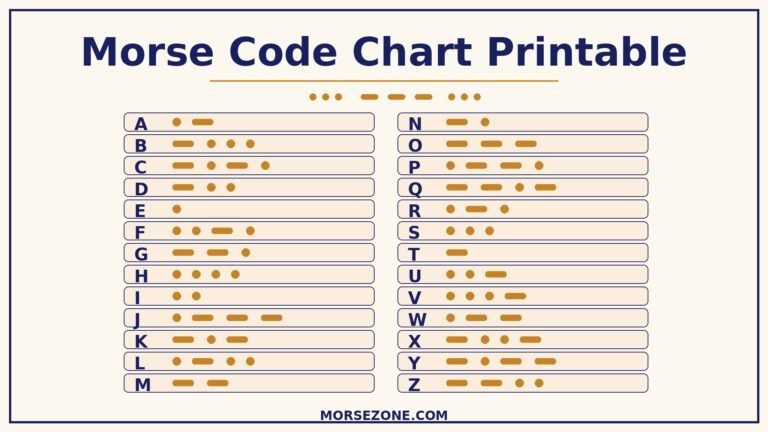
In International Morse Code, the letter E is a single dot (·) — one short signal, lasting exactly one unit of time. That is the whole character. No dashes, no combinations. Spoken aloud, operators pronounce a dot as “dit”, so E is simply “dit”.
Every character in Morse follows the same timing system, standardised by the International Telecommunication Union (ITU):
| Element | Duration |
|---|---|
| Dot (dit) | 1 time unit |
| Dash (dah) | 3 time units |
| Gap between the parts of one letter | 1 time unit |
| Gap between letters | 3 time units |
| Gap between words | 7 time units |
Because E is a single element with no internal gaps, it is the fastest character in the entire code to send — a single blip of tone, light or key press. The Morse code article on Wikipedia documents this timing system and notes that the single dit is the basic unit from which everything else is measured.
Why Does E Get the Shortest Signal?
This was not an accident — it was one of the cleverest design decisions in the history of communication. Morse’s original plan in 1837 was far cruder: transmit only numerals, and look each number up in a codebook. It was his collaborator Alfred Vail who expanded the system around 1840 to encode letters directly, and Vail wanted the new code to be genuinely efficient.
So Vail did something remarkable: he estimated how often each letter appears in English text — by counting the movable type in the type cases of a local newspaper in Morristown, New Jersey. The letters that appeared most often received the shortest codes. E, the most common letter in English, earned a single dot; T, the next most common, earned a single dash. The rare letters got the long, complicated patterns. (Source: Morse code — Wikipedia)
Think about what that means: every time an operator sends the letter E, they are cashing in a piece of 1840s data science. Frequency analysis made Morse code dramatically faster than a flat code where every letter cost the same effort — and the single dot for E is the purest expression of that idea.
A Short History of the Single Dot
- 1832 — Samuel Morse, returning by ship from Europe after witnessing demonstrations of electromagnetism, conceives the idea of a single-wire electric telegraph. He was a portrait painter by profession; the telegraph was his second career.
- ~1840 — Alfred Vail builds out the alphabet code with frequency-based letter assignments. The code is first used in 1844, and on 24 May 1844 Morse sends the famous first public message, “What hath God wrought”, from Washington to Baltimore.
- 1848 — Friedrich Gerke refines the code on German railways (the “Hamburg alphabet”), cleaning up inconsistent dash lengths and spacings.
- 1865 — International Morse Code is standardised internationally, and the ITU later maintains it as Recommendation ITU-R M.1677-1.
Here is the remarkable part: through every revision — Vail’s original, Gerke’s refinement, the 1865 international standard — the code for E never changed. In fact, only four character codes are identical to Vail’s 1840s original: E, H, K and N. That single dot has survived more than 180 years of revisions untouched, a testament to how right Vail’s frequency analysis was.
How to Say, Tap and Flash E
Say it: “dit”
Operators vocalise a dot as “dit” and a dash as “dah”. E is just “dit” — the shortest spoken character in the code. Say it crisply, at a steady pace. Its natural partner is T, spoken “dah”: the two single-element letters form the code’s smallest mirror pair, and drilling “dit, dah, dit, dah” trains your ear in the most fundamental contrast in Morse — short versus long. (The same mirror-pair idea works for A and N, covered in our guide to A in Morse code.)
Tap it: one light tap
No key? No problem. Tap E on any table with a single light fingertip tap. That is genuinely how many learners start — one tap, and you have sent a real letter. Try tapping your initials and notice how often the quick single tap of E appears.
Flash it: one short blink
For visual signalling, E is one brief flash of a torch or phone light. It is the easiest letter to send by light, which makes E a natural first step for flashlight practice — and a handy letter to know for the emergency signalling techniques every beginner should learn.
E in Famous Transmissions
Because E is everywhere in English, it is woven through every famous Morse message ever sent:
- “What hath God wrought” (1844) — Morse’s first public message is studded with Es; four of its first five words contain the letter. Every one of those Es went out as a single dot.
- SOS (··· −−− ···) — the international distress signal is built from the same atomic element as E: the dot. Three dots make S, three dashes make O, three dots make S again. When the Titanic’s operators sent SOS in 1912, they were sending the shortest possible building blocks as fast as humanly possible — read the full story in our collection of famous messages sent in Morse code.
- The NATO phonetic alphabet — in radio culture, E is “Echo” (just as D is “Delta”). Hams use both systems side by side: Morse on the key, phonetics on the microphone.
- Ham radio procedure — in on-air shorthand, a rapid string of dits serves as the error/correction prosign: an operator who makes a mistake sends a burst of quick dots to cancel it and start the word again. It is fitting that the simplest element in the code doubles as its eraser. You will meet more of this on-air shorthand in our explainer of what 73 means in ham radio.
Why Beginners Learn E First
E is where almost every Morse course begins, and for good reasons:
- It is the simplest possible character. One element, no timing decisions. You can send a correct E within seconds of first learning what Morse code is.
- It teaches the “unit”. Everything in Morse is measured in dits. Once you feel what one unit sounds like, the three-unit dash and the various gaps make intuitive sense.
- It pairs perfectly with T. Learn E and T together and you have mastered the short/long contrast that underpins the entire code — the same mirror-pair method that makes A and N click.
- It appears constantly. Roughly one in eight letters of English text is an E, so from your very first practice message you will be using it. Early success keeps learners motivated.
A five-minute E practice routine
- Type “E” into the Morse Code Translator and listen to the single dit.
- Type “ETETET” and listen for the short/long alternation — dit, dah, dit, dah.
- Tap E on your desk twenty times, then alternate E and T taps until the difference feels physical.
- Send a real word: “SEE” is ··· · · — three dots, a gap, one dot, a gap, one dot. “THE” is − ···· ·.
- Flash “SOS” with your phone torch: three short flashes, three long, three short. You have just sent the most famous distress signal in history.
Ten focused minutes a day beats an hour once a week. Morse is a physical skill as much as a mental one — your ears and your sending hand both need the reps.
Frequently Asked Questions
What is E in Morse code?
E in Morse code is a single dot (·) — one short signal, one unit of time, spoken aloud as “dit”. It is the shortest character in the entire International Morse Code alphabet.
Why is E only one dot in Morse code?
Because E is the most common letter in English. Alfred Vail assigned the shortest codes to the most frequent letters after estimating letter frequency by counting type in a newspaper’s type cases. E earned the single dot; T earned the single dash.
How do you pronounce E in Morse code?
Operators say “dit”. A dot is always voiced as “dit” (and as “di” when it is not the final element of a longer character), while a dash is voiced as “dah”.
What is the opposite of E in Morse code?
T — a single dash (−), spoken “dah”. E and T are mirror images: the shortest possible short signal versus the shortest possible long signal. Learning them as a pair is the fastest way to internalise the dot/dash distinction.
Has E always been a single dot?
Yes. E is one of only four character codes (E, H, K and N) that are identical to Alfred Vail’s original 1840s assignments. Every later revision — Gerke’s 1848 refinement and the 1865 international standard — left the single dot for E untouched.
Conclusion
E is proof of the quiet elegance of Morse code: the most-used letter costs the least effort — one dot, one unit of time, unchanged for over 180 years. Vail’s frequency analysis was so sound that no committee ever found a reason to improve on it.
The best way to make it yours is to hear it and send it, starting today. Open the free Morse Code Translator, type your name, and count the dits. Then work through the alphabet one letter at a time — E is down, and T is its perfect mirror.