
If you have ever listened to an amateur radio conversation, watched a Morse code contact wind down, or browsed a ham radio forum, you have almost certainly seen the number “73” tucked at the very end of a message. It appears on QSL cards, in logbooks, at the end of digital-mode exchanges, and in the sign-offs of operators across the globe.
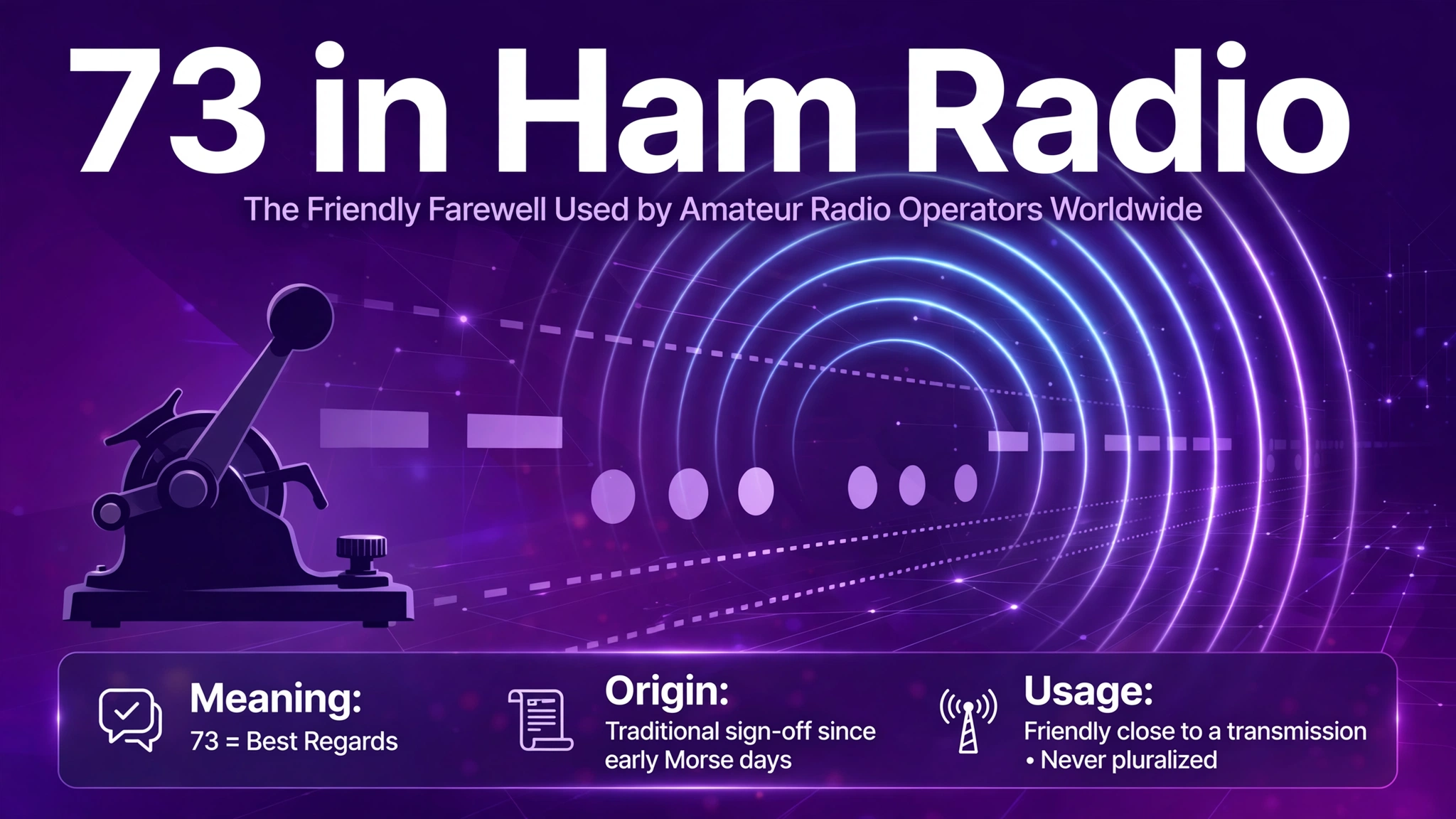
So, what does 73 mean in ham radio? It means “best regards” — a warm, shorthand way of saying goodbye when a contact (called a QSO in ham radio lingo) comes to an end. Hams have been sending it for well over a century, and it remains one of the most recognisable traditions in amateur radio.
73 Means “Best Regards” — The Short Answer
When an operator sends or says “73”, they are offering friendly regards to the station they have been talking to. It is the radio equivalent of “all the best” or “take care”. A typical sign-off in Morse code (known to hams as CW, short for continuous wave) might run something like:
DE G4ABC 73 ES GL — “from G4ABC, best regards and good luck”
The abbreviation is used in spoken conversation too, where operators pronounce it “seventy-three”. Newcomers to the hobby sometimes wonder whether 73 is a frequency, a code for an emergency, or part of a callsign. It is none of those things — it is simply a greeting, and one of the oldest pieces of radio etiquette still in daily use.
Where Did 73 Come From?
The story of 73 begins not with radio at all, but with the wired telegraph. Long before amateur radio existed, landline telegraph operators handled huge volumes of messages by hand, and they needed ways to shorten the most common phrases. Number codes did that job perfectly.
The Phillips Code of 1879
In 1879, Walter P. Phillips of the United Press Associations compiled a book of abbreviations called the Phillips Code for use by press telegraphers. The code assigned short number sequences to everyday expressions so operators could send copy faster. According to long-standing radio tradition, 73 in the original Phillips Code meant “my love to you” — an affectionate sign-off that wire operators would send to one another at the end of a shift or a long exchange.
Western Union’s 92 Code
A separate and older list, Western Union’s 92 Code of 1859, also contained numeric abbreviations for common phrases. In that code, 73 was listed with a meaning much closer to the one hams use today: “best regards”. Telegraphers on the American landline networks used it to close out messages politely and efficiently.
From Landlines to the Airwaves
When wireless telegraphy arrived in the early 1900s, many of its first operators were former landline telegraphers. They brought their shorthand with them. Early amateur experimenters — the hams of the 1910s and 1920s — adopted 73 naturally, and the American Radio Relay League (ARRL), the national association for amateur radio in the United States, helped standardise operating customs as the hobby grew. Samuel Morse and Alfred Vail could hardly have imagined that their 1840s invention would one day carry internet-era phrases, yet the old telegraph shorthand survived the leap to radio almost intact.
Try encoding it yourself with our free Morse code translator and you will see exactly how little effort these abbreviations cost to send.
How to Send 73 in Morse Code
Because 73 is a number, it is sent using the digit patterns of International Morse Code — the standard maintained by the ITU (International Telecommunication Union). Every digit uses exactly five signals, which you can study in our Morse code numbers chart:
| Character | Morse pattern |
|---|---|
| 7 | --... |
| 3 | ...-- |
So “73” goes out as --... ...--. In a live CW contact, an operator sends this at the end of the QSO, often followed by the SK prosign (...-.-), which formally signals the end of transmission.
The beauty of 73 is its efficiency. Saying “best regards, it was a pleasure speaking with you, goodbye” takes a dozen words; 73 takes two short groups of signals. On a weak, fading HF signal where every character counts, that economy is not just charming — it is practical.
How Ham Operators Use 73 Today
Although 73 was born on the telegraph wire, it is very much alive in modern amateur radio:
- On Morse (CW): 73 remains the standard closing of a two-way contact. A skilled operator might send it at 25 words per minute (WPM) without a second thought.
- On voice modes: Operators on SSB and FM repeaters say “seventy-three” as a friendly sign-off. You will hear it on nets, contests, and casual roundtables alike.
- On digital modes: Even computer-to-radio modes like FT8, where exchanges are almost entirely automated, end with a “73” message — proof that the tradition has survived every technological change.
- In writing: Hams sign emails, forum posts, and QSL cards (the postcard-like confirmations exchanged after contacts) with “73”, often followed by their callsign.
The American Radio Relay League (ARRL) and amateur radio clubs worldwide continue to teach 73 to every new generation of licensees, so the greeting shows no sign of fading.
73 vs 88 — and Other Classic Number Abbreviations
73 is not the only number with a hidden meaning on the bands. Here are the classics every listener should know:
| Abbreviation | Meaning | Typical use |
|---|---|---|
| 73 | Best regards | Friendly sign-off at the end of a contact |
| 88 | Love and kisses | Affectionate sign-off, usually between close friends or family |
| 30 | No more / end of transmission | Press heritage; used to mark the end of a bulletin |
| 599 | Perfect signal report | The RST (readability-strength-tone) report “perfectly readable, extremely strong, perfect tone” |
Beyond the numbers, hams use word abbreviations with the same spirit: TNX (thanks), ES (and), DE (from / “this is”), and Q-codes such as QTH (location) and QRZ (who is calling me?). Together they form the compact language of the airwaves — and a fun challenge for anyone learning to decode Morse, much like the famous messages sent in Morse code throughout history.
The Great “73s” Debate: Never Pluralise It
Ask any experienced operator about the fastest way to spot a newcomer, and many will say the same thing: sending or saying “73s”. Because 73 already means “best regards” — plural by nature — adding an extra “s” is redundant, like saying “best regardses”. It is a gentle but persistent piece of ham radio etiquette: the correct form is always just 73.
Nobody will be unkind about the mistake — every operator was new once — but dropping the “s” is one of the quickest ways to sound like you belong on the bands.
When Should You Use 73?
The etiquette is simple:
- Use it at the end of a contact, not in the middle. It is a sign-off, not a greeting.
- Send it after your callsign, so the other station knows exactly who is signing off.
- Listen first. Spend time on the bands (or on web-based receivers) hearing how experienced operators close their QSOs, then imitate the rhythm.
- Do not use 73 with emergency traffic. Real emergency communication stays plain and unambiguous — abbreviations have no place there.
If you are learning Morse from scratch, start with the building blocks: the Morse code alphabet covers every letter pattern, and 73 will feel natural once digits are under your fingers.
Frequently Asked Questions
What does 73 mean in ham radio?
73 means “best regards”. It is a traditional shorthand sign-off used by amateur radio operators at the end of a contact, in Morse code, on voice, and in digital modes.
What is 73 in Morse code?
In International Morse Code, 7 is --... and 3 is ...--, so 73 is sent as --... ...--. Operators send it at the end of a QSO, often before the SK end-of-transmission prosign.
Why do ham radio operators say 73 instead of goodbye?
The tradition comes from 19th-century telegraphy. Landline operators used numeric abbreviations like 73 (“best regards”) to save time, and early wireless operators carried the habit onto the airwaves. It is shorter, friendlier, and universally understood across languages.
What does 88 mean in ham radio?
88 means “love and kisses”. It comes from the same telegraph-code heritage as 73 but is more affectionate, typically exchanged between close friends or family members rather than casual contacts.
Is it correct to say “73s” in ham radio?
No — “73s” is considered incorrect. Since 73 already means “best regards” (plural), adding an “s” is redundant. Experienced operators always use the plain form, 73.
Conclusion
What does 73 mean in ham radio? Two digits, five signals each, carrying more than 150 years of history: best regards. From the press wires of the Phillips Code to FT8 exchanges beamed across continents, 73 has survived every leap in communication technology because it does something simple and human — it says goodbye with warmth.
The next time you hear “seventy-three” at the end of a contact, you will know exactly what is being said. And if you want to send it yourself, open the Morse code translator, type “73”, listen to the pattern, and you have just joined one of the oldest traditions on the air.