Long before texts, tweets, and satellite phones, the world’s most urgent news traveled in dots and dashes. Morse code — the system of short and long signals developed by Samuel Morse and Alfred Vail in the 1830s and 1840s — carried everything from the first telegraph dispatch to wartime distress calls and one of the most daring acts of defiance ever broadcast. These are the famous messages that made Morse code immortal.
The First Message Ever Sent: “What Hath God Wrought”
On May 24, 1844, Samuel Morse sat in the Supreme Court chamber of the U.S. Capitol and tapped out the first public telegraph message to Baltimore, 40 miles away: “What hath God wrought” — a line from the Book of Numbers. His partner Alfred Vail, who had done much of the practical engineering behind the system, received it. The phrase, chosen by Annie Ellsworth, proved that electrical signals could carry language across vast distances in seconds.
In International Morse Code, it looks like this:
.– …. .- – / …. .- – …. / –. — -.. / .– .-. — ..- –. …. –
That single transmission launched the telecommunications age — and every dot and dash since has followed in its footsteps. What follows are the messages that turned a clever invention into a lifeline: distress calls from the Atlantic, a prisoner’s silent defiance, and the wartime traffic that helped decide the fate of nations.
The Titanic’s Desperate Calls: CQD and SOS
The most famous Morse messages in history were sent from a sinking ship. On the night of April 14, 1912, the RMS Titanic — call sign MGY — struck an iceberg in the North Atlantic. In the wireless room, chief operator Jack Phillips and his assistant Harold Bride began transmitting distress calls using their Marconi wireless equipment.
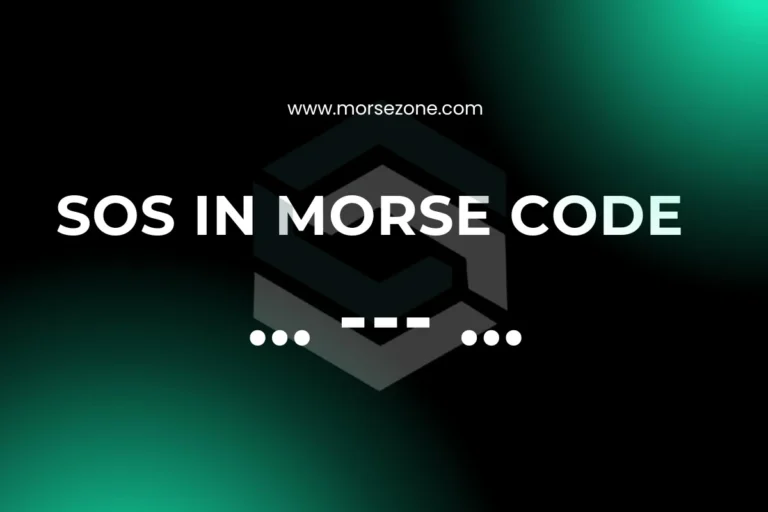
Phillips initially sent CQD — the Marconi company’s own distress signal — along with the ship’s position. As the situation grew dire, Bride later recalled suggesting they try the newer international signal too. The Titanic’s operators began alternating between CQD and SOS, the three-dots-three-dashes-three-dots signal adopted internationally just a few years earlier:
… — …
The RMS Carpathia, some 58 miles away, received the calls and raced through ice fields to the rescue, saving 705 survivors. Tragically, the SS Californian sat within sight of the Titanic’s distress rockets — but its lone wireless operator had gone to bed, and no one was listening.
Jack Phillips stayed at his key until the power failed; he did not survive. Harold Bride survived, though injured, and helped operate the Carpathia’s wireless on the journey to New York. The disaster exposed a fatal flaw: ships weren’t required to keep round-the-clock wireless watches. The 1912 Radio Act, passed months later, mandated continuous monitoring — and made SOS the undisputed king of distress signals.
The First SOS Ever Sent
SOS didn’t debut on the Titanic. Its first documented use came on August 11, 1909, when the steamship SS Arapahoe lost its propeller off the North Carolina coast and radioed SOS — the signal adopted at the 1906 Berlin radiotelegraph convention and effective from July 1908. The Arapahoe was towed to safety, and the new distress call proved itself in a real emergency three years before the Titanic made it legendary.
Jeremiah Denton: Blinking “TORTURE” in Morse
Perhaps the most courageous Morse message ever transmitted used no wires, no radio, and no key — just eyelids. In 1966, U.S. Navy pilot Jeremiah Denton was a prisoner of war in North Vietnam, forced to appear in a televised propaganda interview. As he answered the interviewer’s questions, Denton slowly blinked his eyes in Morse code, spelling out:
T O R T U R E
– / — / .-. / – / ..- / .-. / .
It was the first confirmation the United States received that American POWs were being tortured in Vietnam. Denton’s silent broadcast — picked up by U.S. intelligence analysts watching the footage — changed how the world understood the prisoners’ plight. He endured nearly eight years of captivity and later became a U.S. Senator. His blinking remains the most famous non-electronic use of Morse code in history.
WWII: Morse Code at War
World War II was arguably Morse code’s finest hour. Radio operators across every theater tapped out orders, intelligence, and news around the clock:
- D-Day communications relied heavily on Morse-trained operators coordinating landings, naval gunfire, and air support across the English Channel.
- Resistance networks in occupied Europe used clandestine wireless sets — often built from smuggled parts — to send Morse intelligence to London. Operators worked in constant danger; German direction-finding vans hunted their signals, and capture meant torture or death.
- Naval warfare ran on Morse. Submarines, convoys, and fleet commands exchanged coded messages in dots and dashes, and the battle to intercept and decode enemy signals — including the work at Bletchley Park — helped decide the war at sea.
A brief note on a related legend: the U.S. Marines’ Navajo code talkers are sometimes mentioned alongside Morse operators, but they used something entirely different — an unbreakable spoken code built on the Navajo language. Morse carried the signals; the Navajo code protected what those signals meant. Both proved that in war, communication itself is a weapon.
The ITU (International Telecommunication Union) had standardized International Morse Code decades earlier, which is why Allied operators from different nations could all read the same signals — a quiet triumph of international cooperation that paid off in wartime.
Modern Echoes: Morse Code Isn’t Dead
Morse hasn’t vanished — it has simply gone quiet, waiting in the background:
- Aviation still uses it: every VOR navigation beacon broadcasts its identifier in Morse, which pilots learn to recognize by ear.
- Amateur radio operators keep CW (continuous wave) alive as a beloved mode; in weak-signal conditions, a Morse signal can get through when voice cannot.
- Assistive technology uses Morse-derived interfaces — people with severe motor impairments can type using single switches with dot-dash timing.
- Popular culture loves it: from the Stranger Things Christmas lights to countless spy films, those beeps remain instantly recognizable.
Try It Yourself: Encode History’s Famous Messages
Reading about these messages is one thing — hearing them is another. You can encode any of history’s famous phrases into authentic Morse code with audio playback using the free translator at morsezone.com. Type “SOS” and hear the exact rhythm that saved 705 lives, or encode “What hath God wrought” and listen to the message that started it all. No signup, no cost — just dots, dashes, and history.
Frequently Asked Questions
What did the Titanic actually send — SOS or CQD?
Both. Chief operator Jack Phillips began with CQD, the Marconi company’s traditional distress call, and the Titanic’s wireless room alternated between CQD and SOS as the sinking progressed. The Carpathia responded to the calls and rescued the survivors.
What does SOS stand for?
Nothing — and that’s the point. SOS isn’t an abbreviation for “Save Our Souls” or “Save Our Ship.” It was chosen at the 1906 Berlin convention purely because …—… is unmistakable and easy to send, even by an untrained operator in a panic.
How did Jeremiah Denton’s blinking work?
Denton blinked his eyes in Morse timing during a 1966 televised interview — long blinks for dashes, short for dots — spelling T-O-R-T-U-R-E. U.S. intelligence analysts decoded it from the footage, confirming for the first time that American POWs were being tortured in North Vietnam.
Was Morse code used in WWII?
Extensively. Military radio operators used Morse for orders, intelligence, and coordination across every theater — from D-Day landings to resistance networks in occupied Europe to naval communications. It remained a core military skill well into the Cold War.
Is Morse code still used today?
Yes, though in narrower roles. Aviation navigation beacons broadcast Morse identifiers, amateur radio operators use CW mode worldwide, and Morse-based interfaces help people with severe disabilities communicate. The ITU still maintains the International Morse Code standard.
Conclusion
From a Washington telegraph office in 1844 to a prison camp in Vietnam in 1966, Morse code carried humanity’s most consequential messages through 120 years of history. The dots and dashes that summoned the Carpathia, exposed torture, and coordinated D-Day were all built from the same simple idea Samuel Morse and Alfred Vail proved with four words: “What hath God wrought.” What it wrought, it turned out, was a language fast enough to save lives — and durable enough to outlive the age that invented it.