No in Morse Code – Meaning, Translation, Symbol, Sound & Easy Guide
Morse code is one of the oldest and most reliable communication systems ever developed. Whether you are a beginner learning the basics or someone who wants to expand their knowledge, understanding how to express simple words like “no” in Morse code is a great starting point. This guide covers everything — from the exact translation of no in Morse code, its sound, symbol, and how to say it — to related phrases like “yes and no in Morse code,” “hell no in Morse code,” and much more.
What Is Morse Code?
Morse code is a system of communication that uses a series of dots (.) and dashes (–) to represent letters, numbers, and punctuation. Originally developed in the 1830s by Samuel Morse and Alfred Vail, it was used extensively in telegraphy and military communication. Today, it is still used in aviation, amateur radio, and emergency signaling.
Each letter of the English alphabet has a unique Morse code pattern. Learning even a few of these patterns can be incredibly useful.
What Is “No” in Morse Code?
The word “no” consists of two letters: N and O.
Here is the Morse code translation for each letter:
| Letter | Morse Code |
|---|---|
| N | –· |
| O | ––– |
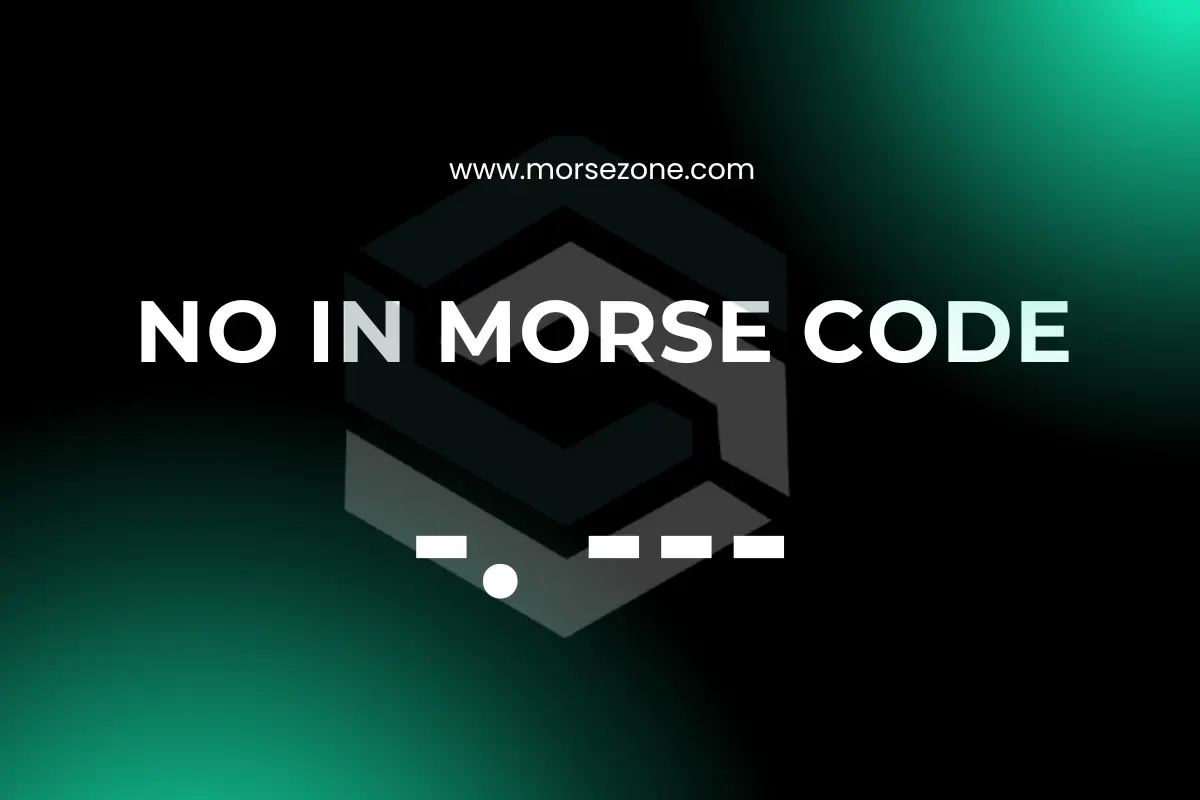
So, no in Morse code is: –· –––
Written out in standard Morse notation:
N O –· –––
This is the direct, universally accepted translation. There is a single space between each letter and three spaces between each word.
No in Morse Code – Symbol Breakdown
Understanding the symbol helps you recognize it visually and audibly.
- N (–·) = One dash followed by one dot
- O (–––) = Three consecutive dashes
So when you see or hear –· –––, that is Morse code for the word “no.”
No in Morse Code – Sound Guide
Morse code is not just visual — it has a distinct sound pattern used in radio communication. Here is how each element sounds:
- Dot (·) = Short beep (dit)
- Dash (–) = Long beep (dah)
“No” in Morse code sound:
N = DAH-dit O = DAH-DAH-DAH
So the full word “no” sounds like: DAH-dit [pause] DAH-DAH-DAH
This rhythm is what radio operators and Morse code learners train their ears to recognize. If you want to hear the actual no in Morse code sound, many free online Morse code audio translators and players are available.
How to Say “No” in Morse Code
Knowing how to say no in Morse code depends on whether you are using sound, light, or written signals:
- By sound: Tap or beep — long-short [pause] long-long-long
- By light: Flash — long-short [pause] long-long-long
- In writing: –· –––
- Using dots and dashes text:
-. ---
This is the standard way across all Morse code communication systems.
How Do You Say “No” in Morse Code in Different Ways?
Sometimes a simple “no” is not enough. Here are several common phrases and how they translate:
Not in Morse Code
“Not” = N, O, T
| Letter | Morse Code |
|---|---|
| N | –· |
| O | ––– |
| T | – |
Not in Morse code: –· ––– –
Hell No in Morse Code
“Hell no” = H, E, L, L / N, O
| Letter | Morse Code |
|---|---|
| H | ···· |
| E | · |
| L | ·–·· |
| L | ·–·· |
| N | –· |
| O | ––– |
Hell no in Morse code: ···· · ·–·· ·–·· / –· –––
No Problem in Morse Code
“No problem” = N, O / P, R, O, B, L, E, M
| Letter | Morse Code |
|---|---|
| N | –· |
| O | ––– |
| P | ·––· |
| R | ·–· |
| O | ––– |
| B | –··· |
| L | ·–·· |
| E | · |
| M | –– |
No problem in Morse code: –· ––– / ·––· ·–· ––– –··· ·–·· · ––
Oh No in Morse Code
“Oh no” = O, H / N, O
| Letter | Morse Code |
|---|---|
| O | ––– |
| H | ···· |
| N | –· |
| O | ––– |
Oh no in Morse code: ––– ···· / –· –––
No One in Morse Code
“No one” = N, O / O, N, E
| Letter | Morse Code |
|---|---|
| N | –· |
| O | ––– |
| O | ––– |
| N | –· |
| E | · |
No one in Morse code: –· ––– / ––– –· ·
No Thanks in Morse Code
“No thanks” = N, O / T, H, A, N, K, S
| Letter | Morse Code |
|---|---|
| N | –· |
| O | ––– |
| T | – |
| H | ···· |
| A | ·– |
| N | –· |
| K | –·– |
| S | ··· |
No thanks in Morse code: –· ––– / – ···· ·– –· –·– ···
No You in Morse Code / No U in Morse Code
“No you” or “no u” = N, O / Y, O, U
| Letter | Morse Code |
|---|---|
| N | –· |
| O | ––– |
| Y | –·–– |
| O | ––– |
| U | ··– |
No you / No U in Morse code: –· ––– / –·–– ––– ··–
Yes and No in Morse Code
One of the most commonly searched combinations is yes and no in Morse code. Here is a complete breakdown:
Yes in Morse Code
“Yes” = Y, E, S
| Letter | Morse Code |
|---|---|
| Y | –·–– |
| E | · |
| S | ··· |
Yes in Morse code: –·–– · ···
No in Morse Code
No in Morse code: –· –––
Quick Summary Table:
| Word | Morse Code |
|---|---|
| Yes | –·–– · ··· |
| No | –· ––– |
No in Morse Code to English – Reverse Translation
If you receive a Morse code message and want to decode it to English, here is how to translate no in Morse code to English:
- See –· → This is the letter N
- See ––– → This is the letter O
- Combined → The word is NO
You can use any standard Morse code translator tool online to quickly convert Morse signals to English text. Simply input the dots and dashes and the tool will output the plain text translation.
Easy Tips to Learn Morse Code
Learning Morse code does not have to be difficult. Here are some practical methods:
- Start with short words — Words like “no,” “yes,” “hi,” and “ok” are great starting points.
- Use mnemonics — Associate each letter’s sound pattern with a word (e.g., N = “NO-go” = DAH-dit).
- Practice with a Morse code translator — Online tools let you listen to the sound of each letter and word.
- Learn the most common letters first — E (·), T (–), A (·–), N (–·), and O (–––) are used most frequently.
- Repeat daily — Even 10 minutes a day can significantly improve your Morse code reading speed.
Why Learn Morse Code?
- Emergency communication: Morse code works even when voice communication fails.
- Amateur radio (HAM radio): Widely used in the hobby radio community.
- Military and aviation history: Understanding Morse code helps appreciate historical communication methods.
- Mental exercise: Learning a new communication system exercises memory and pattern recognition.
- Fun and practical skill: Impress people by tapping out secret messages!