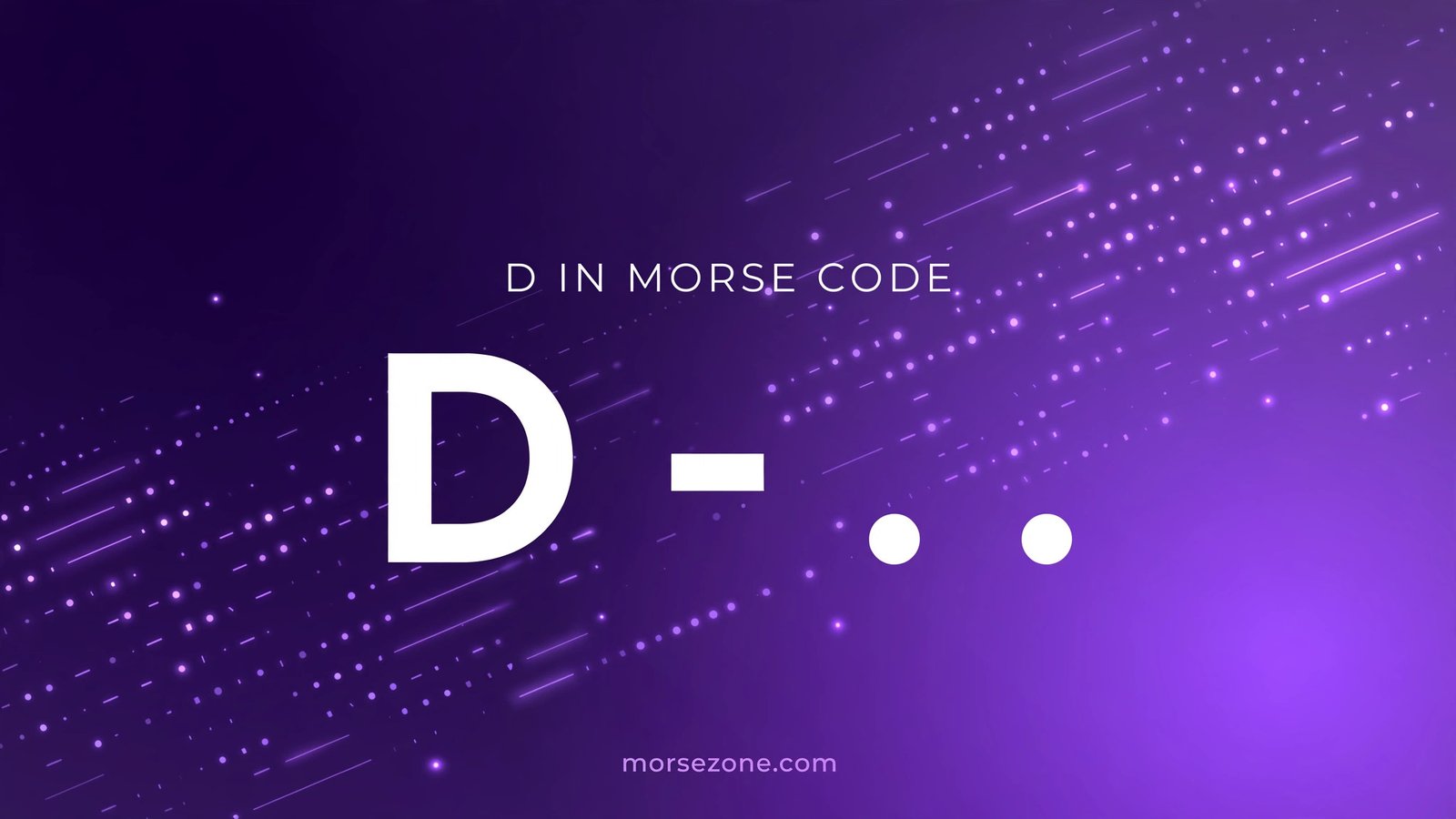
Few letters in Morse code hit as hard as D. A single dash followed by two quick dots — dash-dot-dot (-..) — it sounds like a drumbeat: DAAH-di-dit. It is short, rhythmic, and instantly recognizable once you have heard it a few times. Better still, D opens one of the most-used shortcuts in all of amateur radio: the DE prosign, which ham operators send at the start of nearly every transmission.
Whether you are learning Morse code for ham radio, emergency preparedness, or pure curiosity, D is a letter worth mastering early. In this guide you will learn exactly what D sounds like, how to tap it, clever ways to remember it, and how it is used on the air. You can follow along and hear every pattern on the free Morse Code Translator — just type a letter and listen.
What Is D in Morse Code?
In International Morse Code, the letter D is represented as -.. — one dash (a long signal) followed by two dots (short signals). The standard timing, defined by the International Telecommunication Union (ITU), is:
- A dot lasts one time unit
- A dash lasts three time units
- The gap between the parts of one letter is one time unit
- The gap between letters is three time units
So D, spoken aloud, sounds like “DAAH-di-dit” — one long tone, then two short ones. At 20 words per minute, the whole letter takes well under a second.
D sits in an interesting family of letters. Compare it with its neighbors: B is dash-dot-dot-dot (-…), which is D with one extra dot tacked on. And N is dash-dot (-.), which is D without its final dot. Learning these relationships is one of the fastest ways to build fluency — instead of memorizing 26 isolated patterns, you learn clusters. The full Morse code alphabet chart lays out every letter side by side, which makes these patterns much easier to spot.
A bit of history: the code we use today is International Morse Code, standardized in its modern form in the mid-19th century and refined by the ITU. It descends from the original system developed by Samuel Morse and Alfred Vail in the 1830s and 1840s for the electric telegraph. The letter assignments were not random — common letters got the shortest codes (E is a single dot, T a single dash), while less common letters like D received slightly longer patterns.
How to Remember D in Morse Code
Everyone learns differently, so here are several memory hooks for D (-..). Pick the one that sticks:
1. The drumbeat. D is DAAH-di-dit — a boom followed by two taps. Think of a drummer’s fill at the end of a bar, or a knock on a door: knock-knock-knock with the first knock heavier. Once you feel the rhythm, the pattern is hard to forget.
2. The “D” shape trick. Write a capital D and trace it: the straight vertical stroke is the long dash, and the curved belly can be imagined as two quick dots bouncing along it. It is a stretch, but visual learners swear by it.
3. The word-association method. Think of the word “DOGGED” — say it with Morse rhythm: DAWG-ed — one stressed syllable followed by two quick ones.
4. Learn it as part of DE. As you will see below, ham operators send DE (-.. .) constantly. If you learn the two-letter combination as one chunk — DAAH-di-dit di — you get D for free.
How to Tap and Signal D
Knowing the pattern is only half the battle — you need to be able to send it cleanly. Here is how to produce D (-..) with the three classic methods:
With a straight key or paddle
A straight key is the traditional telegraph key: press down for the signal, release to stop. For D:
- Press and hold for the dash — about three times as long as a dot. Count “one-two-three” in your head at first.
- Release briefly (one dot-length pause).
- Tap twice, quickly and lightly, for the two dots.
The most common beginner mistake is making the dash too short (so it sounds like three dots — the letter S) or leaving too big a gap between the dash and the dots (so it sounds like T followed by I). Keep everything tight: the three elements of D belong together as one letter.
By tapping on a table
No key? No problem. Tap the dash with a firm press of your fingertip (or a knuckle rap) and the dots with two light taps: TAP-tap-tap. This is how many people first practice, and it works surprisingly well for building muscle memory.
With a flashlight or blinking light
For visual signaling — useful in emergency-preparedness contexts — a long flash followed by two short flashes spells D. If you are interested in the numeric side of signaling too, the Morse code numbers page covers 0–9 with the same clarity.
Listening practice
The real skill in Morse is copying — hearing the pattern and recognizing the letter instantly. Start slow (5–10 words per minute), listen to D mixed with letters you already know, and gradually increase speed. Aim to recognize D by its overall rhythm rather than counting individual dots and dashes; at real-world speeds, counting is impossible, and rhythm recognition is what fluent operators actually use.
D in Ham Radio — The “DE” Prosign
Here is where D earns its keep. In amateur (ham) radio, operators rarely just chat — they follow a compact set of conventions called prosigns (procedural signals) that keep transmissions short and unambiguous. One of the most important is DE.
DE (-.. .) literally means “from” or “this is.” A ham operator begins a call by sending their own callsign preceded by DE. For example, an operator with the callsign W1ABC calling CQ (seeking any station) sends:
CQ CQ DE W1ABC W1ABC K
Which translates to: “Calling anyone, this is W1ABC, over.”
The ARRL — the American Radio Relay League, the national association for amateur radio in the United States — documents these operating conventions in its publications and training materials, and DE appears in virtually every on-air exchange, from casual contacts to emergency nets to international DX pileups. Because it is sent so often, experienced operators recognize the DAAH-di-dit di rhythm of DE as a single familiar sound, the way you recognize a common word without sounding out its letters.
If you are studying for a ham license or just curious about on-air culture, learning DE early gives you a genuine head start: you will be able to follow the opening of real conversations the first time you tune into the CW bands.
D in the NATO Phonetic Alphabet — “Delta”
Morse code is not the only system where D has a special identity. In the NATO phonetic alphabet — the internationally standardized set of code words used to spell things clearly over radio and telephone — D is “Delta.”
The phonetic alphabet (Alpha, Bravo, Charlie, Delta, Echo, Foxtrot…) was developed after World War II and adopted by the ITU and ICAO to eliminate confusion between similar-sounding letters. On a noisy voice channel, “D” and “B” and “E” can blur together; “Delta” cannot be mistaken for anything else.
Hams use both systems side by side: Morse for CW contacts, phonetics for voice contacts. So the letter D lives a double life in radio culture — -.. on the key, “Delta” on the microphone.
Practice Tips for Mastering D
Ready to lock D into long-term memory? Here is a focused practice routine:
- Listen first, 5 minutes. Type “D” into the Morse Code Translator and listen to it at a comfortable speed. Then type “DDD DDD” and feel the rhythm.
- Pair it with B. Type “DBDBDB” and listen. Train your ear to catch the difference: two trailing dots (D) versus three (B).
- Learn DE as a chunk. Type “DE” repeatedly until DAAH-di-dit di feels like one word. This is the single most useful two-letter combination in ham radio.
- Send it yourself. Tap D on a table — firm press, tap, tap — twenty times. Then try sending your initials in Morse.
- Add it to words. Practice common words containing D: “DOG” (-.. — –.), “DAY” (-.. .- -.–), “CODE” (-.-. — -.. .). Real words make the letter meaningful.
Ten focused minutes a day beats an hour once a week. Morse is a physical skill as much as a mental one — your ears and your sending hand both need the reps.
Frequently Asked Questions
What is D in Morse code?
D in Morse code is dash-dot-dot (-..): one long signal (dash) followed by two short signals (dots). Spoken aloud, it sounds like “DAAH-di-dit.”
How do you remember D in Morse code?
Think of it as a drumbeat — one heavy beat followed by two light taps. It also helps to learn D alongside B (-…), which is the same pattern with one extra dot, or to memorize the ham radio prosign DE (-.. .) as a single chunk.
What does DE mean in ham radio?
DE (-.. .) is a prosign meaning “from” or “this is.” Operators send it before their callsign at the start of a transmission — for example, “CQ DE W1ABC” means “calling anyone, this is W1ABC.” It is one of the most frequently sent letter combinations on the CW bands.
What is D in the NATO phonetic alphabet?
D is “Delta” in the NATO phonetic alphabet (Alpha, Bravo, Charlie, Delta…). The phonetic alphabet is used for clear voice communication over radio, while Morse code (-..) is used for telegraphy — radio operators commonly know both.
Is Morse code still used today?
Yes. While commercial telegraphy ended decades ago, Morse (called CW in amateur radio) is actively used by hundreds of thousands of ham operators worldwide for its efficiency and reliability at weak signal levels. It is also popular in emergency-preparedness training, aviation (navigational beacons identify themselves in Morse), and education. The ARRL continues to support and promote Morse proficiency among amateurs.
Conclusion
D (-..) may be just one letter, but it punches above its weight: a memorable drumbeat rhythm, a built-in pairing lesson with B, the gateway to the all-important DE prosign, and a second identity as “Delta” in the phonetic alphabet. Learn it well and you have not just a letter — you have a foothold in real on-air conversation.
The best way to make it stick is to hear it and send it, repeatedly, starting today. Open the free Morse Code Translator, type “DE,” and listen to the most useful two letters in ham radio. Then work through the full Morse code alphabet chart one letter at a time — D is down, 25 to go.