There is something quietly delightful about wishing someone a happy birthday in dots and dashes. Long before texts, calls and social media posts, Morse code carried birthday greetings across oceans by wire and by radio — and today it is one of the most-searched Morse phrases on the web. Search data backs that up: around 210 people a month in the US search for exactly this phrase, with a global volume of about 750 searches a month, and the keyword difficulty is a very manageable 21% (Easy) — which is why this guide is written to rank for it.
In this guide you will learn the full code for “happy birthday”, see every letter broken down in a clear chart, pick up memory tricks that make the pattern stick, and discover practical ways to send it — by torchlight, by tapping, by sound, or over the air. No prior Morse experience is needed.
Happy Birthday in Morse Code
The full message is:
.... .- .--. .--. -.-- -... .. .-. - .... -.. .- -.--
That is thirteen letters, split into two words. “Happy” is .... .- .--. .--. -.-- and “birthday” is -... .. .-. - .... -.. .- -.--. Between the two words, leave a longer pause — seven dot-lengths in standard timing — so the listener can hear where one word ends and the next begins.
If you are in a hurry, here is the short version: tap out .... .- .--. .--. -.--, pause, then tap out -... .. .-. - .... -.. .- -.--. That is the whole greeting. Everything else in this guide is about understanding it, remembering it, and sending it well.
Happy Birthday Letter by Letter
Each letter of the alphabet has its own Morse pattern, built from short dots and longer dashes. International Morse Code, standardised by the International Telecommunication Union (ITU), is the version used around the world today. Here is the complete breakdown:
| Letter | Morse Code | How to remember it |
|---|---|---|
| H | .... | Four quick dots — like four drum beats |
| A | .- | Dot-dash — the sound of “a-DAH” |
| P | .--. | Dot-dash-dash-dot — the trickiest letter in the word |
| P | .--. | Same again — “happy” has a double P |
| Y | -.-- | Dash-dot-dash-dash — long, then short, then long |
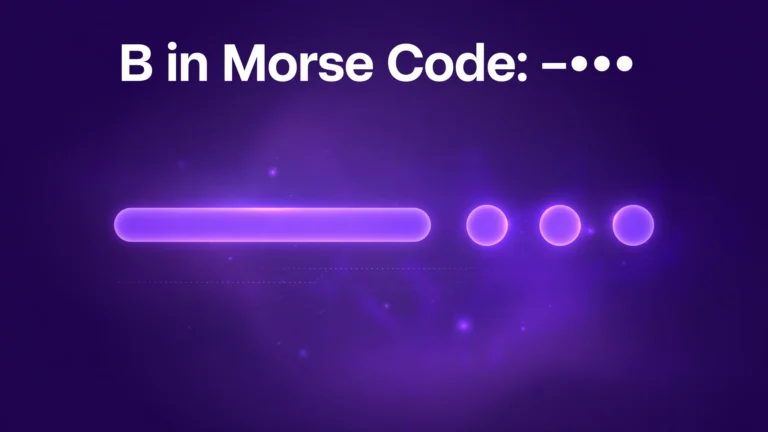
| B | -... | Dash then three dots — the mirror of H |
| I | .. | Two dots — the shortest letter pair with T |
| R | .-. | Dot-dash-dot — a neat, balanced rhythm |
| T | - | A single dash — the simplest letter of all |
| H | .... | Four dots again |
| D | -.. | Dash-dot-dot — the reverse of B’s rhythm |
| A | .- | Dot-dash again |
| Y | -.-- | Dash-dot-dash-dash, closing the word |
Notice how often the same letters repeat: P appears twice, H twice, A twice and Y twice. Once you know H, A, P, Y, B, I, R, T and D, you know the whole greeting. That is only nine distinct letters — a very manageable first project for anyone learning Morse code from scratch.
How to Remember the Pattern
Memorising thirteen letter patterns at once feels daunting, so break the greeting into small, rhythmic chunks. Morse operators have used memory tricks for generations, and the same techniques work for birthday wishes.
Learn it as rhythm, not as dots
Morse code is a sound language. Say each pattern out loud as “dit” for a dot and “dah” for a dash. “Happy” becomes dit-dit-dit-dit, dit-dah, dit-dah-dah-dit, dit-dah-dah-dit, dah-dit-dah-dah. Clap or tap the rhythm while you say it. Most people find the rhythm sticks far faster than the written symbols.
Chunk the words
Do not try to learn all thirteen letters in one go. Learn “happy” first — five letters — and practise it until it flows. Then learn “birthday” — eight letters — the same way. Only then join the two words together with the longer word gap. Short, repeated practice sessions of five minutes beat one long cramming session.
Use the double letters as anchors
The double P in “happy” is a gift: the same pattern twice in a row. Say “hap-py” and feel the repeated .--. .--.. The repeated H, A and Y in “birthday” work the same way. Anchoring on repeats cuts the amount you actually have to memorise almost in half.
Write it on the card first
If you are putting the code on a birthday card, write the dots and dashes under the English words first, then practise reading them aloud. Writing by hand engages a different kind of memory, and the card itself becomes a cheat sheet the birthday person can decode with a Morse code translator.
How to Send Happy Birthday in Morse Code
Knowing the pattern is only half the fun — sending it is the other half. Morse code works through any channel that can switch on and off: light, sound, touch or radio. The timing rules are the same everywhere.
The timing rules
- A dot lasts one unit of time.
- A dash lasts three units.
- The gap between dots and dashes inside one letter lasts one unit.
- The gap between letters lasts three units.
- The gap between words lasts seven units.
At a relaxed learning speed, one unit might be a fifth of a second. Speed matters less than consistency: steady, even timing is what makes a message readable. Radio amateurs measure speed in words per minute (WPM), but for a birthday greeting, slow and clear always beats fast and garbled.
By torchlight
A torch is the classic party trick. Short flash for a dot, long flash for a dash. Spell out the greeting across the room, or flash it at a window. This is also a genuine emergency signalling skill — the same technique, with the distress pattern SOS, is how stranded people have attracted rescue for over a century.
By tapping
Tap on a table, a wall or a glass: a light tap for a dot, a firmer knock for a dash. Tapping is wonderfully discreet — you can send a birthday greeting during a video call without saying a word, or tap it out on someone’s shoulder as a surprise. Children often love this version best, and it makes a charming introduction to the code for young learners — see our guide to Morse code for kids.
By sound
Whistle it, beep it on a phone app, or play it on a piano — one note, short or long. A birthday message beeped as a phone notification sound is a small surprise that lands well, and there are free Morse apps that will play any text you type, which is perfect for checking your timing before you perform it live.
Over the radio
Amateur radio operators still exchange greetings in Morse (CW) every day, and a birthday greeting sent over the air is a genuine tradition in the hobby. If you know a radio amateur, ask them to send it — or learn enough to send it yourself. The ham radio community has kept Morse alive for more than a century, and its friendly conventions, like sending “73” as a sign-off, are part of the charm. Read what 73 means in ham radio to understand the culture behind the code.
Happy Birthday in Morse Code for Cards, Texts and Gifts
The written code makes a lovely decorative element. Here are a few ideas that readers have used:
- Birthday cards: write the dots and dashes on the front and the translation inside — or leave the translation out and let the recipient decode it with an online translator.
- Text messages: send the code as a message:
.... .- .--. .--. -.-- -... .. .-. - .... -.. .- -.--. It looks mysterious, and decoding it becomes part of the gift. - Jewellery and crafts: Morse code bracelets, where beads stand for dots and dashes, are a popular handmade gift. The birthday pattern spells out in beads beautifully because it is long enough to look decorative.
- Cakes: pipe the dots and dashes in icing around the edge of a cake, or arrange candles in two groups — four short and one long — as a visual joke for a Morse fan.
- Social media: post the code as a caption and challenge friends to decode it. It works especially well as a story or reel where the reveal comes a beat later.
Pair it with other Morse greetings you already know: good morning, goodbye, please and thank you all follow the same letter-by-letter logic.
Common Mistakes to Avoid
A few errors trip up almost every beginner, and all of them are easy to fix once you know to watch for them.
- Rushing the word gap. The seven-unit pause between “happy” and “birthday” is the most commonly skipped timing. Without it, the listener hears one long jumble instead of two words.
- Making dashes too short. A dash must be clearly longer than a dot — three times as long. If your dashes are only slightly longer than your dots, the message becomes unreadable.
- Confusing P and Y. P is
.--.and Y is-.--— they are near-mirrors of each other. Say them aloud as rhythms until they feel different. - Mixing up B and D. B is
-...and D is-... One extra dot changes the letter entirely, so count carefully. - Forgetting the double P. “Hapy” is not a word. The double P is part of the charm — and the rhythm.
A Short History of Birthday Greetings in Code
Morse code itself dates to the 1830s and 1840s, when Samuel Morse and Alfred Vail developed the first practical electric telegraph system. By the late nineteenth century, telegraph operators were sending personal messages — including birthday greetings — across continents in minutes, something that had previously taken weeks by post. The code that carried those greetings is the same International Morse Code standardised by the ITU and still used by radio amateurs today.
Birthday messages were among the earliest personal telegrams, and telegraph offices even sold special greeting forms for the purpose. The tradition survived every new technology that followed: radio, telephone, text message. Sending “happy birthday” in Morse today connects a modern celebration to nearly two centuries of communication history — which is part of why it still feels special. Famous messages sent in Morse, from the first telegraph line to the Titanic’s distress calls, show just how much history this simple code carries — read more in our collection of famous messages in Morse code.
Try It Yourself
The fastest way to get confident is to practise with a live tool. Type “happy birthday” into the Morse code translator on our homepage, listen to the audio, and try to copy the rhythm. Then type your own name, or the name of the birthday person, and learn that too. A personalised greeting — their name in Morse, followed by “happy birthday” — is a gift no shop can sell.
Once the pattern feels comfortable, try sending it without looking at the chart. Then try receiving: have a friend tap it to you, slowly, and see if you can decode it. Sending and receiving are different skills, and both are worth practising.
Frequently Asked Questions
What is “happy birthday” in Morse code?
“Happy birthday” in Morse code is .... .- .--. .--. -.-- -... .. .-. - .... -.. .- -.--. “Happy” is .... .- .--. .--. -.-- and “birthday” is -... .. .-. - .... -.. .- -.--, with a longer pause between the two words.
How do you say happy birthday in Morse code with a torch?
Use short flashes for dots and long flashes for dashes: flash .... .- .--. .--. -.--, pause for seven dot-lengths, then flash -... .. .-. - .... -.. .- -.--. Keep the timing steady and the flashes clearly short or long.
Is there a Morse code birthday song?
There is no official Morse version of the “Happy Birthday” song, but the phrase itself is commonly tapped, flashed or beeped as a greeting. Some people tap the rhythm of the song’s melody in Morse timing as a playful variation — the dots and dashes follow the tune rather than the letters.
How long does it take to send “happy birthday” in Morse code?
At a relaxed learning speed of about 5 words per minute, the greeting takes roughly 25–30 seconds including the word gap. Experienced operators sending at 15–20 WPM can send it in under 10 seconds. For a birthday, slow and clear is better than fast.
Can I put Morse code on a birthday card?
Yes — it is one of the most popular uses of the code. Write the dots and dashes on the front of the card and either include the translation inside or leave it as a puzzle for the recipient to decode with an online Morse translator.
Conclusion
“Happy birthday” in Morse code — .... .- .--. .--. -.-- -... .. .-. - .... -.. .- -.-- — is a small skill with an outsized charm. It takes only nine letters to learn, it works by light, sound, touch or radio, and it turns an ordinary greeting into something memorable. Practise the rhythm a few minutes a day, try it on a card or by torchlight, and you will have a party trick — and a piece of living history — that you keep for life.
Ready for the next greeting? Learn good morning in Morse code or go back to the beginning and master the alphabet with our guide to how to learn Morse code fast.