
One is the first digit in the Morse code number series — and a perfect place to understand how all ten digits work. 1 in Morse code is one dot followed by four dashes: .—-, spoken as “di-dah-dah-dah-dah.” Once you see the pattern behind the digits, 1 stops being a shape to memorise and becomes the logical start of a rule you can apply to every number from 0 to 9.
In this guide you will learn how to send, hear and practise 1, how it anchors the famous five-signal digit pattern, where it shows up in real radio traffic and history, and how it differs from the letter A — a confusion that catches many beginners. Try each example as you read — Morse code is learned by ear and by hand, not just by eye. You can check any combination instantly with a Morse Code Translator.
What Is 1 in Morse Code?
In International Morse Code, the standard system standardised under the ITU (International Telecommunication Union), the digit 1 is represented by one dot and four dashes: .—-. A dot, or “dit,” is the shortest signal — one timing unit — while a dash, or “dah,” is about three units long. So 1 begins with a single short tap and finishes with four long, steady tones, each separated by a short gap.
Spoken rhythm is the fastest way to lock it in. Say it slowly out loud: di — dah — dah — dah — dah. The contrast between the short opening dot and the four long dashes is what makes 1 recognisable: no letter in the Morse alphabet sounds quite like it. Keep the four dahs even and unhurried — rushing the ending is the most common reason a listener copies something else entirely.
The Digit Pattern: Why 1 Is One Dot and Four Dashes
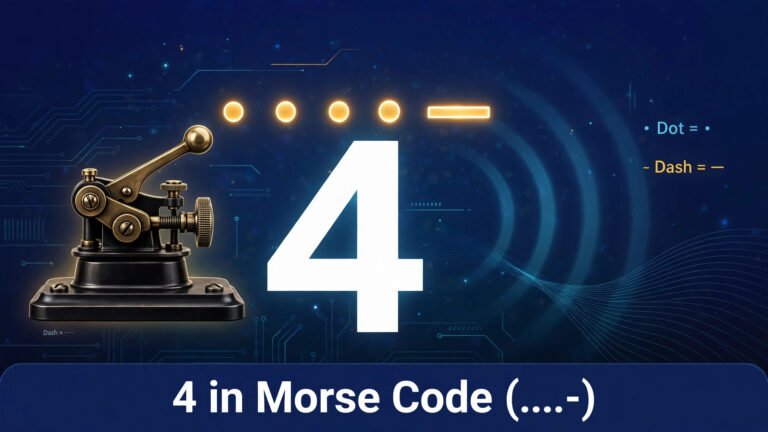
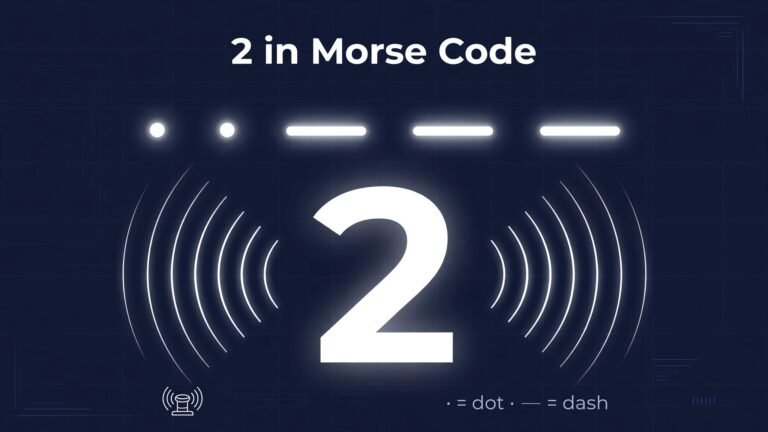
Morse digits follow a beautifully simple rule: every digit is exactly five signals, and the number of dots counts up from 1 to 5, then the pattern reverses. The digit 1 is the first step of that count — one dot, then four dashes to fill the five-signal frame. The digit 2 is two dots and three dashes (..—), 3 is three dots and two dashes (…–), 4 is four dots and one dash (….-), and 5 is five dots (…..). After 5, the dots are replaced by dashes one at a time: 6 is one dash and four dots (-….), 7 is two dashes and three dots (–…), 8 is three dashes and two dots (—..), and 9 is four dashes and one dot (—-.), with 0 closing the series as five dashes (—–).
One is the anchor of the first half of the pattern. If you learn “count the dots for 1–5,” you can work out 1, 2, 3, 4 and 5 without memorising them separately — and notice that 1 and 9 are mirror images: one dot plus four dashes versus four dashes plus one dot. That symmetry is not a coincidence; it is the design that made the code learnable for 19th-century telegraph operators, and it still makes it learnable today.
Full Morse Code Digits Table (0–9)
| Digit | Morse Code | Spoken Rhythm |
|---|---|---|
| 0 | —– | dah-dah-dah-dah-dah |
| 1 | .—- | di-dah-dah-dah-dah |
| 2 | ..— | di-di-dah-dah-dah |
| 3 | …– | di-di-di-dah-dah |
| 4 | ….- | di-di-di-di-dah |
| 5 | ….. | di-di-di-di-dit |
| 6 | -…. | dah-di-di-di-dit |
| 7 | –… | dah-dah-di-di-dit |
| 8 | —.. | dah-dah-dah-di-dit |
| 9 | —-. | dah-dah-dah-dah-dit |
Teachers often introduce 1 first in the digit series because the rule it demonstrates — count the dots — unlocks the rest. The standard digit codes are documented in the Morse code reference on Wikipedia and in the full Morse code chart, both worth bookmarking while you practise.
How Long Is One? Timing Explained
Timing is what turns dots and dashes on a page into a signal a listener can copy. The standard rules are simple: a dot is one unit, a dash is three units, the gap between signals inside one character is one unit, the gap between characters is three units, and the gap between words is seven units.
Count 1 out in units. One dot (1 unit) plus four dashes (12 units) plus the four one-unit gaps between signals gives 17 units. Compare that with the letter A (.-), which is only 8 units, and with the digit 5 (…..), which is 9 units. One is genuinely long — more than twice the length of the letter A — which is why radio operators developed a shortcut for it, covered below.
At a slow learning speed, 17 units feels long. That is normal, and it is helpful: the opening dot followed by a run of long tones is a distinctive shape. When you hear a short blip leading into four steady dahs, your brain can settle on 1 well before the character finishes.
How to Send 1 in Morse Code
You do not need expensive equipment to send the digit 1. With a telegraph key or practice oscillator, press briefly for the dot — a quick tap — then press and hold for each dash, roughly three times as long as the dot, keeping your wrist relaxed so the four dahs stay even. By sound, tapping or flashlight, use the same pattern: one short signal followed by four long ones, with brief pauses between them. The method changes; the timing does not.
Step-by-step practice drill
- Say “di-dah-dah-dah-dah” out loud five times, keeping the four dahs even and the opening di short.
- Tap the pattern on a table: one short tap, then four slow taps counted to three.
- Send “1” on its own, then in pairs: 1 1, 1 9, 9 1 (feel the mirror image).
- Send a short number containing 1, such as 11 or 21, and listen back if you can record yourself.
- Mix 1 with letters you already know — for example, send “A1” — so you learn to hear the digit in context, not only in isolation.
Examples: 1 in Real Numbers
One rarely travels alone. It usually appears inside a larger number, and reading whole numbers is the skill that matters. Here are some real-world examples, written out so you can practise them end to end:
- 1912 — .—- —-. .—- ..— (the year the Titanic sank — and the first year a distress call by wireless telegraphy was heard worldwide)
- 1969 — .—- —-. -…. —-. (the year humans first landed on the Moon)
- 911 — —-. .—- .—- (the US emergency number — digits 9, 1, 1)
- 2026 — ..— —– ..— -…. (the current year, a great practice string)
- 11 — .—- .—- (two ones — notice the three-unit pause between the two characters)
Notice the spacing: inside a character, signals are separated by one unit, but between characters the gap is three units. That longer pause tells the listener one digit has ended and the next has begun. When you practise, exaggerate it slightly — it feels slow, but it makes your sending far clearer.
1 vs A: The Classic Beginner Mistake
The most common confusion for beginners is between the digit 1 (.—-) and the letter A (.-). They share the same opening dot, so at speed a rushed 1 can sound like a drawn-out A. But the difference is simply counting: A is dot-dash and done, while 1 keeps going with three more dahs after the dash. In a message, context usually resolves any remaining doubt — a string of digits in a year, frequency or score is far more likely to contain 1 than the letter A.
Send the full five signals every time. Cutting 1 short is the single biggest cause of mis-copies in the digit series, because the ear latches onto the familiar A and stops listening. If you have been working through the alphabet series, comparing A side by side with 1 is a useful ear-training exercise. The same counting discipline applies to every character, from the digit series to letters like Z in Morse Code — a character whose zigzag pattern rewards the same careful listening.
Cut Numbers: The Shortcut Radio Operators Use
Because 1 takes 17 units — long for such a common digit — experienced operators often shorten it in fast traffic. In “cut numbers,” several dashes are reduced to a single dash, so 1 is sent as A (.−): one dot, one dash. The digit 9 is similarly cut to N (−.), so the classic contest exchange “599” is sent as “5NN.”
This is a convention, not a second official code: it only works when both sender and receiver already know that numbers, not letters, are being sent. Beginners should learn the full one-dot-four-dash 1 first and treat cut numbers as advanced shorthand to recognise later, not as a replacement. If you send “A” where a beginner expects a digit, your number will be copied as a letter and the exchange will be wrong. Learn the standard, then learn the shortcut — in that order.
Where 1 Appears in Real Morse Code Use
One shows up wherever numbers matter, which is almost everywhere in radio life. Amateur radio operators send frequencies, signal reports, contest exchanges, call signs and grid locators full of ones — call signs in many countries begin with a single digit, and a signal report of “599” is the heartbeat of CW contesting. Years, dates and times all depend on 1 being copied correctly.
Historically, the digit arrived with the numbers themselves. Samuel Morse and Alfred Vail designed the original American code in the 1830s and 1840s, and the International Morse Code that followed standardised digits alongside letters. By the early 20th century, numbers travelled by wireless telegraphy in ship traffic, railway messages and military communications — the Titanic’s 1912 distress call is the most famous example of Morse digits reaching the world at a moment of crisis. The ITU later formalised the code, which is why the digit 1 is identical in every country today.
Tips to Remember 1 in Morse Code
- Count the dots: digits 1–5 simply count their dots — one dot means 1. The pattern does the memorising for you.
- Feel the mirror: 1 (.—-) and 9 (—-.) are exact mirrors. Learn them as a pair and both stick.
- Listen for the short opening: no letter starts “di-dah-dah-dah-dah.” That opening dot followed by four dahs is a unique signature.
- Practise in real numbers: years (1912, 1969, 2026), phone numbers and emergency numbers all contain ones — send a few every day.
- Never cut it short: send all five signals. Stopping at “.-” turns your digit into the letter A.
Frequently Asked Questions
What is 1 in Morse code?
1 in Morse code is one dot and four dashes: .—-, spoken as “di-dah-dah-dah-dah.” It is the first digit of the five-signal digit pattern, lasting 17 timing units.
How do you say 1 in Morse code?
Speak it as “di-dah-dah-dah-dah”: one short “di” followed by four long “dah” sounds. Radio operators sometimes shorten it to “A” (.−) in fast cut-number traffic, but learners should use the full code.
What is the difference between 1 and A in Morse code?
The letter A is dot-dash (.-) while the digit 1 is dot-dash-dash-dash-dash (.—-). Count the signals after the opening dot: one means A, four means 1. Context also helps — years and frequencies contain digits, not letters.
Why do all Morse code digits have five signals?
The five-signal design makes digits regular and easy to learn: the number of dots rises from 1 to 5, then dashes take over from 6 to 9, with zero as five dashes at the end. Every digit takes the same number of signals, even though their durations differ.
How can I practise 1 in Morse code?
Say “di-dah-dah-dah-dah” aloud, tap it, send it with a practice key or flashlight, and then practise real numbers such as 1912, 911 and 2026. Mixing 1 with its mirror image 9 builds recognition faster than drilling it alone.
Conclusion
One in Morse code is one dot and four dashes — the first step of the digit pattern that makes every number from 0 to 9 predictable. Learn it as the dot-counting anchor of the series, practise it inside real years and emergency numbers, and send all five signals so it never collapses into the letter A. With 1 mastered, the rest of the series follows the same rule: count the dots, count the dashes, and the pattern does the rest. Keep practising a little every day, and the short-then-long signature of 1 will soon feel as natural as the dots and dashes you already know.