What Is 4 in Morse Code?
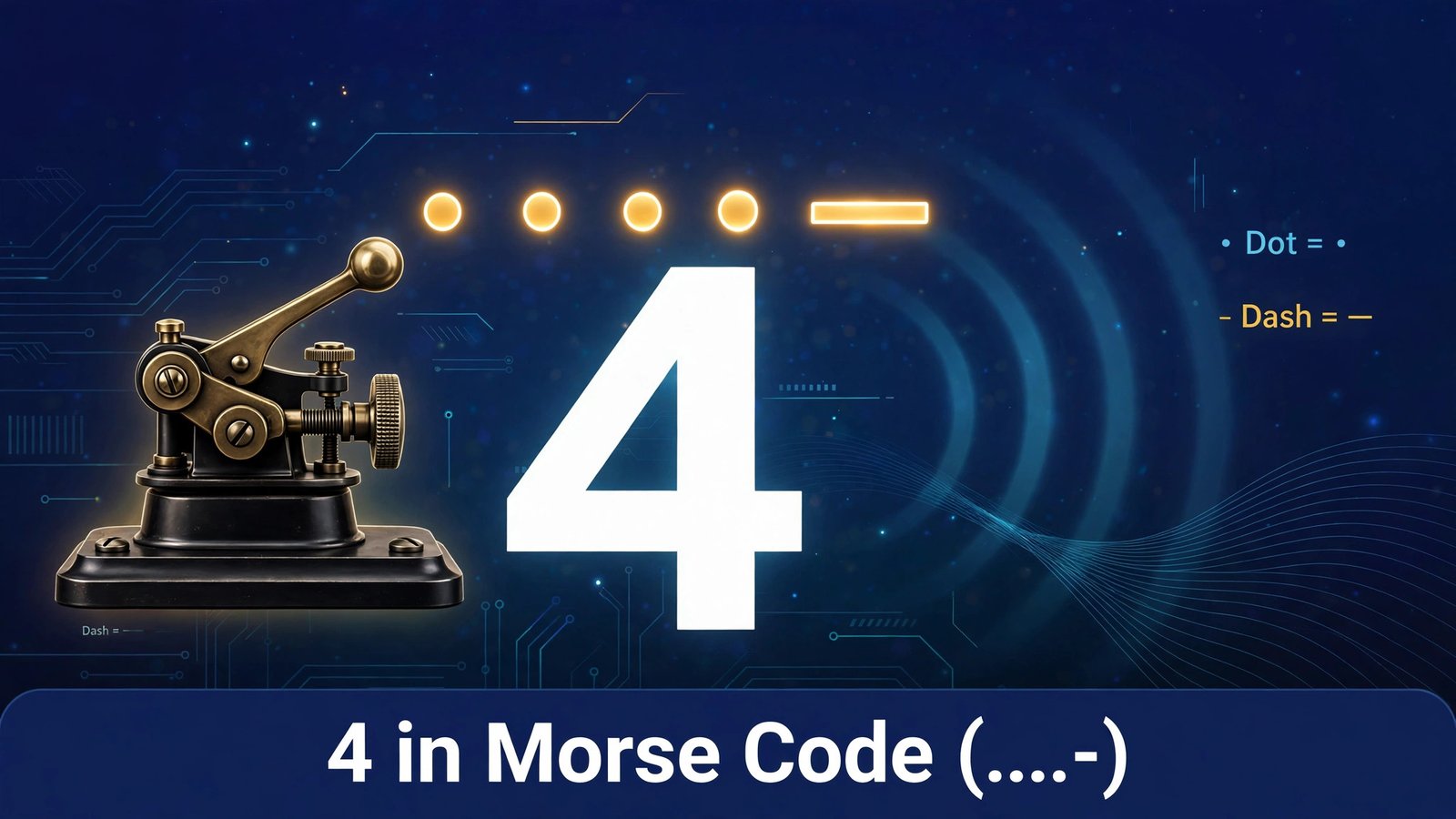
The number 4 in Morse code is ….- — four dots followed by one dash. In spoken shorthand, operators read it as “di-di-di-di-dah,” with each element separated by a short pause so the receiver can tell the four quick dots apart from the final long dash.
Like all Morse numerals, the code for 4 is exactly five elements long. That five-element structure is one of the smartest design decisions in International Morse Code: with five dits and dahs to work with, every digit from 0 to 9 gets a unique, rhythmically distinct pattern that sounds unmistakable even through static.
| Digit | Morse code | Spoken rhythm |
|---|---|---|
| 4 | ….- | di-di-di-di-DAH |
How to Read ….- : The Timing Rules
Sending Morse by eye is one thing; sending it so someone else can decode it is another. The timing rules standardized by the ITU (International Telecommunication Union) are what make ….- sound like the number 4 instead of a random rattle of clicks:
- A dot (dit) lasts one time unit.
- A dash (dah) lasts three time units.
- The gap between the elements of a single character is one unit.
- The gap between complete characters is three units.
- The gap between words is seven units.
So ….- is: dit (pause) dit (pause) dit (pause) dit (pause) — longer dah. Practice it slowly at first, then build speed. You can type it into our free Morse Code Translator to hear exactly what it should sound like and check your own tapping against the correct audio.
How to Remember 4 in Morse Code: The Counting Trick
Here is the easiest memory hook in all of Morse code, and it is no accident — Samuel Morse and Alfred Vail designed the numerals this way. For the digits 1 through 5, the number of dots at the start of the pattern equals the digit itself:
| Digit | Code | Memory rule |
|---|---|---|
| 1 | .—- | one dot |
| 2 | ..— | two dots |
| 3 | …– | three dots |
| 4 | ….- | four dots |
| 5 | ….. | five dots (no dashes at all) |
Digits 6 through 0 mirror the pattern from the other end: they begin with dashes, and the count of dots at the end tells you how far past 5 you are. So once you know that 4 = “four dots then a dash,” the whole set of numerals unlocks with barely any extra memorization.
A second mnemonic some learners use: the word “four” has four letters, and the code starts with four dots. Say “four-dots-then-dash” out loud a few times while tapping it, and the pattern sticks within minutes.
The Complete Morse Code Numbers Chart (0–9)
Learning 4 is faster when you see it in its natural family. Here is every numeral in International Morse Code — notice the elegant 1–5 / 6–0 symmetry:
| Digit | Morse code | Digit | Morse code |
|---|---|---|---|
| 0 | —– | 5 | ….. |
| 1 | .—- | 6 | -…. |
| 2 | ..— | 7 | –… |
| 3 | …– | 8 | —.. |
| 4 | ….- | 9 | —-. |
Our number-by-number series already covers 0, 1, 2 and 3 in Morse code with the same send-it, hear-it, remember-it format — perfect if you are working through the digits in order.
4 in Ham Radio and Real-World Use
Amateur radio operators send numbers constantly, so ….- is one of the most-heard patterns on the HF bands. A few places you will meet it:
- Call signs: many call signs contain a digit — a “4-land” call sign (W4, K4, N4) belongs to the southeastern United States, and operators send that ….- dozens of times per session.
- Signal reports: the RST system (Readability, Strength, Tone) rates contacts on a 1–9 scale, so a report like “579” ends in …– and a “449” ends in ….-.
- Contests: during popular contests like CQ WW, operators exchange serial numbers (“….- ….- ….-” for contact number 444) at 25+ words per minute, and the four-dot opening of ….- is instantly recognizable.
- Frequencies: reading out a frequency such as 14.074 MHz means sending ….- twice.
At contest speed, experienced operators stop counting dots and dashes entirely — ….- becomes a single rhythmic “sound shape,” the way a fluent reader sees a whole word instead of individual letters. That is the real goal of practice: pattern recognition, not counting.
Emergency Signaling: Where Numbers Matter
The most famous Morse distress pattern remains SOS in Morse code (… — …), but numbers play a quiet supporting role in emergency communication. Coordinates, casualty counts, frequencies and times are all sent as numerals, and in a noisy, high-stress situation the crisp five-element patterns — including ….- — cut through interference better than spoken words. This is one reason Morse proficiency is still taught in some military and maritime training programs: when voice fails, ….- and its siblings still get through.
Why the Numbers Look Like This: A Short History
The five-element numerals were not part of Samuel Morse’s original 1830s code. Morse’s first design assigned the shortest patterns to the most common letters — a brilliant frequency-based idea — but numbers were an afterthought, sent as spelled-out words. It was Alfred Vail, Morse’s partner and the true architect of the code’s timing system, who helped systematize the dot-dash patterns, and the 1844 Baltimore–Washington telegraph line proved the design in real traffic.
The digits were later regularized into the elegant 1–5/6–0 symmetry we use today, and the ITU standardized International Morse Code in 1865 at the Paris telegraph conference. That is why ….- works identically whether it is keyed by a ham in Ohio, flashed by a sailor, or decoded by a smartphone app: 160 years of continuous use have made the numeral patterns one of the most durable signaling systems ever invented. You can hear how little has changed — the rhythm of ….- on a modern practice oscillator is the same rhythm a Civil War telegrapher would have recognized.
Practice: Send and Decode ….-
Try these three quick drills. Each takes under two minutes:
- Tap it back: knock ….- on a table — four quick taps, a short pause, one long press. Repeat five times, keeping the dash clearly longer than the dots.
- Flashlight drill: in a dark room, flash four short blinks and one long flash. Have someone else decode it.
- Speed ladder: send the sequence 1-2-3-4-5 (.—- ..— …– ….- …..) and listen to how each pattern grows by exactly one dot. Then try 5-4-3-2-1 in reverse.
Then decode this mini-message (each group is one digit): ….- —– ….- ….. — that spells 4-0-4-5. Run it through the Morse Code Translator to check your answer instantly.
FAQ: 4 in Morse Code
What is 4 in Morse code?
4 in Morse code is ….- — four dots followed by one dash, spoken as “di-di-di-di-dah.”
How do you remember ….- easily?
Count the dots: for digits 1–5, the number of leading dots equals the digit. Four dots means 4. The mirror rule covers 6–0 (leading dashes, trailing dots).
How do you type 4 in Morse code on a keyboard?
Type four periods followed by one hyphen: ....-. Our Morse Code Translator accepts this directly and plays the correct audio.
Is ….- the same in American and International Morse code?
Essentially yes for the numeral 4. The old American (railroad) Morse code differed mainly in letter patterns and intra-character spacing; the digits 0–9 in modern International Morse Code are the universal standard used by amateur radio, aviation and maritime services worldwide.
What comes after 4 in the numbers series?
5 is ….. — five dots, the only numeral with no dashes at all. Then the pattern mirrors: 6 is -…., 7 is –…, 8 is —.., 9 is —-., and 0 is —–.
Conclusion
4 in Morse code (….-) is one of the friendliest patterns to learn: four dots, one dash, and a counting trick that teaches you half the numerals at once. Tap it, flash it, and send it through the Morse Code Translator until the rhythm feels automatic — then keep going with 5 through 9 and the full alphabet series. Every pattern you master makes the next one easier.