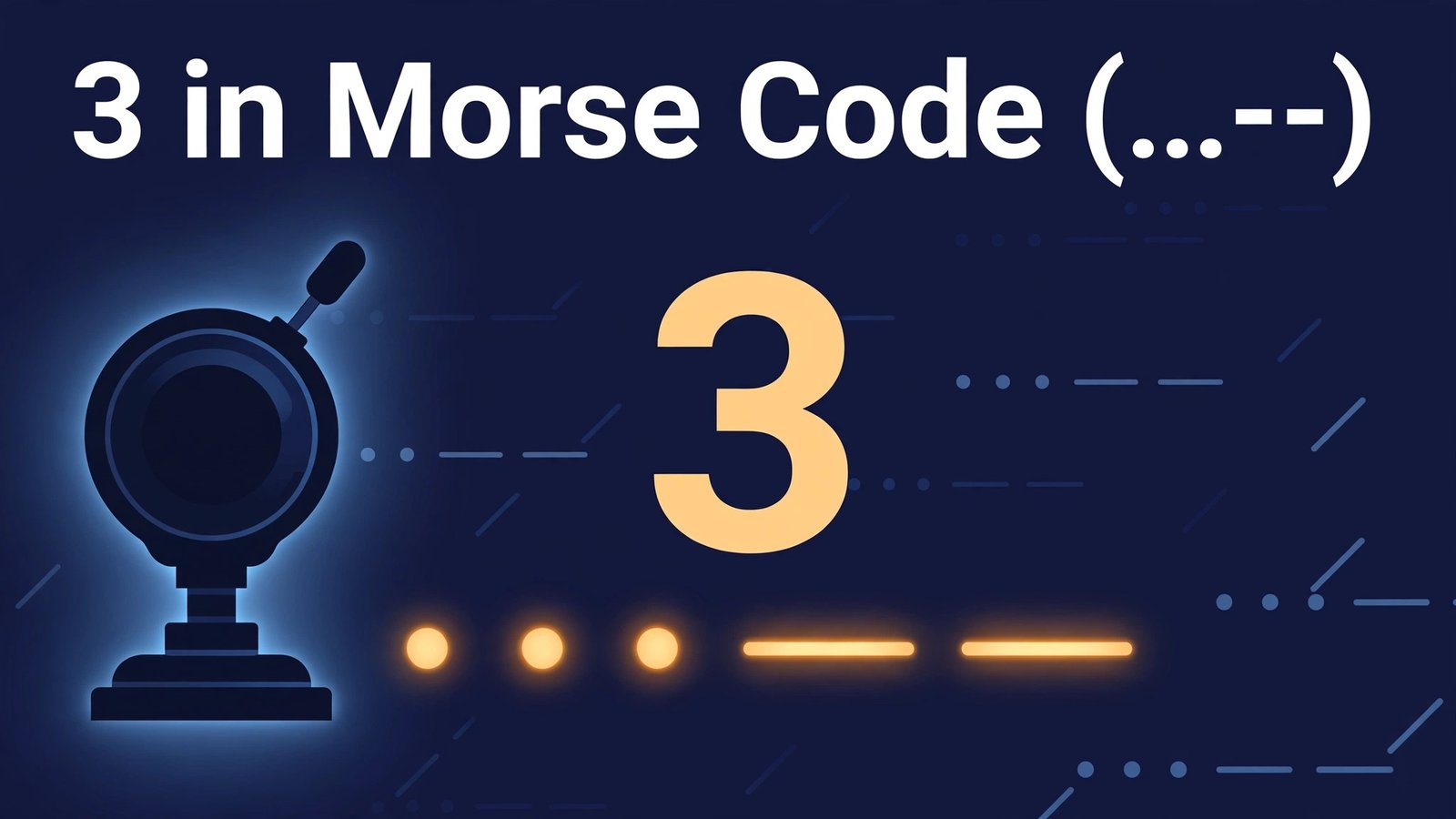
The number 3 in Morse code is written as …– — three short dots followed by two long dashes. It is one of the most satisfying number patterns to learn, because it sits right at the balance point of the number system: enough dots to count on one hand, enough dashes to feel the rhythm of longer signals. In this guide you will learn exactly how to send …– with a key, buzzer, flashlight, or whistle, why the pattern looks the way it does, and how the number 3 appears in real-world Morse practice, from contest exchanges to emergency signaling.
What is 3 in Morse code?
In International Morse Code, every number 0–9 uses exactly five signal elements, and the number 3 is …– (dot-dot-dot-dash-dash). The five-element structure comes from a brilliant piece of 19th-century design: numbers are the reverse of each other around the midpoint. Look at the full table:
| Number | Morse code | Pattern |
|---|---|---|
| 1 | .—- | 1 dot, 4 dashes |
| 2 | ..— | 2 dots, 3 dashes |
| 3 | …– | 3 dots, 2 dashes |
| 4 | ….- | 4 dots, 1 dash |
| 5 | ….. | 5 dots |
| 6 | -…. | 1 dash, 4 dots |
| 7 | –… | 2 dashes, 3 dots |
| 8 | —.. | 3 dashes, 2 dots |
| 9 | —-. | 4 dashes, 1 dot |
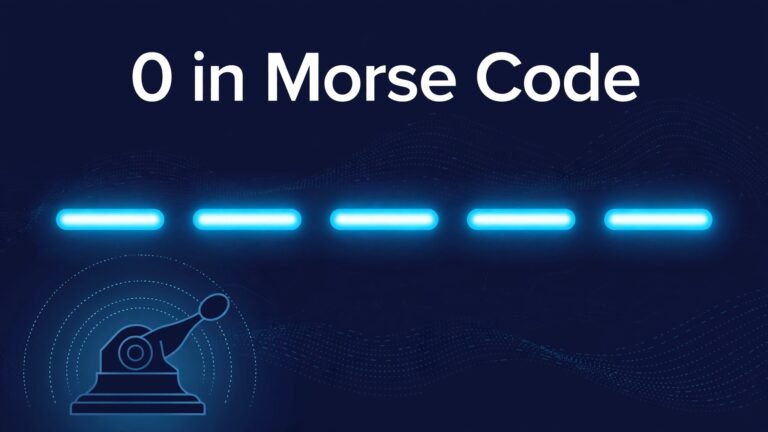
| 0 | —– | 5 dashes |
The pattern is perfectly symmetrical: count the dots in …– (three) and you have the number itself; count the dashes in —-. for 9 and you get six — which is 9 mirrored. This regularity is deliberate. When Samuel Morse and Alfred Vail built the first practical American telegraph system in the 1840s, they needed operators who could memorize and copy code at speed. Regular, predictable number patterns were far easier to teach than arbitrary ones. The system was later standardized internationally by the ITU as International Morse Code, the version every radio amateur still learns today.
You can try sending …– on our free Morse code translator to hear exactly how the three dots and two dashes sound at your own pace.
How to send 3 in Morse code
Sending …– correctly is about timing, not just order. The four timing rules of Morse code are:
- Dot — one unit of time
- Dash — three units of time
- Gap between dots and dashes inside one character — one unit
- Gap between characters — three units (crucial for “3” since numbers appear in groups)
At 20 words per minute, one unit lasts about 60 milliseconds, so …– sounds like: dit-dit-dit-DAH-DAH — roughly 1.3 seconds of sound with the tiny internal gaps. Practice saying the rhythm out loud before you touch a key; many instructors recommend vocalizing every pattern for a week before copying it by ear.
On a straight key
Tap the knob lightly three times for the dots, then hold it down firmly twice for the dashes. Keep your wrist straight and let the motion come from your fingers and hand — never your whole arm. Beginners tend to rush the dots and drag the dashes; a metronome app set to a slow tempo helps lock in the 1:3 ratio.
With a flashlight or signal lamp
Flashlight Morse is still taught in scouting and survival courses. Three quick blinks, then two long holds, then a dark pause. At night, a phone flashlight is visible for a surprisingly long distance. If you want a quieter no-light method, two fingers tapped on a table work the same way — tap-tap-tap, then two long presses.
With a buzzer or whistle
Whistle blasts carry through wind and foliage better than shouting. Three short peeps followed by two long ones is the standard way to signal the number 3 in emergency drills. Three blasts alone is the internationally recognized distress signal — a fact worth knowing so you never confuse signaling a number with calling for help.
How to memorize …– fast
The fastest memorization method for numbers exploits the same symmetry the designers built in. Two mnemonics used in amateur-radio license classes:
- Count the dots: numbers 1–5 start with dots. The number of dots is the number. Three dots = 3. This works for …– instantly.
- Opposites: 3 (…–) and 7 (–…) are exact mirrors — dots and dashes swap places. Learn them as a pair.
The Koch method — learning at full speed with two characters and adding more only at 90% accuracy — is the gold standard for sound-based learning. If you prefer visual learning, write …– on a flashcard with the digit 3 and test yourself both directions: digit → code and code → digit. Most learners lock in all ten numbers within a week of daily ten-minute sessions.
We covered the earlier numbers in this series — see 2 in Morse code (..—), 1 in Morse code (.—-), and 0 in Morse code (—–) — for practice drills that build on one another.
Where you will actually see 3 used in Morse code
Amateur radio contests
Contest exchanges almost always contain numbers. The classic exchange “599” (a signal report meaning perfectly readable, extremely strong, perfect tone) is sent with abbreviated numbers in many contests — but in the famous CQ World Wide DX contest, serial numbers climb into the hundreds and thousands, so patterns like …– are heard constantly. Experienced operators recognize number patterns by sound without consciously decoding, a skill called “instant recognition” that takes most hams about a year of regular operation to develop.
Emergency and survival signaling
As noted above, three blasts or flashes are the universal distress call in the wild. That meaning predates and overrides the number use: in a survival context, any group of three short signals is read as “I need help” before it is read as a digit. Knowing this distinction is part of responsible Morse practice.
Maritime and aviation history
Before voice radio took over, Morse was the language of the sea. Call signs like the famous SOS (…—…) — three dots, three dashes, three dots — are built from the same elements as …–. Maritime distress traffic in the early 20th century, including the Titanic’s signals in 1912, was sent by trained Marconi operators using exactly the timing rules described above.
Countdowns and everyday play
Teachers and parents love Morse countdowns — tapping …– ..— .—- (3-2-1) before a game or launch is a fun classroom trick that sneaks number patterns into children’s memory. It pairs beautifully with learning the letter A in Morse code (.-) as a first letter, since both use simple dot-dash combinations.
Common mistakes when sending or reading …–
- Running it into the next character: without the three-unit letter gap, …– can blur into a neighboring pattern. Pause deliberately after the final dash.
- Uneven dashes: both dashes should be the same length. A short-long dash pair still decodes, but it sounds sloppy and slows down the operator copying you.
- Confusing it with …-. (F) or …- (V): …– shares its first four elements with V (…-) and its first three with F (…-.); only the full five elements make a number. Count every element.
- Confusing it with 7 (–…): the mirror pair. If you hear dashes first, it is 7, not 3.
Frequently asked questions
What is 3 in Morse code?
The number 3 is …– in Morse code: three dots followed by two dashes. Like all Morse numbers, it uses exactly five signal elements.
How do you tap out 3 in Morse code?
Tap three quick dots (tap-tap-tap), then two long dashes. On a table: tap-tap-tap, then two firm presses, each about three times as long as a tap.
Is …– the same in American and International Morse code?
Yes. The number patterns are identical in American Morse (the original railroad code) and International Morse Code. The differences between the two systems affect some letters and punctuation, not the numbers. The history of Morse code on Wikipedia traces how the ITU standardized these patterns in the 19th century.
How long should the dashes in …– be?
A dash is three times the length of a dot, with one-unit gaps between elements. So …– at 20 words per minute is: 1-1-1-3-3 units with tiny pauses between.
Why do all Morse numbers have five elements?
The five-element structure creates the dot/dash symmetry that makes numbers easy to memorize (1–5 start with dots, 6–0 with dashes) and easy to distinguish from letters, which use one to four elements. It was a deliberate design choice by Morse and Vail for operator speed and reliability.
Keep practicing
The number 3’s …– is a confidence-builder: once it clicks, the whole number system usually follows within days. Continue the series with 0 in Morse code if you started from the top, or practice translating any text into code with our free Morse code translator — paste a phone number and hear how …– sounds inside real digit groups.