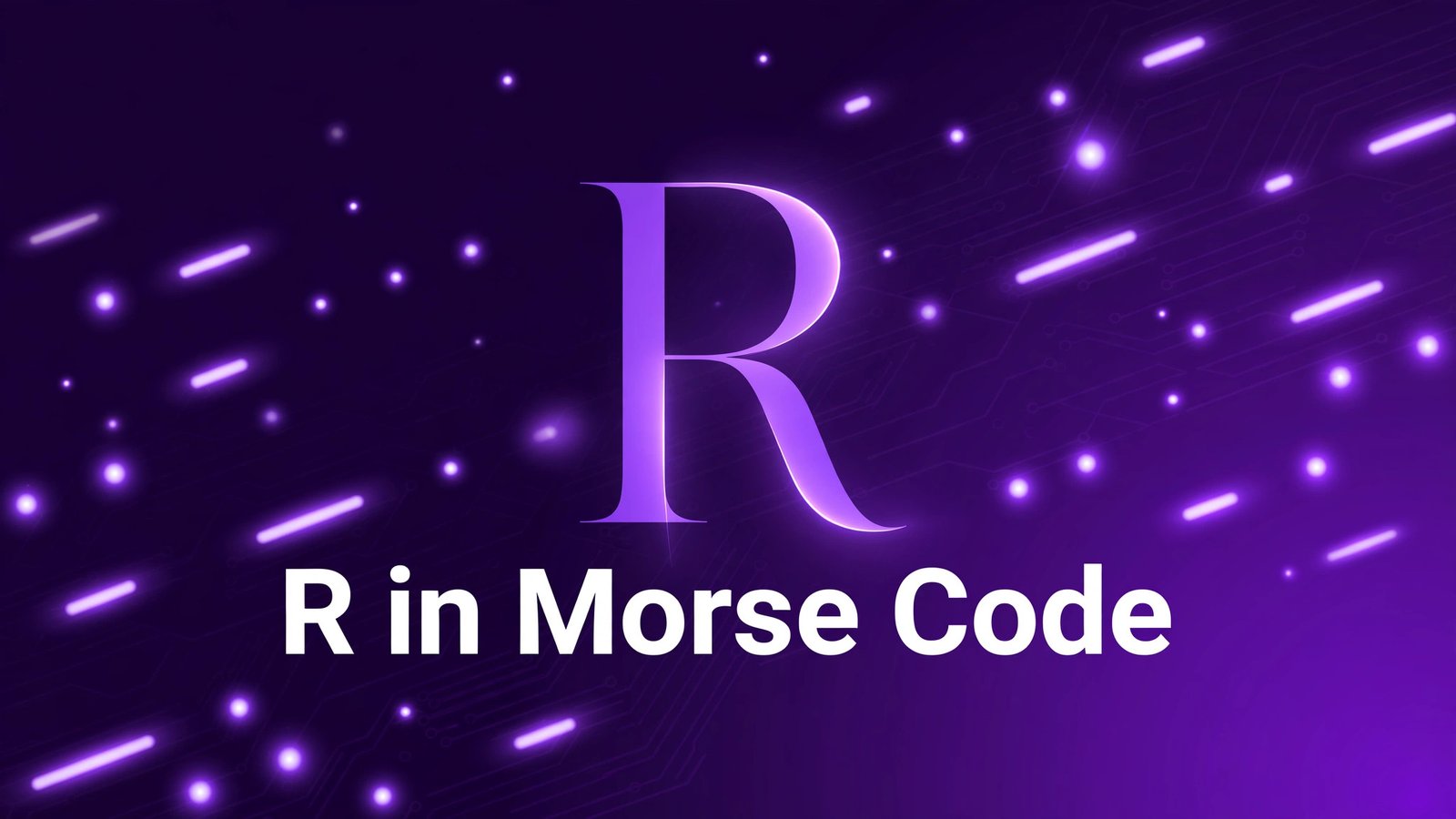
The letter R in Morse code is ·−· — a short dot, a long dash, then a short dot. Operators say it as “di-dah-dit”, and it is one of the most recognisable three-signal letters in International Morse Code, the system standardised by the International Telegraph Union (the ancestor of today’s ITU) in 1865. Whether you are learning the code for amateur radio, emergency signalling, or simple curiosity, R is worth memorising properly — its middle dash is the only thing separating it from S (···), and mixing the two up is one of the classic beginner mistakes. This guide covers the exact signal, the timing rules that make it readable, how it sounds, how to send it with a torch, a buzzer or a radio key, and how R is actually used on the air.
What is R in Morse code?
Here is the letter R broken down into its elements:
| Letter | Morse code | Signals | Spoken as |
|---|---|---|---|
| R | ·−· | dot – dash – dot | di-dah-dit |
Notice the pattern: R starts and ends with a short signal, with a single long signal in the middle. Because shorter codes were given to the most frequent letters — E is a single dot (·), T a single dash (−) — R’s three-element code tells you it was considered moderately common by the code’s designers. Morse code is case-insensitive, so ·−· means both uppercase R and lowercase r; there is no separate code for capitals.
If you want to see where R sits among the rest of the alphabet, our complete Morse code alphabet chart lists every letter, number and punctuation mark in one place.
How “R” sounds: di-dah-dit
Experienced operators strongly recommend learning letters by their sound, not by counting dots and dashes on paper. On the radio, R arrives as a quick rhythm: dit-DAH-dit — a short beep, a beep three times as long, and a final short beep, all run close together.
A useful way to burn it into memory is to compare it with its neighbours:
- R = di-dah-dit (·−·) — dot, dash, dot
- S = di-di-dit (···) — all three signals short
- K = dah-di-dah (−·−) — the mirror image: long, short, long
Hearing the three side by side trains your ear to catch that middle dash — the single detail that turns an S into an R. The ARRL, the American amateur radio association, has long advised beginners to learn the sound of each character as one unbroken rhythm rather than as a sequence of parts.
The timing rules behind ·−·
Morse code only works because every operator follows the same timing. The whole system is built on one unit of time — the length of a single dot. Everything else is a multiple of it:
| Element | Duration | Applied to R |
|---|---|---|
| Dot (dit) | 1 unit | The first and last signals of R |
| Dash (dah) | 3 units | The middle signal of R |
| Gap within a letter | 1 unit of silence | Between the dot, dash and dot of R |
| Gap between letters | 3 units of silence | After finishing R, before the next letter |
| Gap between words | 7 units of silence | After a word ending in R |
So sending R takes 1 + 1 (gap) + 3 + 1 (gap) + 1 = 7 units of signal and silence combined. At 20 words per minute — a comfortable receiving speed for a learner — one unit lasts about 60 milliseconds, so the whole letter takes well under half a second. Speeds are conventionally measured in words per minute (WPM) using the standard word “PARIS”, which takes exactly 50 units to send.
How to send R in Morse code
You can practise R with almost anything that switches on and off. Three methods cover most learners:
1. With a torch or phone light
A quick flash (dot), a flash held three times as long (dash), then another quick flash — keeping a one-unit pause of darkness between each. Torches are the classic emergency method because light travels line-of-sight and needs no equipment beyond the lamp. Try spelling simple words containing R, like “ROAR” (·−· −−− ·−·) or “ART” (·− − ·−·), slowly at first.
2. With a buzzer, app or online key
Audio practice is closer to real radio work. Press or tap for a short tone (dit), hold for the longer tone (dah), and release briefly between. The fastest way to hear perfectly timed R is to type it into a free Morse Code Translator tool and play the audio back — you will hear exactly how the three signals should run together at a consistent speed, which is the habit you want your own sending to copy.
3. With a straight key on the radio
Amateur radio operators learning CW (continuous wave, the mode used for Morse on air) usually start on a straight key: press down briefly for the dot, hold three times longer for the dash, and lift for one unit between the elements. R is an excellent early keying drill because the dot-dash-dot motion teaches you to switch cleanly between short and long presses without rushing the gaps.
R vs K vs S: the letters learners mix up
R’s neighbours on the code chart cause the most confusion. Keep this table handy until the differences feel automatic:
| Letter | Code | Pattern | Memory aid |
|---|---|---|---|
| R | ·−· | short – long – short | A dot “sandwich” with a dash filling |
| K | −·− | long – short – long | The mirror image of R — dash sandwich |
| S | ··· | short – short – short | Same as R but the middle signal is short |
| L | ·−·· | short – long – short – short | R with an extra dot on the end |
Two other confusions are worth clearing up. R is not the same as the NATO phonetic word “Romeo”. “Romeo” is how voice operators say the letter R on a phone or voice radio so it cannot be misheard; ·−· is how the letter R is keyed in Morse. They belong to different systems, though both identify the same letter. And if you are working through the alphabet in order, compare R with its chart neighbour Q in Morse code (−−·−) — the two share a rhythm family but Q opens with two dashes where R opens with a dot.
The letter R on the radio: “roger” and received
In amateur radio procedure, a single sent R (·−·) is shorthand for “received” — the famous “roger”. When a station copies your transmission correctly, replying with one R confirms it, which is why the letter punches above its weight in on-air use. You will hear it constantly in CW contacts, contest exchanges and emergency nets.
This procedural role is also why R is a favourite early letter for new hams: it is short, rhythmic, and immediately useful the first time you get on the air. Our guide to O in Morse code ( −−− ) covers another letter with a starring on-air role, as the backbone of the SOS distress signal.
A little history: how R got its code
The ·−· code for R comes from International Morse Code, but the story starts earlier. In the 1830s and 1840s, Samuel Morse and his collaborator Alfred Vail developed an early American version of the code for the electric telegraph; Vail keyed the famous first US telegraph message, “What hath God wrought”, over the Washington–Baltimore line in 1844.
The American code had quirks — including different lengths of dash and gaps inside letters — that made it error-prone. A cleaner variant developed for German railways in 1848 spread across Europe, and in 1865 the International Telegraph Conference in Paris adopted it as the single international standard. The codes we use today, including ·−· for R, descend from that 1865 standard, which the ITU still maintains. So when you send R, you are keying a pattern agreed upon more than 160 years ago — and still recognised worldwide.
How to practise R until it sticks
- Learn by sound from the start. Listen to R at full speed rather than counting dots on paper. The Koch method — learning two letters at full speed, adding more only when you copy 90% correctly — builds this habit from day one.
- Drill R against S and K. Have a practice app or partner send random R, S and K characters and write down what you hear. The contrast cements the middle dash in your ear.
- Keep sessions short. Ten to fifteen focused minutes beats an hour of tired copying. Stop when your accuracy drops; fatigue teaches mistakes.
- Send as well as receive. Keying R yourself on a practice oscillator or a translator tool’s playback teaches the dot-dash-dot motion and the one-unit gaps, which makes recognising it far easier.
- Use it on the air early. Sending a single R to acknowledge a contact is real-world practice — and every ham remembers their first “roger”.
Frequently asked questions
What is R in Morse code?
R in Morse code is ·−· — dot, dash, dot. It is spoken as “di-dah-dit” and is the same in International Morse Code everywhere in the world.
How do you tap out R in Morse code?
Tap once briefly (dot), pause for one unit, tap and hold three times as long (dash), pause for one unit, then tap once briefly (dot). The whole letter takes 7 timing units including the internal gaps.
What does a single R mean in ham radio?
A single sent R (·−·) means “received” — the origin of the voice-radio word “roger”. Operators use it to acknowledge that a transmission was copied correctly.
Is R the same as “Romeo” in Morse code?
No. “Romeo” is the NATO phonetic alphabet word for the letter R, used on voice radio to avoid mishearing. ·−· is the Morse code signal for the same letter. They are two different systems identifying one letter.
How is R different from S in Morse code?
R is ·−· (dot-dash-dot) while S is ··· (dot-dot-dot). The only difference is the middle signal: a long dash in R, a short dot in S. That middle dash is the detail to listen for.
Conclusion
The letter R is a small pattern with an outsized role: ·−· is quick to send, easy to recognise once you listen for the middle dash, and doubles as the on-air acknowledgement every radio operator uses daily. Master its timing — one unit, three units, one unit, with single-unit gaps — and you have a template for dozens of other three-signal letters. Then put it to work: hear it played back on a Morse Code Translator, drill it against S and K, and look up the rest of the letters on the Morse code alphabet chart as you build out the full set.