What Is N in Morse Code?
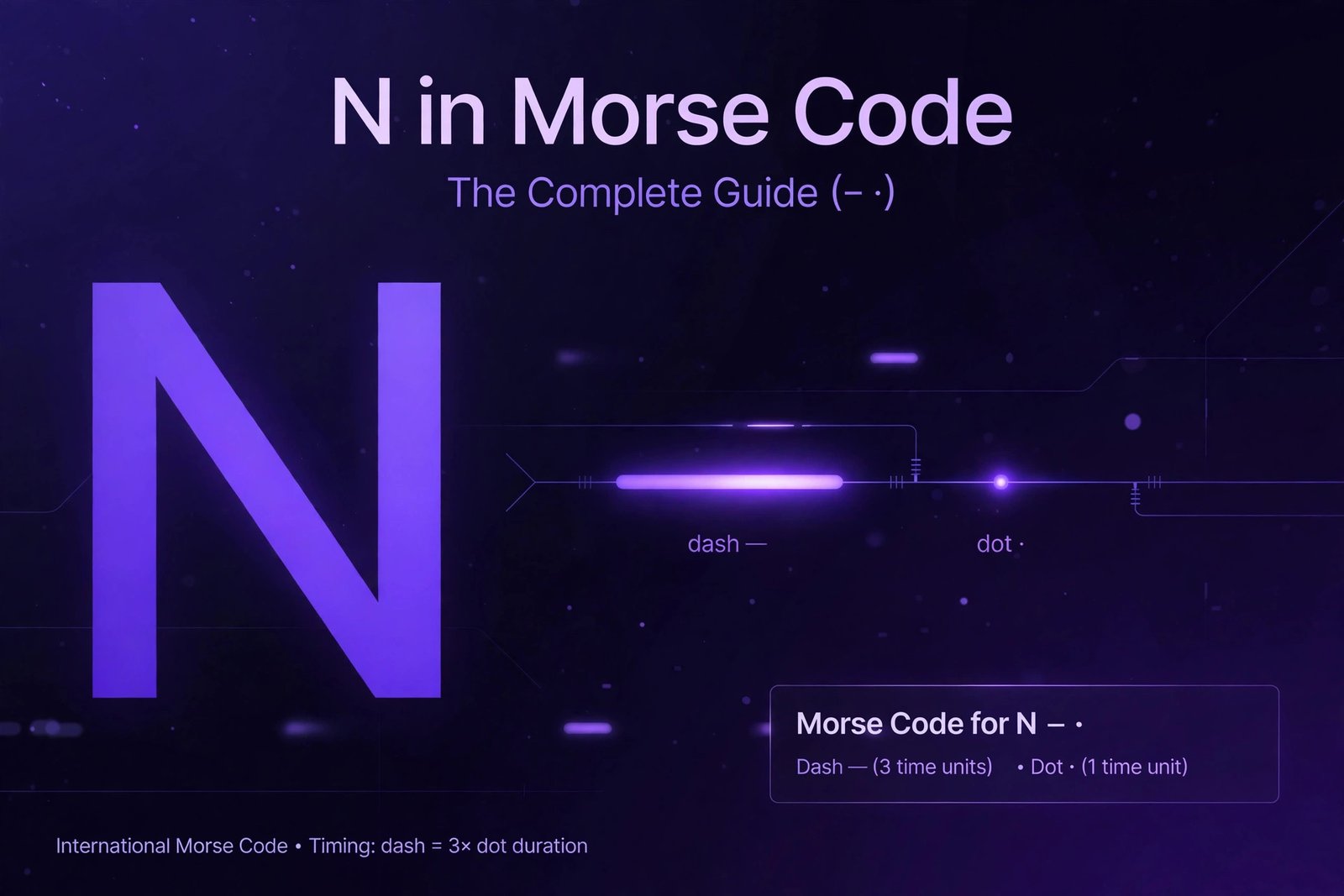
The letter N in Morse code is a dash followed by a dot: − · (pronounced “dah-dit”, or “DAH-dit”). It is one of the shortest codes in the International Morse Code alphabet — one long tone, one short tone, and you are done.
| Letter | Morse Code | Sound | Phonetic Alphabet |
|---|---|---|---|
| N | − · | DAH-dit | November |
A dash lasts three times as long as a dot, so sending N takes five time units in total (3 for the dash, 1 for the dot, plus the 1-unit gap between them). It is one of the quickest letters to key — which makes sense, since N is one of the most frequently used letters in English.
If you only remember one thing from this guide: N = dash then dot. Long, then short. “NO.”
How N Fits Into the Morse Code Alphabet
N is the 14th letter of the alphabet, and it sits in one of the busiest neighborhoods of the Morse code chart — a cluster of dash-led codes that beginners love to mix up:
| Letter | Code | Sound |
|---|---|---|
| M | − − | DAH-DAH |
| N | − · | DAH-dit |
| O | − − − | DAH-DAH-DAH |
| K | − · − | DAH-dit-DAH |
| A | · − | dit-DAH |
Two relationships are worth memorizing. First, N is the exact mirror image of A: A is dot-dash (· −), N is dash-dot (− ·). Swap the order and you swap the letter. Second, N is the first half of K: K is N plus one extra dash (− · −). Once you can hear these patterns, the dash-led corner of the alphabet stops feeling like noise and starts feeling like grammar.
You can compare every letter side by side on our Morse code alphabet reference chart.
How to Send and Recognize N: Timing Rules
Morse code is a rhythm, not just a set of symbols. The International Morse Code, maintained under International Telecommunication Union (ITU) standards, defines exact timing ratios — and N is a clean example of all of them:
- A dash lasts 3 time units (a dot lasts 1).
- The gap between the dash and the dot of N is 1 time unit — the same as between any two parts of one letter.
- The gap between N and the next letter is 3 time units.
- The gap between words is 7 time units.
Send N like this: beeeeep — bip, with only the briefest breath between the two tones. The single most common beginner mistake is pausing in the middle: if the gap between the dash and the dot stretches too far, a listener will read two separate letters — T (−) followed by E (·) — instead of one N. Rushing is forgiving; pausing inside a letter is not.
The fastest way to internalize the rhythm is to hear it. Type “N” into the Morse Code Translator on our homepage and press play — you will hear the long-short pattern at whatever speed you choose.
Memory Tricks: How to Remember N in Morse Code
N is already a two-signal code, but these tricks make it impossible to forget:
- The “NA-vy” mnemonic: Say the word “navy” with a heavy stress on the first syllable — “NA-vy”. The long, stressed “NA” is your dash; the quick, soft “vy” is your dot. DAH-dit, done.
- The mirror of A: A is dit-DAH (· −) and N is DAH-dit (− ·). Learn them as a pair and you get two letters for the price of one.
- The emphatic “NO”: N starts the word “no” — picture saying “NO!” firmly. The strong N sound is the dash; the word ends before it can linger, and that abrupt stop is the dot.
- Finger taps: One long press, one short tap on a table. If it sounds like a door knock — knock-knock with the first knock longer — you have got it.
Pair these with active listening practice — sending letters without peeking at a chart, a technique called the Koch method — and N will become one of the first letters you recognize purely by ear.
N in Morse Code: History and Background
Morse code was developed in the 1830s and 1840s by Samuel Morse and refined by his collaborator Alfred Vail, who designed the first practical telegraph keys. Vail’s key insight was frequency-based: the most common letters in English earned the shortest codes. That is why E is a single dot and T is a single dash — and it is also why N, the sixth most common letter in written English, earned a compact two-signal code (− ·).
The code in use worldwide today is International Morse Code, formalized in the 1860s and maintained under ITU standards. It is the same code still used by amateur radio operators (hams), by aviation navigation beacons that identify airports in Morse, and in assistive technology that lets people with limited mobility communicate with simple switches.
N also has a special place in aviation: in the NATO phonetic alphabet it is “November”, and every civilian aircraft registered in the United States carries a tail number beginning with N — so the letter is literally written across the sky every day.
Common Words With N: Practice Examples
The fastest way to lock in a letter is to send it inside real words. Here are common N words with their full codes — try keying each one, then check yourself on the translator:
| Word | Morse Code |
|---|---|
| NO | − · − − − |
| ON | − − − − · |
| IN | · · − · |
| AND | · − − · − · · |
| ONE | − − − − · · |
| NEW | − · · · − − |
| MAN | − − · − − · |
| END | · − · − · · |
| SUN | · · · · · − − · |
| NINE | − · · · − · · |
“NO” and “ON” are ideal starter words — each is just two letters, and both put N’s long-short rhythm in your ear immediately. For the letter beginners confuse with N most often, study our guide to M in Morse code right after this one and learn the pair together.
N vs. Similar Letters: Avoid the Classic Confusions
| Pair | Codes | How to Tell Them Apart |
|---|---|---|
| N vs M | − · vs − − | N ends short, M ends long. Hear “DAH-dit” vs “DAH-DAH.” |
| N vs A | − · vs · − | Exact inverses. Ask: which came first, the long tone or the short one? |
| N vs K | − · vs − · − | K is N with an extra dash on the end. Count the tones: two vs three. |
| N vs D | − · vs − · · | D adds a trailing dot. “DAH-dit” vs “DAH-di-dit.” |
If you ever mishear N on the air, slowing your listening speed down (reducing WPM, or words per minute) almost always resolves it — at lower speeds the difference between a long and a short tone is unmistakable.
Quick Practice Drill for N
- Type “N” into the Morse Code Translator and listen at 10 WPM, then at 20 WPM.
- Cover the chart and have a friend (or the translator’s audio) play random letters — say each one aloud before checking.
- Send “NO”, “ON”, and “AND” by key, flashlight, or finger taps until the long-short rhythm is automatic.
- Learn N together with M (− −) as a pair — mastering both at once permanently ends the most common beginner confusion.
FAQ: N in Morse Code
What is N in Morse code?
N in Morse code is a dash followed by a dot: − ·, pronounced “dah-dit” (DAH-dit). It is the 14th letter of the alphabet and one of the shortest codes in International Morse Code.
How do you remember N in Morse code?
Say “NA-vy” with a heavy stress on the first syllable — the long “NA” is your dash and the short “vy” is your dot. N is also the mirror image of A (· −).
What is the difference between N and M in Morse code?
N is − · (dash-dot) and M is − − (two dashes). Listen for the ending: N ends with a short tone, M ends with a long one.
What is the NATO phonetic word for N?
“November”. Radio operators often say “November” when spelling the letter N over the air, and the DAH-dit Morse pattern pairs with it.
How long does it take to send N?
Five time units: 3 for the dash, 1 for the intra-letter gap, and 1 for the dot — excluding the 3-unit gap before the next letter.
Conclusion
N in Morse code (− ·) is one of the quickest wins in the whole alphabet: dash, dot, done. Master its long-short rhythm, keep the gap inside the letter tight, and learn it alongside M (− −) to kill the classic confusion before it starts. Every letter you lock in makes the next one faster — open the Morse Code Translator, type your name, and hear N in context today.