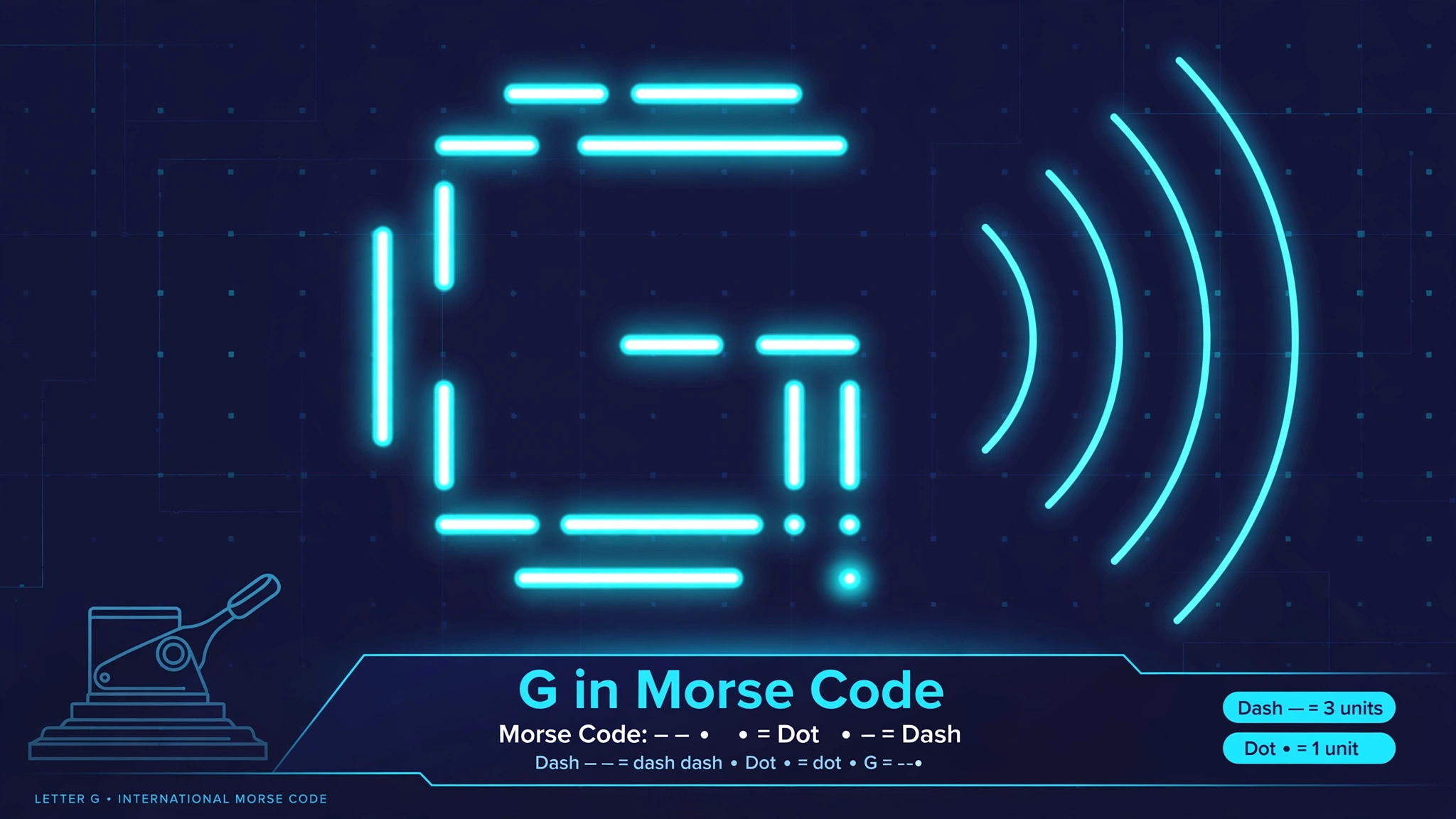
The letter G in Morse code is --· — dash, dash, dot, spoken as “dah-dah-dit”. It is one of the six “long” letters of the International Morse Code alphabet that begin with a dash, and it shows up more often than you might expect: in everyday words, in amateur radio callsigns, and even on the side of every British aeroplane. In this guide you will learn exactly how to write, key, hear, and remember G in Morse code, with timing rules, practice drills, and answers to the most common questions.
If you are working through the alphabet letter by letter, this guide follows the same format as our F in Morse code and A in Morse code tutorials — and you can test every example instantly with our free Morse Code Translator tool.
What Is G in Morse Code?
In International Morse Code — the standard maintained by the International Telecommunication Union (ITU) — each letter is a unique sequence of short signals (dots, or dits) and long signals (dashes, or dahs). The letter G is encoded as:
| Letter | Morse Code | Signal Pattern | Spoken As |
|---|---|---|---|
| G | –· | dash – dash – dot | dah-dah-dit |
A dash is three times as long as a dot. The short silence between the parts of a single letter lasts one dot-length, the gap between letters lasts three dot-lengths, and the gap between words lasts seven. So the letter G takes:
- Dash (3 units) + intra-letter gap (1) + dash (3) + intra-letter gap (1) + dot (1) = 9 time units in total.
That makes G a mid-weight letter: quicker than Q (--·-, 13 units) but slower than E (·, 1 unit). At a comfortable learning speed of 20 words per minute, you will hear G as a confident DAH-DAH-dit — two long tones followed by a short blip.
How to Key and Hear G
Sending Morse by hand, whether on a classic straight key, a telegraph sounder, or a flashlight, is all about rhythm. For G:
- Press and hold for one dash-length — dah.
- Release briefly (one dot-length of silence).
- Press and hold again for a second dash — dah.
- Release briefly again.
- Tap quickly for the dot — dit.
Common beginner mistake: making the second dash too short, which turns --· into something that sounds like -·· (the letter D). Keep both dashes equal — a good rule of thumb is that the whole letter should take about the same time as saying the word “good-morning” at a steady pace.
To train your ear, paste --· into our Morse Code Translator and press play at different speeds. Hearing the pattern at 15, 20, and 25 WPM builds the instant recognition that on-air operators rely on — at real speed, nobody counts dots and dashes, they recognise the shape of the sound.
Memory Tricks for G (–·)
G belongs to the family of six dash-led letters: B (-···), G (--·), J (·---), O (---), Q (--·-), Z (--··). Grouping letters by shape cuts memorisation time dramatically. Notice the pattern inside this family: B, G, and Z are all “dash followed by dots-and-dashes” — G is the only one with two dashes then one dot.
A popular mnemonic technique assigns a word whose syllables match the pattern — long stressed syllables for dashes, short ones for dots. For G, say “GO-od-GO”? That gives only two syllables. Better: hum the rhythm to the opening of a familiar tune, or simply chant “dah-dah-dit, dah-dah-dit” while tapping two long taps and a short one on your desk. Three repetitions and the rhythm usually sticks.
Another reliable anchor: the letter G’s code --· is the mirror image of the letter W (·--). Learn them as a pair and you get two letters for the price of one — just remember that G starts with the dashes.
G Beyond Morse Code: Where Else the Letter G Signals
NATO phonetic alphabet: “Golf”
In voice radio procedure, the letter G is spoken as “Golf” in the NATO phonetic alphabet, standardised in 1956 and used by aviation, maritime, and military operators worldwide. When an amateur radio operator spells a callsign containing G over a noisy channel, “Golf” cuts through static far better than the bare letter — the same principle that makes Morse’s sharp dah-dah-dit so recognisable.
Amateur radio: callsigns that start with G
The ITU allocates callsign blocks to countries, and all amateur radio callsigns beginning with G belong to the United Kingdom — a detail overseen nationally by organisations such as the ARRL community and Ofcom. The second letter narrows it down: G for England, GM for Scotland, GW for Wales, GI for Northern Ireland, GD for the Isle of Man, GU for Guernsey, and GJ for Jersey. So when you hear --· -- ---- on the air — G-M-0 — you are listening to a Scottish station.
Aviation: every British aeroplane wears a G
Civil aircraft registrations are allocated by country: American planes begin with N, French planes with F, and every UK-registered aircraft carries a registration beginning with G, for example G-ABCD, regulated by the UK Civil Aviation Authority. Spotters at any British airport read those G- registrations all day — each one, if you tapped it out, beginning with dah-dah-dit.
Practice Words Starting With (or Containing) G
The best drill is real words. Encode these with our free Morse Code Translator, listen to the audio, then try keying them yourself:
| Word | Morse Code |
|---|---|
| GO | --· --- |
| DOG | -·· --- --· |
| EGG | · --· --· |
| BIG | -··· ·· --· |
| GOLF | --· --- ·-·· ··-. |
| EAGLE | · ·- --· ·-·· · |
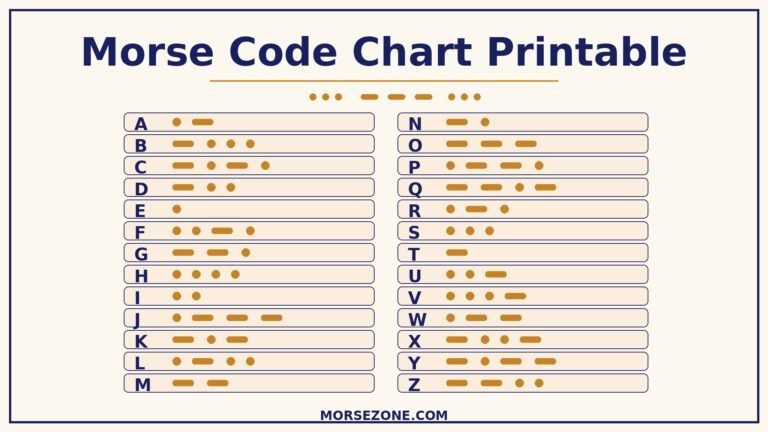
Notice how EGG is almost pure rhythm practice: dit, DAH-DAH-dit, DAH-DAH-dit. Ten slow repetitions of EGG will lock the G pattern into your muscle memory faster than any flashcard. For a full reference of every character, keep our Morse code alphabet chart open in another tab while you practise.
Letters That Look (or Sound) Like G — Don’t Mix These Up
| Letter | Code | How it differs from G (--·) |
|---|---|---|
| Z | --·· | One extra dot at the end — “dah-dah-dit-dit” |
| Q | --·- | Ends with a dash instead of a dot — “dah-dah-dit-dah” |
| W | ·-- | Mirror image: starts with a dot — “dit-dah-dah” |
| O | --- | Three dashes, no dot — “dah-dah-dah” |
Z is the classic trap: at speed, --·· and --· blur together. The trick is to listen for the ending — a clean stop after the short blip means G; a second blip means Z. This “listen to the tail” habit is one of the first skills taught in the Koch method of Morse training, where you learn letters at full speed, two at a time, so your brain pattern-matches sounds instead of counting.
Frequently Asked Questions
What is G in Morse code?
G in Morse code is --· — two dashes followed by one dot, spoken “dah-dah-dit”. It is part of the International Morse Code standard maintained by the ITU.
How do you write G in Morse code by hand?
Write two long marks (dashes) followed by one short mark (dot), with tiny gaps between the parts of the letter: --·. When keying it, hold-press, hold-press, quick-tap, keeping both dashes equal in length.
What does G sound like in Morse code?
It sounds like DAH-DAH-dit — two long tones and a short blip, taking 9 dot-length time units in total. You can hear it at any speed using our Morse Code Translator audio playback.
What is the NATO phonetic word for G?
“Golf.” The NATO phonetic alphabet (standardised 1956) assigns “Golf” to the letter G for clear voice communication in aviation, maritime, and military radio.
Why do British ham radio callsigns start with G?
The ITU allocates callsign blocks by country, and the G block belongs to the United Kingdom. G means England, GM Scotland, GW Wales, GI Northern Ireland, GD Isle of Man, GU Guernsey, and GJ Jersey.
Keep Going: Master the Whole Alphabet
G is one of the most satisfying letters to learn — its bold dah-dah-dit rhythm is easy to recognise once it clicks. From here, continue with the next letters in our series, or jump to the complete Morse code alphabet chart to see how G fits among all 26 letters, 10 numerals, and common punctuation. And whenever you want to hear, send, or decode real Morse instantly, our free Morse Code Translator is one click away.