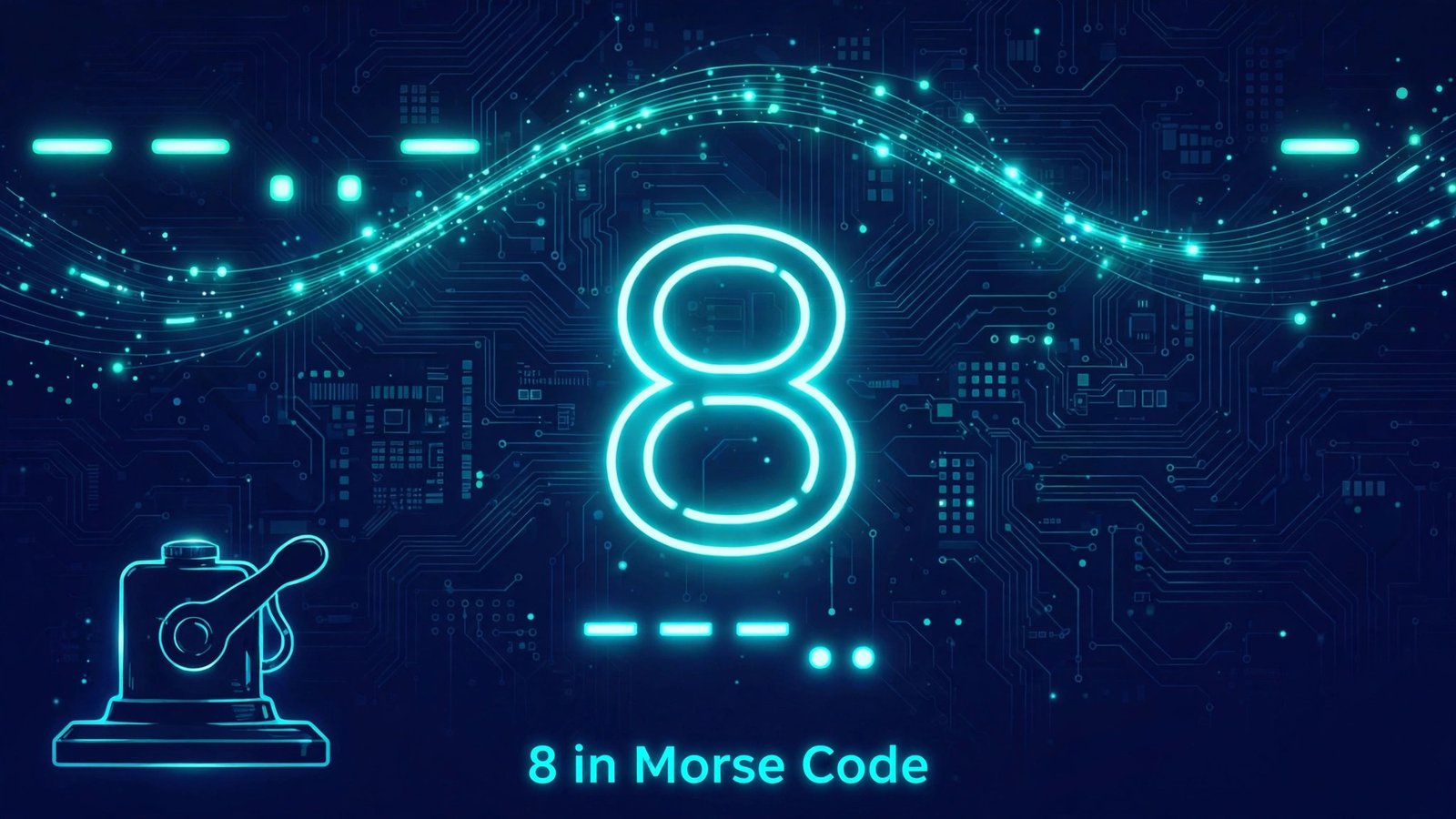
The number 8 in Morse code is written as — — — · · (three dashes followed by two dots). Like every numeral in International Morse Code, it follows a strict five-symbol pattern that makes it instantly recognisable on air, over a radio, or on paper. Whether you are working through the numbers series, studying for an amateur radio licence, or just curious, here is everything you need to know about sending, hearing, and remembering the digit 8.
New to the code? Try typing any letter or number into our Morse code translator and hear it played back at real speed — it is the fastest way to build an ear for the patterns.
What Is 8 in Morse Code?
The digit 8 is encoded as —.. — three long tones (dashes, also called “dahs”) followed by two short tones (dots, called “dits”). Every number from 0 to 9 uses exactly five symbols, which is one reason numerals are easy to pick out of a Morse stream once you know the system.
| Character | Morse code | Spoken as | Signal pattern |
|---|---|---|---|
| 8 | —.. | dah dah dah dit dit | long long long short short |
Timing matters as much as the symbols. In standard Morse timing, one dit is the basic unit, a dah lasts three dits, the gap between symbols within a character is one dit, and the gap between characters is three dits. So 8 takes 15 time units to send: 3+1+3+1+3+1+1+1+1. At 20 words per minute, a dit lasts about 60 milliseconds, which means the full digit 8 takes roughly 0.9 seconds to transmit.
How the Number Pattern Works (and Why 8 Looks Like This)
The numerals in International Morse Code were designed as a logical countdown. Numbers 1 through 5 start with dots; numbers 6 through 0 start with dashes. For the second group, the number of leading dashes equals the digit minus five:
| Digit | Morse code | Leading dashes |
|---|---|---|
| 6 | -…. | 1 |
| 7 | –… | 2 |
| 8 | —.. | 3 |
| 9 | —-. | 4 |
| 0 | —– | 5 |
Notice that 8 (—..) is the mirror image of 2 (..—). That symmetry is not a coincidence — the whole numbering scheme was laid out this way by Alfred Vail, Samuel Morse’s collaborator, when the code was being standardised in the 1840s. If you have already learned 7 in Morse code (–…), just add one more leading dash and drop one trailing dot, and you have 8.
How to Send 8 in Morse Code
You do not need a radio to send Morse. The digit 8 can be tapped, flashed, or keyed on almost anything:
- Telegraph key or straight key: hold for a full dah (three times as long as a dit) three times, then tap twice quickly. Keep the intra-character gaps short and even.
- Flashlight or signal lamp: three long flashes followed by two short flashes. This is the same method used for emergency signalling practice, and it works at surprising distances at night.
- Whistle or buzzer: three long blasts, two short ones. Whistles carry well outdoors and are a classic survival-signalling tool.
- Tapping: three firm, longer knocks followed by two quick taps on a table, wall, or pipe.
The most common beginner mistake is rushing the dashes. If your dahs are only twice as long as your dits instead of three times, 8 (—..) starts to blur toward the rhythm of other characters. Practise with the Morse code translator tool set to a slow speed (around 12 WPM) and copy the rhythm before speeding up.
How to Remember —..
A few memory hooks that learners actually use:
- “Three then two.” 8 = three dashes, then two dots. Say it out loud as you send it: dah-dah-dah-dit-dit.
- The 2-mirror trick. 2 is ..— (two dots, three dashes); 8 is the exact reverse. Learn them as a pair.
- The 8-on-its-side trick. Some learners visualise the digit 8 as two stacked loops and picture the three dashes as the “long” top and the two dots as the short bottom. Anything vivid works.
- Count the dashes. For 6–0, dashes = digit − 5. 8 − 5 = 3 dashes. This single rule reconstructs all five codes without memorising each one.
Once the pattern clicks, run through the full series on our homepage translator: 6 (-….), 7 (–…), 8 (—..), 9 (—-.), 0 (—–). Repetition at a comfortable speed is what builds the reflex.
A Short History of the Number Codes
Morse code was developed in the 1830s and 1840s by Samuel Morse and Alfred Vail for the electric telegraph. The earliest American version (often called American Morse or railroad code) used different, sometimes irregular spacings. In 1848, the German telegraph inspector Friedrich Gerke refined the system into a cleaner code that became the basis of what we now call International Morse Code.
The International Telecommunication Union (ITU) standardised International Morse Code in 1865, and the numeral patterns we use today — including —.. for 8 — date from that standardisation. The five-symbol numeral scheme proved so robust that it survived more than 160 years of technological change, from undersea cables to amateur radio to aviation beacons. For a broader look at the timeline, see the history of Morse code on Wikipedia and Britannica’s overview of Morse code.
Where You Will Meet the Digit 8 on Air
Amateur radio callsigns. Call signs worldwide mix letters and digits — a call like W8XYZ contains the digit 8, sent as —.. between the letters. Operators learn to copy numbers fluently because signal reports, contest exchanges, and callsigns are full of them. If ham radio interests you, our explainer on what “73” means in ham radio is a good next read.
Signal reports (RST system). On-air signal reports use digits 1–9 and 5-based scales, so 8s appear constantly: a report of “589” is excellent copy. Recognising —.. instantly keeps a contact flowing.
Aviation and maritime beacons. Non-directional beacons (NDBs) and some navigational aids transmit station identifiers in Morse code, and those identifiers frequently include digits.
Emergency and survival signalling. Three long signals is a universal distress pattern on land and sea; knowing how dashes feel in practice — three of them, as in the first half of 8 — builds the muscle memory for SOS (· · · — — — · · ·) and other distress signals.
Practise 8 With the Morse Zone Translator
The quickest way to lock in —.. is to hear it, see it, and send it yourself:
- Type “8” into the Morse code translator and listen at 12 WPM.
- Type your phone number or birth year and listen for every 8 inside it.
- Tap —.. on your desk until you can do it without counting.
- Speed the translator up to 20 WPM and check you still recognise it.
Then continue the series — the rest of the numbers posts walk through each digit with the same send-and-remember breakdown.
Frequently Asked Questions
What is 8 in Morse code?
8 in Morse code is —..: three dashes followed by two dots, spoken as “dah dah dah dit dit”. It follows the standard five-symbol numeral pattern of International Morse Code.
How do you remember 8 in Morse code?
Remember “three then two”: three dashes, then two dots. It is also the mirror image of 2 (..—), and for digits 6–0 the number of leading dashes equals the digit minus five — 8 − 5 = 3 dashes.
How long does it take to send 8 in Morse code?
Using standard timing (a dash = 3 dots, one-dot gaps between symbols), 8 takes 15 time units. At 20 words per minute that is roughly 0.9 seconds.
Is 8 the same in American Morse code and International Morse code?
The digit patterns are effectively the same in both systems — —.. for 8 works in either. The differences between American (railroad) Morse and International Morse mainly affect some letters and intra-character spacing, which is why the ITU-standardised International code from 1865 is the one still taught and used today.
What number comes after 8 in the Morse code numbers series?
9 is —-. (four dashes, one dot), and then the series wraps to 0, which is —– (five dashes). Try 0 in Morse code to see the pattern complete.
Conclusion
8 in Morse code (—..) is one of the most logical characters in the whole system: three dashes then two dots, the mirror of 2, and a perfect example of the numeral pattern Alfred Vail designed nearly two centuries ago. Send it a few dozen times with the Morse code translator, pair it with its neighbours 7 and 6, and it will be in your fingers for good.