
9 in Morse Code (—-.): How to Send, Remember, and Use It
Nine is the final numeral in the International Morse Code number series — and its pattern, —-. (four dashes followed by one dot), is the mirror image of 1 in Morse code. If you’ve been following our numbers series — 8, 7, 6, and all the rest — this post completes the set. Here’s everything you need to know about 9 in Morse code: the pattern, how to send it, memory tricks, and where it shows up in real radio practice.
What Is 9 in Morse Code?
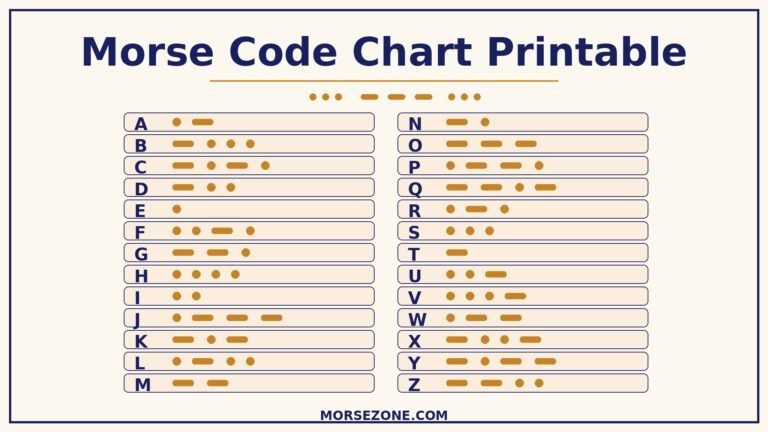
The number 9 in International Morse Code is:
—-.
That’s four long dashes followed by a single short dot. Like all Morse numerals, it is exactly five elements long — five signal units that distinguish numbers from the shorter letter patterns. On a straight telegraph key, you’d hold the key down four times for full-length dashes, then give one quick tap for the dot.
Timing matters in International Morse Code (standardized by the ITU): a dot is one unit, a dash is three units, and the gaps between elements are one unit each. Sending “—-.” cleanly means holding each dash for three steady beats, keeping the gaps even, and finishing with a crisp single dot.
The Mirror Trick: 9 vs 1
Here’s the beautiful symmetry of the Morse number series — the numerals pair off as mirror images:
| Numeral | Pattern | Mirror pair |
|---|---|---|
| 1 | .—- | mirrors 9 |
| 2 | ..— | mirrors 8 |
| 3 | …– | mirrors 7 |
| 4 | ….- | mirrors 6 |
| 5 | ….. | mirrors itself |
| 6 | -…. | mirrors 4 |
| 7 | –… | mirrors 3 |
| 8 | —.. | mirrors 2 |
| 9 | —-. | mirrors 1 |
| 0 | —– | mirrors itself |
Notice the logic: the count of dots equals the numeral for 1 through 5, and the count of dashes equals 10 minus the numeral for 6 through 9. Nine has one dot — count one dot, and you know it’s 9. If you already know 1 (.—-), you already know 9: just reverse it.
How to Send 9 in Morse Code
On a straight key
Four firm, even key-down presses (each about three times as long as a dot), with brief even gaps, then one quick tap. Say the rhythm aloud while you practise: “daaah-daaah-daaah-daaah-dit.”
With a paddle / iambic keyer
Hold the dash paddle for four dashes (the keyer spaces them automatically), then tap the dot paddle once. The 9 pattern feels natural once your hand learns the “four-plus-one” rhythm.
By flashlight, tap, or blinking
The pattern works with any signalling method: four long flashes, pauses between, then one short flash. It’s a popular one for practising because the rhythm is so distinctive. (See our 73 in ham radio post for how numbers like these appear in real on-air shorthand.)
How to Remember —-.
A few memory aids that actually work:
- The mirror rule: 9 is 1 reversed. If .—- is in your fingers, —-. is already there too.
- The logic of the series: for numerals 1–5, the number of leading dots equals the numeral (9’s mirror, 1, has one dot: .—-). For numerals 6–9, the number of trailing dots equals 10 minus the numeral — so 9 ends with a single dot. Simplest version of all: 9 = four dashes + one dot, with the dot at the end. That’s the whole pattern.
- The rhyme trick: “Nine lives shine” — four long notes then one short, like a cat’s tail swish finished with a flick.
- Listen first: paste “—-.” into a Morse code translator and play the audio at 15–20 WPM. Hearing the long-short rhythm a few times burns it into memory faster than reading it.
9 in Morse Code: Practice Drills
Try these drills to lock in the pattern:
- Echo drill: play “—-.” on the Morse code translator tool, then key it back immediately. Repeat 10 times.
- Pair drill: alternate .—- (1) and —-. (9). The reversal makes both patterns stick.
- Full countdown: send 9 down to 0 in sequence — you cover every mirror pair in one run.
- Speed ladder: start at 12 WPM, work up to 20+ WPM. Numerals are sent faster in real traffic, so don’t settle for slow copy.
Where You’ll See 9 in Real Morse Traffic
- Call signs: many amateur radio call signs include 9 (e.g., prefixes like 9A, 9H, 9M, 9V). Copying —-. instantly matters in pileups.
- Signal reports: RST reports like “599” send as ….. —-. —-. — the 9 appears constantly in contest exchanges.
- Frequencies: dial positions, QSO frequencies, and repeater offsets all read out in numerals.
- Dates and contests: CQ contest exchanges, serial numbers, and dates are pure number traffic — fluency with 9 pays off fast.
- The famous “73”: while 73 itself is 7 and 3, the number fluency you build here transfers directly to every ham shorthand in the book.
Common Mistakes With 9
- Rushing the dashes: if your dashes shrink toward dot length, —-. turns into five muddy elements and copy becomes impossible. Keep the 3:1 ratio.
- Losing the final dot: trailing dots get swallowed when the hand relaxes early. Punch the last dot deliberately.
- Mixing 9 with 1: .—- vs —-. — in weak-signal conditions, one flipped pattern can turn a serial number into garbage. The mirror drill above is the fix.
- Counting instead of hearing: don’t count dashes one by one at speed; learn the rhythm shape — “long-long-long-long-short” — the way you recognise a word, not a spelling.
Frequently Asked Questions
What is 9 in Morse code?
Nine is —-. — four dashes followed by one dot. It’s the mirror image of 1 (.—-).
How do you tap out 9 in Morse code?
Tap four long presses and one short tap: “daaah-daaah-daaah-daaah-dit.” On any method — key, paddle, flashlight, or blinking — the rhythm is four long, one short.
Why are Morse numbers five elements long?
Samuel Morse and Alfred Vail designed the numerals as five-element patterns so they’re instantly distinguishable from letters (1–4 elements). The five-element structure also creates the mirror symmetry — 1↔9, 2↔8, 3↔7, 4↔6 — that makes the whole series easy to learn.
Is —-. used outside ham radio?
Yes. It’s the ITU standard pattern used in aviation (identifiers, frequencies), maritime signalling, emergency beacons, and anywhere International Morse Code appears. It’s also the final numeral students learn before moving to prosigns and Q-signals.
How fast should I be able to send 9?
Aim for clean copy at 20 WPM, the standard amateur-radio speed. Most students reach that within a few weeks of daily 15-minute drills like the echo and countdown exercises above.
The Bottom Line
9 in Morse code — —-. — completes our number series from 0 through 9. Four dashes, one dot, the mirror of 1. Learn it with the countdown drill, test yourself with the Morse code translator, and you’re ready for real on-air number traffic — from signal reports to contest serials. Nine down, infinite practice to go.