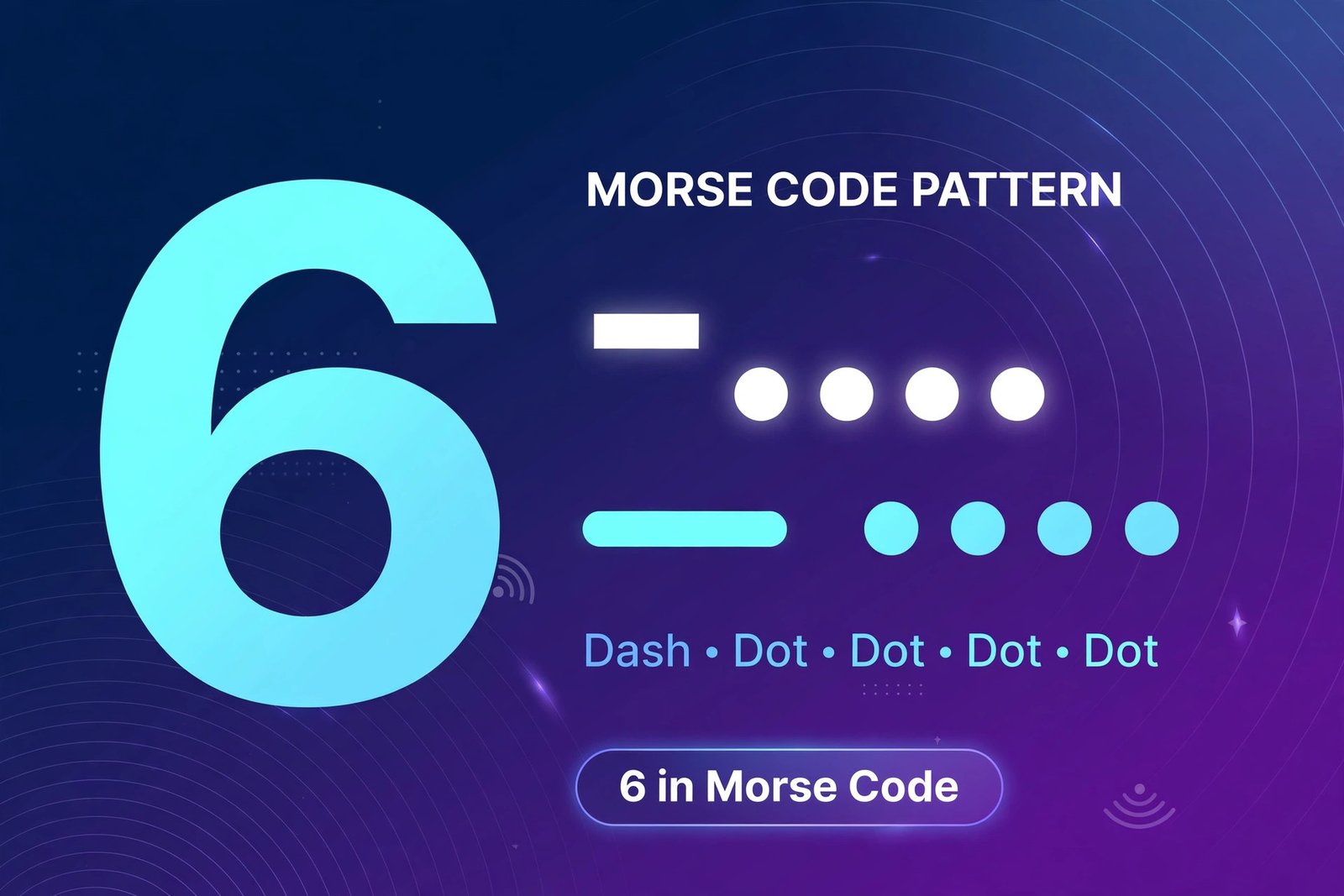
The number 6 in Morse code is -…. — one dash followed by four dots. Spoken aloud, it sounds like “dah di di di dit”: a long tone first, then four short blips. Like every digit from 0 to 9, the number 6 follows a neat mirror pattern that makes the whole number series much easier to learn than most beginners expect. Below, you’ll learn how to send -…. on a key, how to recognise it by ear, a couple of mnemonics that make it stick, and where the digit 6 actually shows up in real radio traffic.
What Is 6 in Morse Code?
In International Morse Code, the digit 6 is encoded as -….: a single dash (dah) followed by four dots (di di di dit). The standard timing rules, maintained by the ITU’s International Morse Code specification, define a dash as three times the length of a dot. Within a single character, each element is separated by a one-unit pause — so when you key -…., the dash rings out long, then four short dots follow in quick succession.
Pronounced the way radio operators say it, 6 is “dah di di di dit”. That rhythm — LONG-short-short-short-short — is the sound signature you’ll train your ear to catch. If you’d like to hear it right now, type “6” into our free Morse code translator and play the audio; listening to the pattern a few times is the fastest way to start recognising it.
The Clever Pattern Behind All Morse Numbers
Here’s the thing that makes digits 0–9 far easier than letters: they’re built on a strict five-element mirror pattern. Every number is exactly five elements long, and the pattern pivots around 5:
- Numbers 1–5 start with dots. The count of dots grows (one for 1, two for 2, and so on), and dashes fill the remaining slots: .—-, ..—, …–, ….-, …..
- Numbers 6–0 start with dashes instead. The count of dashes grows (one for 6, two for 7, and so on), and dots fill the rest: -…., –…, —.., —-., —–
Notice that 6 is the mirror image of 1: -…. is .—- flipped. Where 1 has one dot then four dashes, 6 has one dash then four dots. The same mirroring pairs 2 with 7, 3 with 8, 4 with 9, and 5 with 0. Learn one side of the mirror and you’ve effectively learned the other. Here is the full series for reference:
| Digit | Morse code | Spoken rhythm |
|---|---|---|
| 0 | —– | dah dah dah dah dah |
| 1 | .—- | di dah dah dah dah |
| 2 | ..— | di di dah dah dah |
| 3 | …– | di di di dah dah |
| 4 | ….- | di di di di dah |
| 5 | ….. | di di di di dit |
| 6 | -…. | dah di di di dit |
| 7 | –… | dah dah di di dit |
| 8 | —.. | dah dah dah di dit |
| 9 | —-. | dah dah dah dah dit |
This symmetrical design wasn’t an accident. When Samuel Morse and Alfred Vail developed the code in the 1840s, digits were given fixed five-element patterns so operators could recognise numbers instantly, even through heavy static. Samuel Morse’s original system was standardised internationally in Paris in 1865, and the number patterns have barely changed since.
How to Send 6 on a Telegraph Key
Sending -…. is a great first exercise in mixing dashes and dots, because the dash comes first and sets your rhythm:
- Press and hold for the dash. On a straight key, hold the knob down for about three dot-lengths. If your dot is one second (for learning — real speed is much faster), hold the dash for three seconds.
- Keep the gap short. Release for exactly one dot-length, then tap four dots, each one dot-length, with one-unit pauses between them.
- Don’t pause after the character yet. A three-unit gap signals the next character is coming; a seven-unit gap signals a new word. Keep your -…. tight and self-contained.
On an iambic paddle, the dash is typically sent with your thumb and the dots with your index finger, which makes -…. feel almost like a drum beat: THUMB-finger-finger-finger-finger. Start at a slow, comfortable speed — most learners begin around 5 words per minute (WPM) — and only speed up when the rhythm feels automatic. The translator’s audio player is a handy metronome: play -…. on loop and key along with it.
How to Hear and Recognise -….
Reading Morse from a chart and hearing it live are two different skills. The ear-training approach that works best is to learn sound shapes rather than counting dots and dashes. For 6, the sound shape is unmistakable: one long tone, then four quick ones — dah-di-di-di-dit.
A proven way to build this skill is the Koch method, where you learn characters one at a time at full speed (usually 20 WPM) and only add a new character once you can copy the ones you know at 90% accuracy. Practise -…. alongside its neighbours: listen to 5 in Morse code (…..) and 4 in Morse code (….-) right after 6, and notice how the leading dash is what sets -…. apart from the all-dots crowd.
Try this ear drill: have a friend (or the translator) play a random sequence of 4, 5, 6, and 7, and write down what you hear. The dash-first digits (6 and 7) versus the dot-first ones (4 and 5) should separate themselves within a few minutes of practice.
Mnemonics That Make -…. Stick
Memory hooks are personal, but these three work for almost everyone:
- “Six is one, flipped.” You already know 1 is .—- (one dot, four dashes). Swap every dot for a dash and every dash for a dot, and you get -…. = 6. The whole 1↔6, 2↔7, 3↔8, 4↔9, 5↔0 mirror is the single best trick for the entire number series.
- “Long start, four taps.” The digit 6 is the first number in the series that starts with a long element. Just remember: the second half of the numbers (6–0) always opens with a dash.
- A stressed-first rhythm word. Pick any five-syllable phrase with the stress on the first syllable — “THUN-der-ing-rain-clouds” — and say it in your head as you key. The long first beat maps to the dash, the four short beats to the dots.
Where 6 Shows Up in Real Morse Use
Digits get more airtime than most newcomers realise:
- Amateur radio signal reports. The classic “59” report (perfectly readable, extremely strong) contains a 6’s neighbour — and full reports like “569” are sent as pure Morse digits.
- Call signs and contest exchanges. Radio call signs routinely include numbers, and contest operators send rapid-fire serial numbers where recognising -…. instantly matters. Compare with 3 in Morse code (…–), another digit you’ll hear constantly in exchanges.
- Dates, times, and frequencies. Schedules, net times (“meeting at 1800”), and frequency announcements (“up 5, listening on 14.060”) are all digit-heavy.
- Maritime and aviation history. Ship identifiers, coast-station call signs, and early aviation navigation beacons all leaned on Morse digits long before voice radio took over.
Common Mistakes to Avoid
- Confusing 6 with B. The letter B is -… (dash + three dots); 6 is -…. (dash + four dots). That single extra dot is the whole difference, and it’s the most common mix-up for beginners. Drill the two side by side until the length difference is obvious.
- Adding a fifth dot by accident. Tapping five dots after a dash turns 6 into 7 (-…. vs –… is safe, but sloppy timing can blur them). Count your dots out loud while learning: “dah — two — three — four — five.”
- Pausing too long inside the character. A gap longer than about one unit after the dash makes the receiver hear two separate characters (T followed by H, in this case: – then ….). Keep the whole -…. flowing as one gesture.
- Making the dots too long. If your dots stretch toward dash length, -…. degrades into an unreadable five-dash blur. Exaggerate the 1:3 ratio while practising — it will even out naturally with speed.
Quick Practice Drill for -….
- Flashcard it: write “6 = -….” on a card, glance at it for 5 seconds, flip it, and key the pattern from memory.
- Tap it: tap dah-di-di-di-dit on your desk 20 times until the rhythm is muscle memory.
- Hear it: play 6 on the translator at increasing WPM and write down what you hear.
- Mix it: randomise 0–9, key each one, and time yourself — aim to send all ten in under a minute.
- Stress-test it: send 6 next to B (-…) repeatedly. If you can hear the difference at speed, you’ve learned it.
FAQs About 6 in Morse Code
What is 6 in Morse code?
6 in Morse code is -….: one dash followed by four dots, pronounced “dah di di di dit”.
How do you say 6 in Morse code out loud?
Operators say “dah di di di dit” — a long “dah” for the dash, then four short “di” sounds for the dots.
Is there a trick to remembering the number 6?
Yes — 6 is the mirror image of 1. Where 1 is .—- (one dot, four dashes), 6 is -…. (one dash, four dots). Flip the dots and dashes and you’ve got it. More broadly, digits 6–0 always start with a dash, while 1–5 always start with a dot.
How long should the dash in 6 be?
Exactly three times the length of a dot, with a one-dot pause between each element of the character, per the ITU timing standard.
What’s the difference between 6 and the letter B in Morse code?
Only one dot: B is -… (three dots) while 6 is -…. (four dots). Drill them side by side until the length difference is instinctive.
Conclusion
The number 6 in Morse code — -…., “dah di di di dit” — is one of the friendliest characters to learn, thanks to the mirror pattern it shares with the number 1. Once the LONG-short-short-short-short rhythm is in your ear and your fingers, it becomes a building block: you’ll hear it in signal reports, contest exchanges, and schedules across the amateur radio bands. Keep practising with the translator, work the digits as a set rather than one by one, and the whole 0–9 series will click into place faster than you’d expect.