Reading Morse code is a skill anyone can learn: a short beep is a dot, a longer beep is a dash, and together those two sounds build every letter, number and punctuation mark in the International Morse Code system. This guide explains the timing rules, the full alphabet, and the practice methods that actually work, so you can go from hearing meaningless beeps to copying real messages by ear.
If you want to check your decoding as you practise, the Morse Code Translator on our homepage converts text to Morse and back instantly, which makes it a handy training partner for everything below.
What Morse Code Is
Morse code is a method of encoding text as sequences of short and long signals. It was developed in the 1830s and 1840s by Samuel Morse and Alfred Vail for the electric telegraph, and the first public line, between Washington and Baltimore, opened in 1844 with the famous message “What hath God wrought”. The version used today is International Morse Code, standardised by the International Telecommunication Union (ITU), and it is still used by amateur radio operators, in aviation beacons, and by emergency signallers.
Every character is built from just two elements:
- Dot (dit) — a short signal, one unit long.
- Dash (dah) — a long signal, three units long.
That is the whole alphabet of sounds. The trick to reading Morse code is not memorising dots and dashes on paper, but learning to hear each letter as a single sound pattern, the way you recognise a word in speech without spelling it out letter by letter.
The Timing Rules: The Real Secret to Reading Morse Code
Most beginners fail because they ignore timing. Morse code is a rhythm system, and the gaps between signals carry as much meaning as the signals themselves. The ITU timing rules are:
| Rule | Length |
|---|---|
| Dot | 1 unit |
| Dash | 3 units |
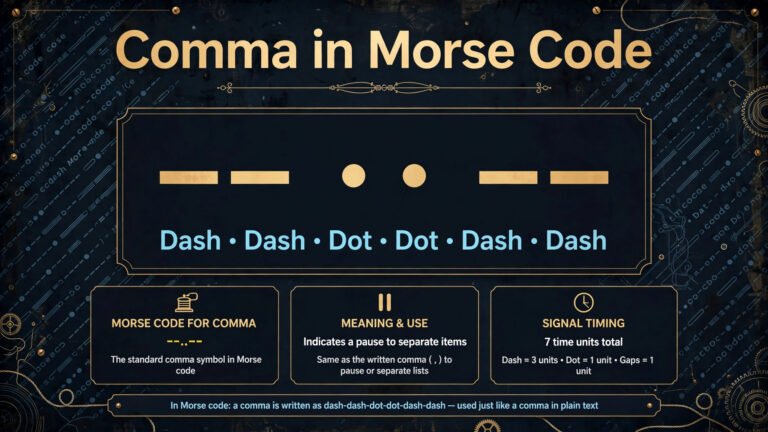
| Gap between dots and dashes inside one letter | 1 unit |
| Gap between letters | 3 units |
| Gap between words | 7 units |
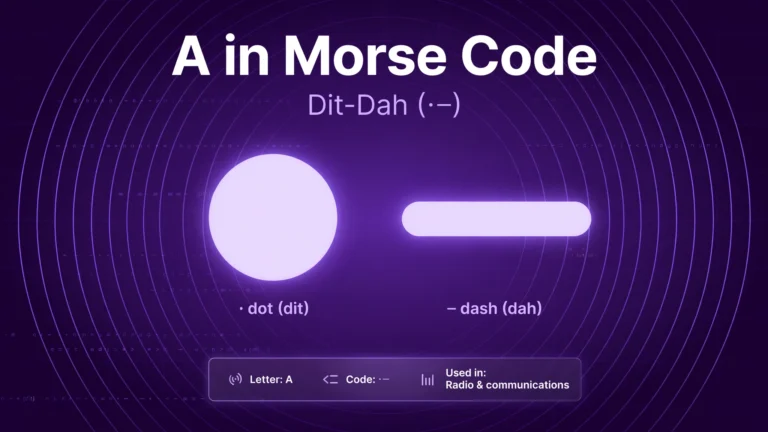
Take the letter A, which is .-: a dot, a one-unit gap, then a dash. The letter N is -.: a dash, a one-unit gap, then a dot. Same two elements, opposite order, different letters — and the one-unit gap is what keeps them apart from two separate letters. At higher speeds the gaps shrink, which is why trained operators hear rhythm, not counting.
Speed is measured in words per minute (WPM), using the standard word PARIS (50 units long, including its word gap). Five WPM is a gentle beginner pace; 20 WPM is a confident conversational speed for many amateur radio operators.
The Morse Code Alphabet
Here is the full International Morse Code alphabet. Use it as a reference while you learn, but do not try to memorise the table by staring at it — the practice methods below will teach your ear instead.
| Letter | Code | Sound | Letter | Code | Sound |
|---|---|---|---|---|---|
| A | .- | di-dah | N | -. | dah-dit |
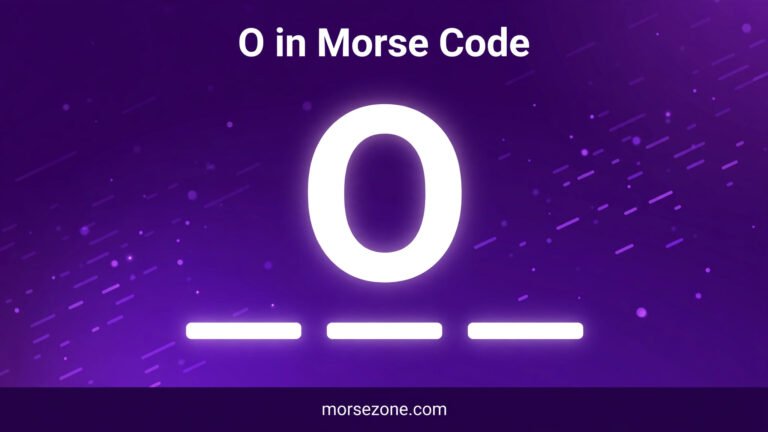
| B | -... | dah-di-di-dit | O | --- | dah-dah-dah |
| C | -.-. | dah-di-dah-dit | P | .--. | di-dah-dah-dit |
| D | -.. | dah-di-dit | Q | --.- | dah-dah-di-dah |
| E | . | dit | R | .-. | di-dah-dit |
| F | ..-. | di-di-dah-dit | S | ... | di-di-dit |
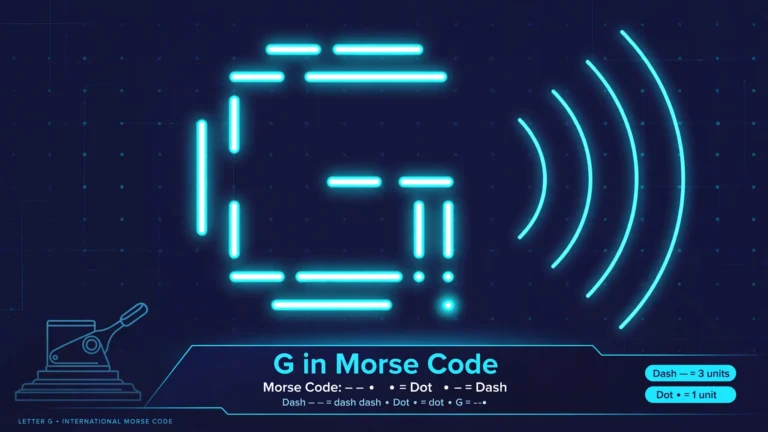
| G | --. | dah-dah-dit | T | - | dah |
| H | .... | di-di-di-dit | U | ..- | di-di-dah |
| I | .. | di-dit | V | ...- | di-di-di-dah |
| J | .--- | di-dah-dah-dah | W | .-- | di-dah-dah |
| K | -.- | dah-di-dah | X | -..- | dah-di-di-dah |
| L | .-.. | di-dah-di-dit | Y | -.-- | dah-di-dah-dah |
| M | -- | dah-dah | Z | --.. | dah-dah-di-dit |
Numbers follow a logical pattern that makes them easier than letters: 1 is .----, 2 is ..---, 3 is ...--, 4 is ....-, 5 is ....., then the pattern mirrors — 6 is -...., 7 is --..., 8 is ---.., 9 is ----. and 0 is -----. Each number is five elements, and the count of dots falls as the count of dashes rises. If you want a printable version to keep beside you, see our free printable Morse code chart.
How to Read Morse Code by Ear: A Step-by-Step Method
Step 1: Learn the sounds, not the pictures
The single biggest mistake is learning Morse code visually — picturing ... on a page and translating it to S. That creates a slow two-step process in your head: sound to picture, picture to letter. Instead, learn each letter as a sound. Say the rhythm out loud as “di-dah” for A, “dah-di-dit” for D, and so on, until the sound itself means the letter. This is how operators read at speed: they hear the shape of a letter, not its dots and dashes.
Step 2: Start with the easiest letters
Begin with the shortest, most distinct letters: E (.), T (-), I (..), M (--), S (...) and O (---). These six give you real words immediately — “SOS” (...---...), “MOM”, “TIE”, “TOO” — which keeps practice rewarding. Add two new letters at a time only when you recognise the current set instantly, without hesitating. This is the heart of the Koch method, the training approach developed by psychologist Ludwig Koch in the 1930s: learn at full character speed from the start, and expand the set gradually.
Step 3: Practise with the Farnsworth method
Speed is two separate skills: how fast each character sounds, and how much space sits between characters. The Farnsworth method keeps characters at full speed (say 18 WPM) but stretches the gaps between them, so your brain has time to think while your ear learns real-speed sounds. Most Morse training apps and websites let you set character speed and effective speed separately — use that. Slow characters are a trap: if you learn letters at 5 WPM, you must unlearn them to go faster.
Step 4: Copy real text, not random letters
Once you know ten or so letters, stop drilling random characters and start copying real words and short sentences. Your brain is a pattern machine: it learns “THE”, “AND” and “YOU” as whole shapes far faster than it learns isolated letters. News headlines, song lyrics and children’s books make excellent copy material. Aim for 15 to 20 minutes a day — short daily sessions beat occasional long ones, because sleep consolidates the sound patterns.
Step 5: Listen to live Morse code
When you can copy slow practice text, start listening to real on-air Morse. Amateur radio operators send Morse (CW) every day, and the American Radio Relay League station W1AW broadcasts regular code practice sessions. Hearing real operators — with their imperfect spacing, fading signals and varied speeds — is what turns a classroom skill into a real one. You can also listen to ham radio shorthand like 73 in context, which teaches you the culture of the bands as well as the code.
Reading Morse Code Visually: Lights, Flags and Written Code
Morse code is not only sound. The same patterns work with any on/off signal:
- Flashlight: short flash for a dot, long flash for a dash. A useful emergency skill — three short, three long, three short flashes is the visual SOS.
- Written code: dots and dashes on paper, used in puzzles, geocaching and classroom activities. If you can read the sounds, reading the written form is trivial.
- Touch and vibration: taps on a table or vibrations on a phone screen, used in accessibility tools and silent signalling.
Visual reading is easier than listening, because you can pause and re-read. But the ear is the real goal: Morse code was designed as an audio language, and fluent operators never look at anything at all.
Common Mistakes When Learning to Read Morse Code
- Counting dots and dashes. If you hear
....and count “one, two, three, four” before deciding it is H, you will never get past 8 WPM. Hear the rhythm as one sound instead. - Learning at slow speed. Characters learned slowly must be relearned at speed. Use Farnsworth spacing instead of slow characters.
- Skipping the gaps. The pause between letters is part of the code. If you ignore it,
...---...becomes a meaningless stream instead of SOS. - Practising in long, rare sessions. Fifteen minutes daily for a month beats five hours on a single weekend.
- Waiting until you “know it all” to listen live. Start listening to real Morse early, even if you only catch a letter or two. Context fills the gaps, and motivation matters more than perfection.
How Long Does It Take to Learn to Read Morse Code?
With 15 to 20 minutes of daily practice, most learners recognise the full alphabet within two to four weeks and copy simple words at 10 to 12 WPM within six to eight weeks. Reaching a comfortable conversational 20 WPM typically takes three to six months. Children often learn faster — if you are teaching a young learner, our Morse code for kids guide has games and activities that make the sounds stick. Progress is not linear: expect plateaus, especially around 10 WPM and again near 18 WPM, and push through them by adding live listening rather than more drills.
Prosigns: The Special Signals You Will Hear
Experienced operators use prosigns — letter combinations sent as one continuous character, with no gap between the letters — for common procedural signals. The ones you will meet first are:
| Prosign | Code | Meaning |
|---|---|---|
| AR | .-.-. | End of message |
| SK | ...-.- | End of contact (signing off) |
| BT | -...- | Break / separator between thoughts |
| KN | -.--. | Go ahead, specific station only |
| Error | ........ | Eight dots — “I made a mistake, ignore that” |
SOS itself is a prosign, not three letters: ...---... is sent as one unbroken pattern, which is why it is so easy to recognise even through noise. You can read the full story of the world’s most famous distress call in our guide to famous messages in Morse code.
Frequently Asked Questions
Is Morse code hard to read?
No — it is one of the simplest codes in existence, with only two symbols. The difficulty is not complexity but fluency: training your ear to recognise 40-odd sound patterns instantly. Most people learn the alphabet in a few weeks of short daily practice; the months after that are about speed, not knowledge.
How do you read Morse code without a chart?
By learning each letter as a sound pattern (“di-dah” for A) rather than a picture of dots and dashes. Use the Koch method: learn two letters at full speed, add more only when the first ones are instant, and practise by copying real words. After a few weeks the chart becomes unnecessary.
What is the easiest way to learn Morse code by ear?
Use the Farnsworth method — characters sent at full speed (around 18 WPM) with long gaps between them — for 15 to 20 minutes a day, starting with the letters E, T, I, M, S and O. Add two letters at a time, then move to copying real words and listening to live amateur radio Morse.
Can you still learn Morse code in 2026?
Yes. Morse code is no longer required for an amateur radio licence, but it is actively used every day on the ham bands, in contests, and by emergency communicators. Free apps, websites and W1AW practice broadcasts make it easier to learn now than at any point in history. For the full picture, see our article on how to learn Morse code fast.
How fast can an experienced operator read Morse code?
Comfortable conversational Morse runs at 20 to 25 WPM. Skilled operators copy 30 to 40 WPM by ear, and contest operators can exceed 50 WPM, usually by copying whole words rather than individual letters. The world record for high-speed telegraphy is above 70 WPM, but that is a specialist sport, not a practical goal.
Conclusion
Reading Morse code comes down to three things: learn the timing rules, learn each letter as a sound rather than a picture, and practise a little every day with real words and live signals. Start with E, T, I, M, S and O, add two letters at a time, and use a printable chart as your training wheels until your ear takes over. Within a month you can be decoding your first real messages — and once you hear your first callsign come through the static, you will understand why this 180-year-old code refuses to die.