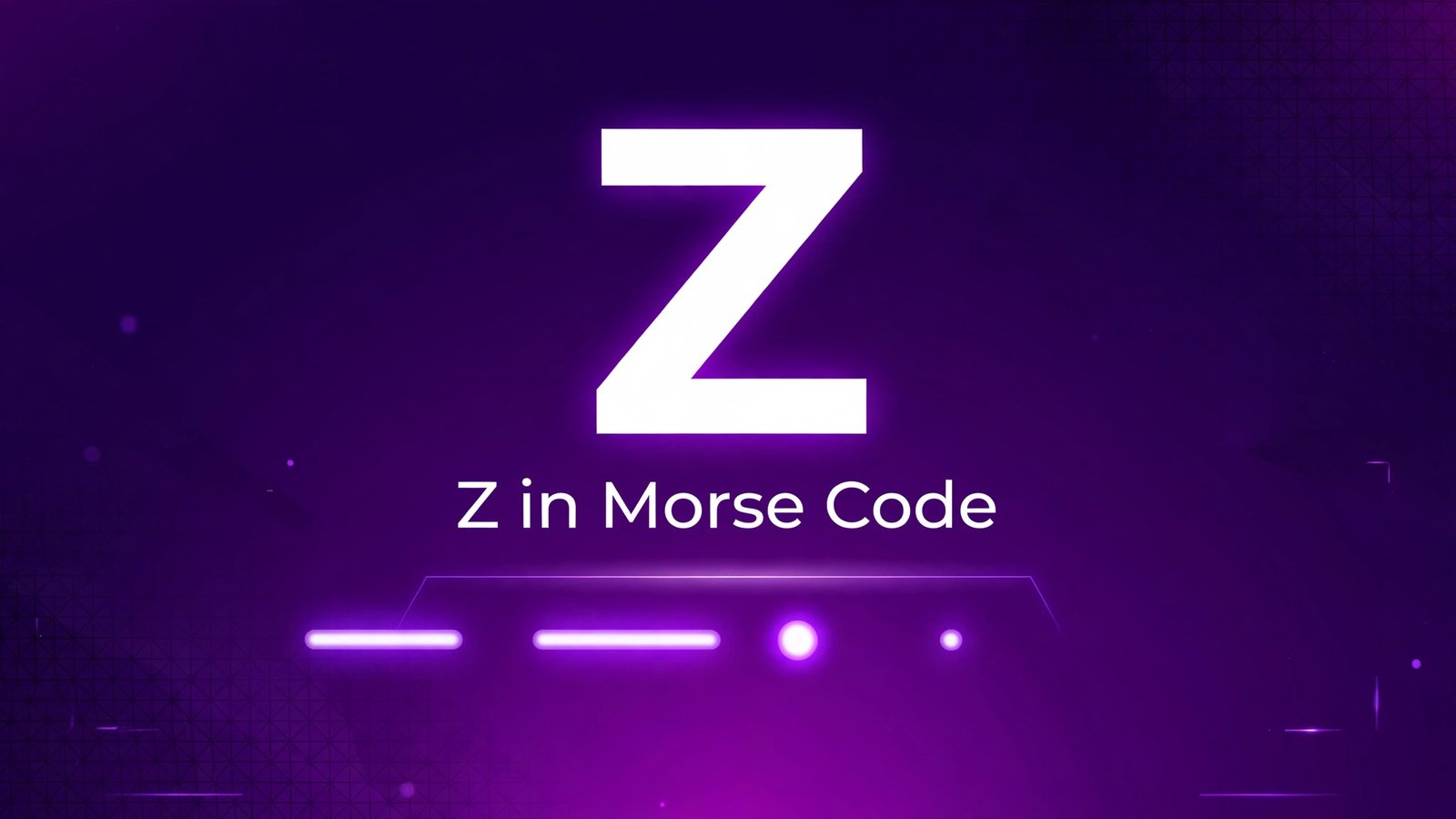
The letter Z is the final letter of the alphabet, and in Morse code it has one of the most satisfying rhythms of all: two long dashes followed by two short dots. Written as –.. and spoken as “dah-dah-di-dit”, it is easy to recognise once you have heard it a few times — and it makes a great finishing point if you have been working through the Morse alphabet letter by letter.
In this guide you will learn what Z looks and sounds like in Morse code, how to send it with a key, a torch or by tapping, and how to remember it — plus practice words, common mistakes, and how Z compares with G and Q.
Want to hear it straight away? Try the Morse Code Translator: type “Z” and listen to the two dashes and two dots at a comfortable speed.
What Is Z in Morse Code?
Z in Morse code is –..: dash, dash, dot, dot. In International Morse Code, every letter is built from two building blocks: short signals (dots, or “dits”) and long signals (dashes, or “dahs”). A dash lasts about three times as long as a dot, and that timing gives each letter its distinctive rhythm.
| Item | Detail |
|---|---|
| Letter | Z (the 26th and final letter of the alphabet) |
| Morse code | –.. (dash, dash, dot, dot) |
| Spoken rhythm | “dah-dah-di-dit” |
| Code system | International Morse Code |
| NATO phonetic word | Zulu |
Z is the last letter of the alphabet, which makes it a natural milestone: once you can send and receive Z confidently, you know the whole A–Z set. Its neighbours are Y in Morse Code and X in Morse Code.
A Short History of Z in Morse Code
Morse code was developed in the 1830s and 1840s by Samuel Morse and Alfred Vail for the electric telegraph. The earliest version, American Morse Code, used pauses inside characters, which made it harder to learn and send reliably. The system that survived, International Morse Code, was standardised in the mid-19th century and later adopted by the International Telecommunication Union (ITU). In it, Z was assigned –.., a pattern that sits neatly in a family of similar codes — which explains both why Z is easy to place and why beginners sometimes mix it up with its cousins. The standard reference on Morse code traces how the system spread from landlines to ships, aircraft and amateur radio stations.
How to Write Z in Morse Code
Writing Z is straightforward once you remember the order: long, long, short, short.
- Step 1: Draw or tap a dash (—), a long signal about three units long.
- Step 2: Draw or tap a second dash (—).
- Step 3: Add a dot (.), a short signal of one unit.
- Step 4: Add a second dot (.).
- Result: –..
Keep the symbols evenly spaced inside the character and leave a larger gap between letters — without that spacing, –.. could blur into neighbouring letters. The same rule applies when keying: the gap inside a letter is one unit, between letters three units.
How to Say and Hear Z in Morse Code
Operators never say “dash dash dot dot”. They say “dah-dah-di-dit”: “dah” for each dash and “di” (or “dit”) for each dot. Say it out loud a few times and the rhythm — long, long, short, short — will settle in.
At a slow learning speed of around 5 words per minute (WPM), each element is stretched out and easy to count. As your speed rises toward 12–20 WPM, you stop counting dots and dashes and start recognising the whole sound shape of the letter. That shift from counting to recognising is the real breakthrough in learning Morse code by ear, and Z is a good letter to practise it with because its two-plus-two pattern is so distinctive. Try listening at a slow speed with your eyes closed, then tapping the pattern back before checking the answer — short, repeated sessions beat one long session every time.
How to Send Z: Key, Torch and Tapping
Z can be sent by any method that can make a long and a short signal:
- Straight key or paddle: Hold the key down for a dash (about three units) and tap briefly for a dot. For Z, that is hold, hold, tap, tap.
- Torch or flashlight: Two long flashes followed by two short flashes — the classic signalling method for emergencies and for fun.
- Tapping or knocking: Two long knocks followed by two short knocks. Keep the long knocks clearly longer than the short ones, or the listener will struggle to tell them apart.
- Whistling or humming: Two long notes followed by two short notes — a handy trick when you have no equipment at all.
Whatever method you choose, consistency matters more than speed: a slow, evenly spaced –.. is far easier to copy than a fast, uneven one. Beginners often rush the dashes; try counting “one-two-three” silently for each dash and “one” for each dot until the timing feels natural.
Memory Tricks: How to Remember Z (–..)
Mnemonics work best when they match the letter’s rhythm. For Z, try these:
- “Zanzibar zoo”: Say it with the stress pattern long-long-short-short — “ZAN-zi-bar-zoo” locks the shape in, and both words start with the letter itself.
- “Zebra zigzag”: Picture a zebra’s zigzag stripes: two long stripes, then two short ones.
- Pair it with its neighbours: Learn X (-..-), Y (-.–) and Z (–..) together as the final trio — the contrast in rhythm makes all three easier to remember.
Pick one mnemonic and stick with it for a week.
Z vs Similar Letters: G, Q and 7
Z is most often confused with three characters that share its shape:
| Character | Code | Rhythm | How to tell it apart from Z |
|---|---|---|---|
| Z | –.. | dah-dah-di-dit | The reference: two dashes, then two dots |
| G | –. | dah-dah-dit | Same start, but only one dot at the end |
| Q | –.- | dah-dah-di-dah | Ends with a dash, not a dot |
| 7 (seven) | –… | dah-dah-di-di-dit | Like Z, but with three dots instead of two |
Drill these four together: send yourself G, Q, Z and 7 in random order and write down what you hear. When you can tell them apart reliably at a slow speed, speed up a little and repeat.
Practice Words Containing Z
Real words make the best practice, because they force you to switch between letters. Try these:
| Word | Morse code |
|---|---|
| Zoo | –.. — — |
| Zebra | –.. . -… .-. .- |
| Buzz | -… ..- –.. –.. |
| Jazz | .— .- –.. –.. |
| Zip | –.. .. .–. |
| Zero | –.. . .-. — |
Start with “zoo” and “zip”, where Z comes first. Then move on to “buzz” and “jazz”, where Z appears twice at the end — a good test of keeping the rhythm steady. Finally, try sending “The zebra is at the zoo” and check it with the translator. The earlier letter guides pair well with this one — for example, W in Morse Code — and the full set together gives you a complete A–Z reference.
Z in Radio, Aviation and Everyday Use
In radio communication, Z is spoken as “Zulu” under the NATO phonetic alphabet, so a call sign containing Z is read aloud as “Zulu” to avoid confusion on a noisy channel. Amateur radio operators — often called “hams” — use Morse code (CW, or continuous wave) as one of their main modes, and Z turns up regularly in call signs and contest exchanges.
Z also gives us “Zulu time”, the military and aviation name for Coordinated Universal Time (UTC), the standard time reference used by pilots, sailors and radio operators worldwide. For a broader picture of how the code earned its place, the Britannica overview of Morse code is a solid starting point, and it explains why a 19th-century system is still taught and used today.
Common Mistakes When Learning Z
- Rushing the dashes: If your dashes are too short, –.. starts to sound like …. (H) or .. (I). Keep dashes three times as long as dots.
- Running letters together: Without a clear gap after Z, the next letter’s dots can merge with Z’s final dots and be misread as 7 (–…).
- Confusing Z with Q: Q ends with a dash (–.-); Z ends with dots (–..). Listen for the ending, not just the start.
- Practising too fast, too soon: Speed built on shaky timing has to be unlearned later.
- Only reading, never listening: If you only ever read –.. on a chart, you will not recognise it on the air.
Quick Practice Drill for Z
- Listen to –.. five times at a slow speed, then tap it back from memory.
- Write out “zoo”, “zip” and “zebra” in Morse code without looking at the table above, then check your answers.
- Mix Z with G, Q and 7 in random order and copy what you hear — aim for eight out of ten correct before increasing speed.
- Repeat daily for a week; a few minutes a day is enough to make Z automatic.
Frequently Asked Questions
What is Z in Morse code?
Z in Morse code is –..: two dashes followed by two dots, spoken as “dah-dah-di-dit”. It is part of International Morse Code, the standard system used by amateur radio operators and learners worldwide.
How do you say Z in Morse code?
Say “dah-dah-di-dit”, with “dah” for each dash and “di” for each dot, keeping dashes about three times as long as dots.
What is the NATO phonetic word for Z?
The NATO phonetic word for Z is “Zulu”, used in radio and aviation to make the letter unmistakable — and it gives us “Zulu time” for Coordinated Universal Time (UTC).
How is Z different from G and Q in Morse code?
Z is –.., G is –. and Q is –.-. All three start with two dashes, but Z ends with two dots, G ends with one dot, and Q ends with a dash. Listening for the ending is the key to telling them apart.
What are some easy words to practise Z with?
Start with “zoo” (–.. — —) and “zip” (–.. .. .–.), then try “zebra”, “buzz” and “jazz”. Words with Z at the start are easiest; words with a double Z at the end, like “buzz”, are a good next step.
Conclusion
Z in Morse code — –.., “dah-dah-di-dit” — is a fitting final letter: distinctive and easy to remember once you link it to a word like “zebra”. Learn it alongside G, Q and 7, practise with real words, and keep your timing slow and even until the sound shape becomes automatic.
With Z learned, you now have the complete Morse alphabet at your fingertips. Try spelling your own name with the Morse Code Translator and see how quickly those dots and dashes start to feel like a second language.