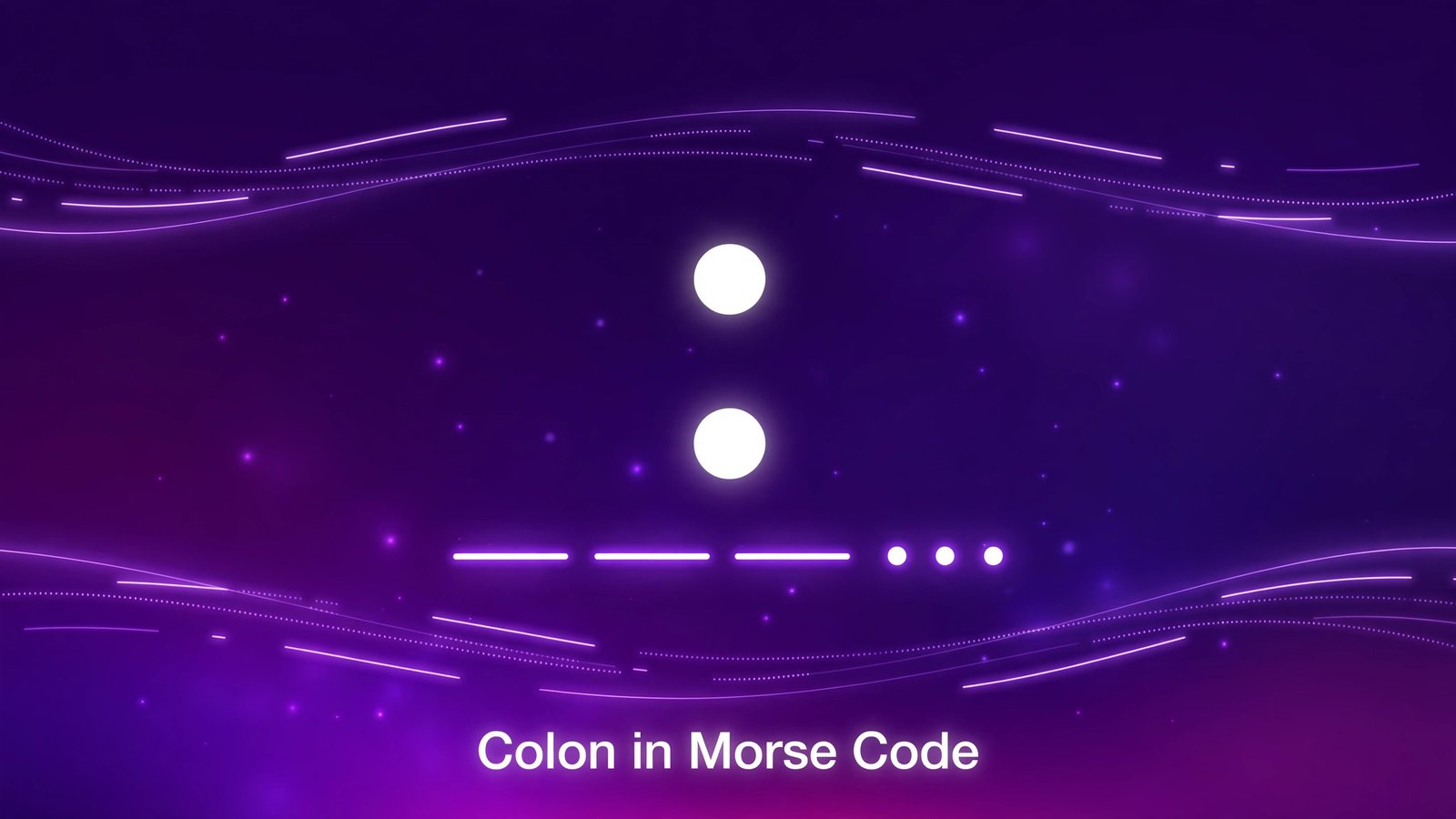
The colon is one of the most useful punctuation marks in Morse code, and one of the easiest to learn. Its pattern is two clean halves — three long dashes followed by three short dots — which makes it stand out clearly on the air. In this guide you will learn the colon in Morse code, how to send it, how to recognise it by ear, when to use it, and how it differs from the easily confused semicolon.
What Is the Colon in Morse Code?
The colon (:) in International Morse Code is ---... — three dahs followed by three dits. Spoken aloud, it sounds like “dah-dah-dah-di-di-dit”. It is an official ITU standard character, defined in Recommendation ITU-R M.1677-1, the international standard that governs the Morse code used by amateur radio operators and maritime services worldwide.
| Character | Morse Code | Sound | Elements | Duration | Status |
|---|---|---|---|---|---|
| Colon (:) | ---... | dah-dah-dah-di-di-dit | 6 | 17 units | ITU standard |
The 17-unit duration comes from the standard timing rules: a dah lasts 3 units, a dit lasts 1 unit, and the five tiny gaps between the six elements add 1 unit each — 9 + 3 + 5 = 17 units. At 20 words per minute, where one unit lasts 60 milliseconds, a colon takes just over one second to send.
How to Send the Colon in Morse Code
Sending a colon is straightforward because the pattern falls into two natural halves. Think of it as the letter O (---) followed immediately by the letter S (...), with no extra gap between them.
- Send three dahs. Hold the key down for three units each: dah — dah — dah. Keep the gaps between them short, exactly one unit.
- Send three dits straight away. Tap the key three times quickly: di — di — dit. Do not pause between the dahs and the dits — the gap inside a character is always one unit.
- Pause for three units before the next character. This gap is what tells the listener that the colon has ended.
On a straight key, the rhythm feels like “long-long-long-short-short-short”. The most common beginner error is leaving too long a gap between the dahs and the dits, which splits the colon into two characters — an O and an S — and changes the meaning entirely. Keep the internal spacing tight and even.
Try it now: type a time such as 9:15 into the Morse Code Translator and listen to how the colon sits between the digits. Then try sending it yourself with a key or even by tapping on a table.
How to Hear and Recognise the Colon
By ear, the colon has a distinctive shape: a heavy opening of three long tones, then a light tail of three short ones. Learners often describe it as sounding like a drum roll that turns into a quick patter. Because the pattern is symmetrical in threes, it is one of the easier punctuation marks to pick out once you know what to listen for.
The main listening trap is the O-plus-S confusion. The letter O is --- and the letter S is ..., so a colon and the two letters “OS” contain exactly the same six elements. The only difference is spacing: inside a colon, every gap is one unit, while between O and S there is a three-unit character gap. This is why experienced operators stress even spacing above raw speed — timing is what separates characters from each other.
A useful way to train your ear is to listen to the colon alongside its neighbours. Compare it with the question mark in Morse code (..--..), which opens with dits instead of dahs, and the period in Morse code (.-.-.-), which alternates dit and dah throughout.
When Do You Use a Colon in Morse Code?
In ordinary writing, a colon introduces something: a list, an explanation, a quotation, or a time. The same jobs apply in Morse code, and a few radio-specific ones too. The colon is optional in most short messages — you could write “MEETING 630” and probably be understood — but in Morse, where there are no capital letters or bold text to guide the listener, punctuation carries extra weight. A single colon can remove an ambiguity that would otherwise take several exchanges to clear up.
- Times of day. This is the colon’s most common job in Morse. “MEETING 6:30” or “NET 19:00” reads far more clearly with the colon than without it, because the digits alone could be mistaken for a single long number.
- Introducing a list. A colon before a list signals that items follow, for example “NEED: BATTERY KEY ANTENNA”.
- Labels and headings. In longer messages, operators use colons after labels such as “NOTE:”, “QTH:” or “NAME:” to mark the start of a field.
- Ratios and scores. A colon separates the two sides of a ratio or a score — “3:1”, “SCORE 2:0” — which is clearer than spelling the numbers out.
- Amateur radio exchanges. In a QSO, colons appear in signal reports, times, and station information, where a missing colon can turn two separate numbers into one confusing string.
Colon vs Semicolon in Morse Code
The colon’s closest lookalike is the semicolon, and the two are a classic source of confusion for learners. They are easy to tell apart once you know the trick: the colon is grouped in threes, while the semicolon alternates.
| Mark | Symbol | Morse Code | Sound |
|---|---|---|---|
| Colon | : | ---... | dah-dah-dah-di-di-dit |
| Semicolon | ; | -.-.-. | dah-di-dah-di-dah-di |
Read the patterns aloud and the difference is obvious. The colon says “long-long-long-short-short-short”, while the semicolon says “long-short-long-short-long-short” — a steady alternating beat. A handy memory aid is to picture the marks themselves: a colon is two dots stacked on top of each other, and its code is two clean blocks of three; a semicolon is a dot over a comma, and its code is an alternating zigzag.
Note that the semicolon is a common addition rather than an ITU standard character, while the colon is fully standard. In practice both are widely used, but the colon is the one you will meet far more often on the air.
Colon Compared With Other Punctuation
The colon belongs to a family of six-element punctuation marks in International Morse Code. Here is how it sits alongside the marks you are most likely to use with it.
| Mark | Symbol | Morse Code | Typical Use |
|---|---|---|---|
| Period | . | .-.-.- | End of a sentence |
| Comma | , | --..-- | Pause inside a sentence |
| Question mark | ? | ..--.. | End of a question |
| Colon | : | ---... | Times, lists, labels |
| Hyphen | – | -....- | Joining words, call signs |
| Slash | / | -..-. | Separating alternatives |
If you are working through the punctuation marks in order, read our guides to the comma in Morse code, the hyphen in Morse code and the slash in Morse code. Learning the marks as a set, rather than one at a time, helps because their patterns contrast with each other — the period alternates, the comma opens with two dahs, and the colon opens with three.
Practice: Words and Times With Colons
The fastest way to make the colon stick is to practise it inside real messages rather than on its own. Try sending and receiving these examples, and check your work with the translator.
| Message | Morse Code |
|---|---|
| 12:30 | .---- ..--- ---... ...-- ----- |
| 5:45 | ..... ---... ....- ..... |
| NOTE: KEY | -. --- - . ---... -.- . -.-- |
| MEET 6:00 | -- . . - ---... -.... ----- ----- |
| SCORE 3:2 | ... -.-. --- .-. . ---... ...-- ..--- |
| QTH: LONDON | --.- - .... ---... .-.. --- -. -.. --- -. |
Start slowly, at around 10 to 12 words per minute, and only speed up when you can copy the colon correctly nine times out of ten. Short daily sessions beat occasional long ones, as our guide to how to learn Morse code explains.
A Short History of Punctuation in Morse Code
When Samuel Morse and Alfred Vail built the first working telegraph system in the 1840s, their code was designed for short, plain messages, and punctuation was barely part of it. The original American Morse code handled letters and numbers, with only a handful of marks. As telegraphy spread, operators needed a fuller set of punctuation to send proper sentences, times and business messages, and the code grew to meet that need.
The International Morse Code we use today was standardised in 1865, and the International Telecommunication Union later codified it in Recommendation ITU-R M.1677-1. That standard defines 12 punctuation marks, including the colon, alongside the 26 letters and 10 digits. The colon earned its place because telegraph operators constantly sent times, prices and lists — exactly the jobs it still does today. The most recent addition to the standard came much later: the at sign (@) was only added in 2004, on the 160th anniversary of Morse’s first public transmission.
For the full story of how the code developed, the Morse code article on Wikipedia and the Britannica overview of Morse code are both solid starting points, and the ITU-R M.1677-1 recommendation itself lists the official character set.
Common Mistakes to Avoid
- Mixing up the colon and semicolon. Remember the grouping: colon is three dahs then three dits (
---...); semicolon alternates (-.-.-.). If your pattern alternates, you have sent a semicolon. - Leaving a gap inside the character. A pause between the dahs and the dits turns the colon into “OS”. Keep all five internal gaps to one unit.
- Sending the colon too slowly. Because it has six elements, beginners sometimes stretch it out. At your target speed, the colon should take the same 17 units as any other six-element mark — no longer.
- Using a colon where a period belongs. In Morse, a full stop is the clearest way to end a sentence. A colon in the wrong place can leave the listener waiting for a list that never comes.
- Skipping punctuation entirely. Many learners drop punctuation to save effort, but in Morse it does real work. A message with colons and full stops is far easier to copy than a wall of unpunctuated characters.
Frequently Asked Questions
What is the colon in Morse code?
The colon (:) in Morse code is ---... — three dahs followed by three dits, spoken as “dah-dah-dah-di-di-dit”. It is an ITU standard character defined in Recommendation ITU-R M.1677-1.
How long does it take to send a colon in Morse code?
A colon takes 17 time units: three dahs (9 units), three dits (3 units) and five one-unit gaps between the elements. At 20 words per minute that is just over one second.
How is the colon different from the semicolon in Morse code?
The colon is ---... (three dahs, then three dits), while the semicolon is -.-.-. (alternating dah and dit). The colon groups in threes; the semicolon alternates throughout.
When should I use a colon in a Morse code message?
Use a colon before a list, before a label such as “NOTE:”, between the hours and minutes of a time such as 12:30, and between the two sides of a ratio or score such as 3:1.
Is the colon an official Morse code character?
Yes. The colon is one of the 12 punctuation marks defined in the international standard, ITU-R M.1677-1, so it is recognised by amateur radio operators and Morse users worldwide.
Conclusion
The colon in Morse code — ---..., dah-dah-dah-di-di-dit — is a small character that does a large job. It keeps times readable, introduces lists, labels fields in longer messages, and removes ambiguities that would otherwise slow a conversation down. Its pattern is easy to remember once you hear the two clean halves, and easy to confuse with the semicolon only until you learn the grouping trick. Practise it inside real messages, keep your spacing even, and it will soon become one of the marks you send without thinking.