
The letter P in Morse code is .–. — a dot, two dashes, and a dot again. It is one of the most satisfying letters to learn because its pattern reads the same forwards and backwards, like a palindrome. In this guide, you’ll learn how to write, send, sound out and remember P, see it inside everyday words, and practise it with the Morse code translator on Morse Zone.
What Is P in Morse Code?
P is transmitted as one dot, two dashes and one final dot, in that order:
| Letter | Morse code | Spoken rhythm | NATO phonetic word |
|---|---|---|---|
| P | .–. | di-dah-dah-dit | Papa |
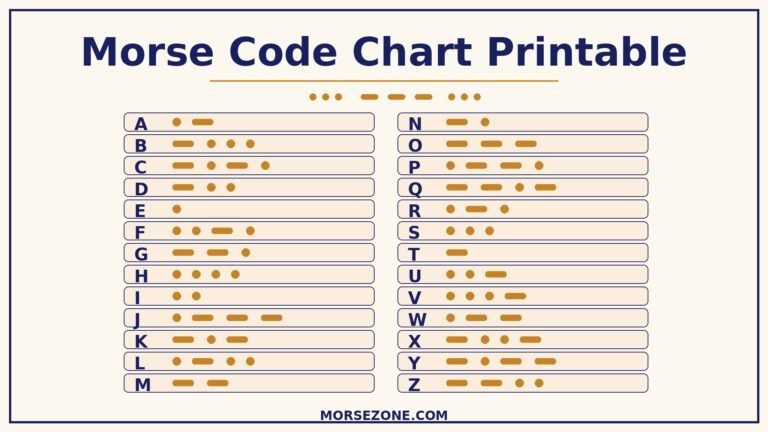
In International Morse Code, the standard maintained by the ITU, a dash lasts three times as long as a dot. So P has a distinctive rhythm: short, long, long, short. Among the 26 letters, P sits in the four-signal family alongside B, C, F, H, J, L, Q, V, X, Y and Z — letters that take a little more effort than quick codes like E or T, which makes P a good letter to learn once the simple ones feel automatic. You can see the whole set on the Morse code alphabet chart.
One quirk of the code’s history belongs to P itself: when the international code was settled in 1865, the patterns for O and P were borrowed from a signalling system developed by Carl August von Steinheil, rather than from Gerke’s revision that supplied most of the other letters. So P carries a small piece of telegraph history in its four signals.
How to Send P on a Telegraph Key
Timing is what turns dots and dashes into readable Morse. A dot is one unit of time, a dash is three units, the silence between signals inside a letter is one unit, and the pause between letters is three units. Here’s how to key P:
- Tap the key briefly for 1 unit (the dot).
- Release for 1 unit (the gap between signals).
- Press and hold for 3 units (dash one).
- Release for 1 unit.
- Hold again for 3 units (dash two).
- Release for 1 unit.
- Tap briefly for 1 unit (the final dot).
Beginners most often rush the dashes, making them sound like dots — then P (.–.) collapses into something unrecognisable. A practical fix: count “one-and-two” silently during each dash while you hold the key. Then type P into our free Morse code translator tool and listen back to hear exactly how the rhythm should sound.
What Does P Sound Like?
Operators vocalise P as “di-dah-dah-dit”. By long-standing radio convention, a dot that isn’t the last element of a letter is voiced “di” rather than “dit” — which is why P’s opening dot gets the short form. Say it out loud a few times and the pattern starts to feel like a doorbell: ding-dong-dong-ding — a quick ring, two long chimes, a quick ring.
To train your ear, try this drill: tap once lightly on a table, then twice with a slower, heavier tap, then once lightly again — tap … TAP … TAP … tap — keeping the gaps between signals short and even. That’s P. Unlike O in Morse code (—), which is a steady pulse of three long tones, P’s syncopation — short-long-long-short — gives it a bounce you can pick out of a busy signal.
Why P Is Easy to Remember: The Palindrome Trick
P has one of the best memory hooks in Morse code: its pattern is a palindrome. Dot-dash-dash-dot reads the same forwards and backwards, so once you know the first half, you automatically know the second. Very few letters share this symmetry — S (…), H (….), I (..) and O (—) are the only other examples, and all of them are single-element patterns. P is the only letter with a mixed palindrome.
A second hook is built into radio itself. P is “Papa” in the NATO phonetic alphabet, the spelling alphabet defined by the ICAO in 1955–56 so letters can’t be misheard over noisy radio. Spell the word PAPA in Morse — .--. .- .--. .- — and you’ll notice the letter P appears twice, right at the start of each “Pa” beat. “Papa” isn’t just how you say P on voice radio; it’s a mnemonic for how you signal it in Morse.
P in Words: Common Examples
Seeing P inside real words cements the pattern. Here are everyday words spelled out in Morse code — read them left to right and listen for the di-dah-dah-dit rhythm of P:
| Word | Morse code |
|---|---|
| PAPA | .–. .- .–. .- |
| POP | .–. — .–. |
| UP | ..- .–. |
| OPEN | — .–. . -. |
| PEN | .–. . -. |
| PLEASE | .–. .-.. . .- … . |
| PIZZA | .–. .. –.. –.. .- |
Notice how P anchors words like POP — dot-dash-dash-dot on both sides of the O — giving the word a drumbeat frame that’s easy to pick out even at speed. Try encoding your own name: if it contains a P, you’ll spot the palindrome rhythm instantly.
P on the Air: Ham Radio and Aviation
P earns its keep in real radio traffic. Amateur radio operators send it constantly in call signs, where “Papa” identifies the letter on voice and .–. identifies it in CW (continuous wave) Morse. On voice, you’ll hear it in the classic sign-off phrase: “DE G4PQR” becomes “Delta-Echo Golf-Four-Papa-Quebec-Romeo”. The ham tradition of “73” (best regards) lives in the same world of on-air shorthand that P belongs to — our guide to what 73 means in ham radio explains how those traditions grew out of 19th-century telegraphy.
In aviation, navigation beacons identify themselves with two- or three-letter Morse identifiers so pilots can confirm they’re tuned to the right station — and many of those identifiers contain a P. The same dot-dash logic that carries letters also carries digits in aviation and radio work, though every digit always uses exactly five signals, as our Morse code numbers guide explains.
P in the Bigger Picture of Morse Code
The International Morse Code we use today was standardised by the ITU (International Telecommunication Union), building on the code that Samuel Morse and Alfred Vail developed for the electric telegraph in the 1840s. One of Vail’s cleverest ideas was assigning the shortest codes to the most common letters — he estimated letter frequency by counting type in a local newspaper’s type cases, which is why E gets a single dot and T a single dash.
P, at roughly 2% of written English, is a mid-frequency letter, so it received a mid-length four-signal code. That four-signal length is no accident: it places P in the same difficulty band as letters like B, F and L, which is why P makes an excellent stepping stone once you’ve mastered the short codes and want a slightly longer pattern before tackling the trickiest letters like Q (–.-) or J (.—).
Practise P Right Now
- Type “P” into the Morse code translator and play the audio — listen to the di-dah-dah-dit rhythm five times.
- Tap the rhythm on a table while saying “di-dah-dah-dit” out loud.
- Send “PAPA” (.–. .- .–. .-) slowly, then gradually build up speed.
- Spell your own name in Morse and count how many P’s you send — the palindrome rhythm stands out.
- When P feels automatic, move on to the next letter in the series: Q (–.-) is a good follow-up, since it shares P’s four-signal shape.
Frequently Asked Questions
What is P in Morse code?
P in Morse code is .–. — one dot, two dashes and one dot. Its pattern is a palindrome, reading the same forwards and backwards.
How do you say P in Morse code?
Operators vocalise P as “di-dah-dah-dit”. A dot is voiced “di” when it isn’t the last element of a letter, which is why P opens with “di” rather than “dit”. It sounds a little like a doorbell: ding-dong-dong-ding.
Is P hard to remember in Morse code?
Not at all — it’s one of the easiest four-signal letters. The pattern is symmetric (dot-dash-dash-dot), and the NATO phonetic word “Papa” doubles as a mnemonic: spell PAPA in Morse and the letter P appears twice.
What’s the NATO phonetic word for P?
P is “Papa” in the NATO/ICAO spelling alphabet. Note that the spelling alphabet and Morse code are separate systems — Papa is how you say the letter on voice radio, while .–. is how you signal it in Morse.
How is P used in ham radio and aviation?
Ham radio operators send P in call signs every day, both in Morse (CW) and on voice as “Papa”. In aviation, navigation beacons broadcast multi-letter Morse identifiers — often containing P — so pilots can confirm the station.
P is one of those letters that rewards you for learning it: a neat palindrome, a built-in mnemonic in “Papa”, and a rhythm you’ll hear everywhere once your ear is trained. Keep practising with the Morse code translator, and di-dah-dah-dit will soon feel like second nature.