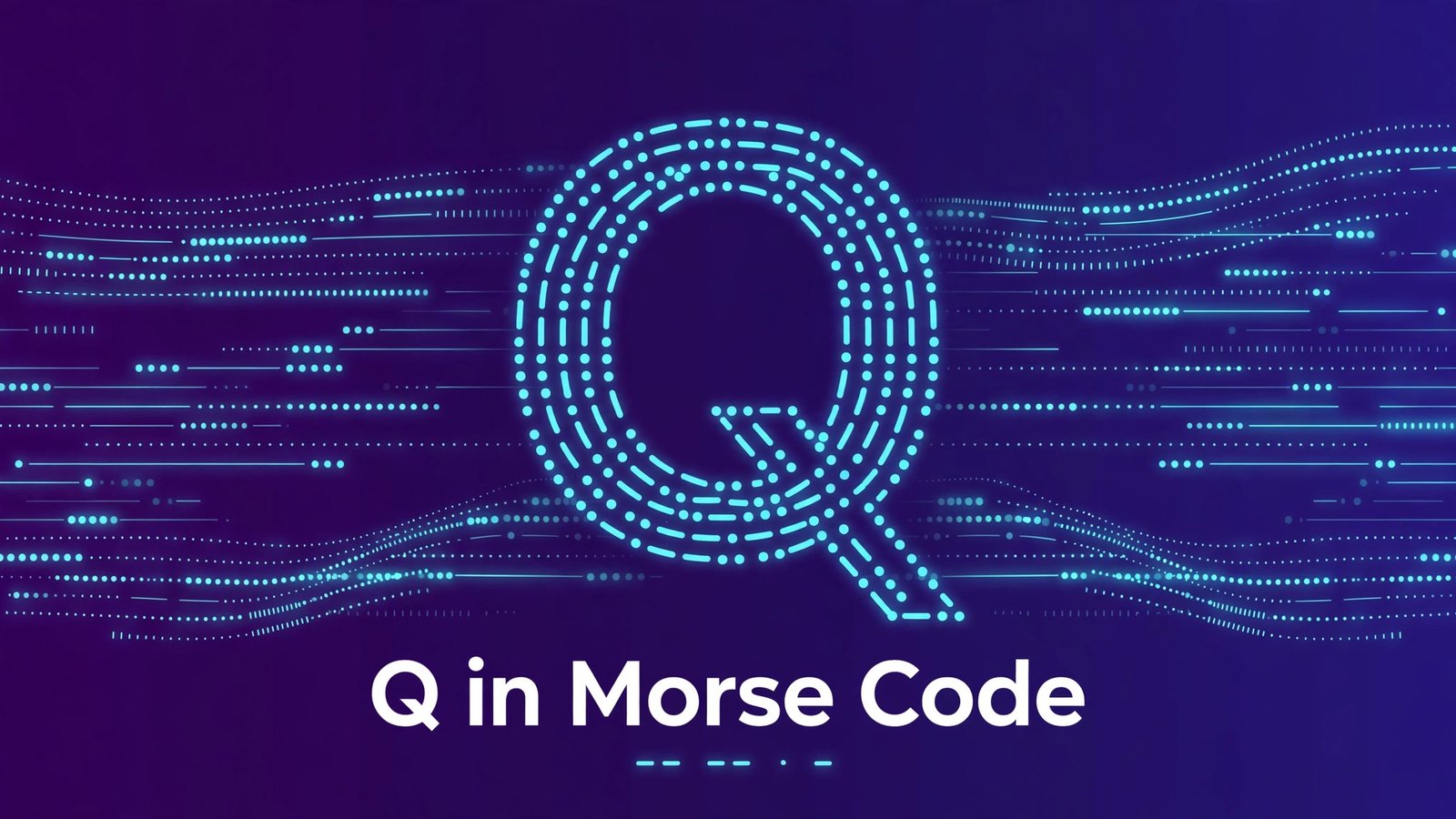
Q in Morse code is ––·– (dash dash dot dash). It is one of the few letters with a four-signal pattern, which makes it one of the most rhythmically distinctive characters in International Morse Code. In this guide you will learn how to send it, how to say it out loud, why it matters so much in amateur radio, and where you have already heard it in real life — every time a train approaches a crossing.
What is Q in Morse code?
The letter Q is written as ––·–: two dashes, a dot, then a dash. Spoken aloud by operators, it becomes “dah-dah-di-dah”. Radio operators use “dit” for a dot and “dah” for a dash, because those syllables mimic the actual sound of the signals.
Like every character in International Morse Code, Q follows strict timing rules that keep the pattern readable:
- A dot lasts 1 time unit
- A dash lasts 3 time units
- The gap between signals inside one letter is 1 unit
- The gap between letters is 3 units
- The gap between words is 7 units
So Q sounds like: dah (pause) dah (pause) dit (pause) dah — long, long, short, long. Q belongs to the four-signal family of the alphabet, alongside B, C, F, H, J, L, P, V, X, Y and Z. You can see the whole family in our full Morse code alphabet chart, which groups every letter by signal count so you can learn them in rhythm families instead of A to Z.
How to say Q in Morse code: the “God save the Queen” mnemonic
The easiest way to memorise Q is a phrase whose natural rhythm matches its pattern: “GOD SAVE THE QUEEN” — GOD (dah), SAVE (dah), THE (di), QUEEN (dah). Say it with long, punchy syllables on the dahs and a quick “the” in the middle, and you are literally speaking ––·–.
This kind of sound-matching mnemonic is one of the oldest tricks in telegraphy training: operators who attach a rhythm word to each pattern recall letters far faster than those who memorise dots and dashes visually. Memory experts use the same technique, and “God Save the Queen” is the classic example given for Q in mnemonic-based Morse courses (source).
Try it now: tap two long taps, one short tap and one long tap on your desk while saying “GOD SAVE THE QUEEN”. Three repetitions is usually enough for the rhythm to stick.
Why Q is special in amateur radio: the Q codes
Q is the only letter that gives its name to an entire signalling system. Q codes (also called Q signals) are three-letter codes that all begin with Q, developed for commercial radiotelegraph communication and still used daily by amateur (ham) radio operators, aviation and maritime services. They compress whole sentences into three letters, which is invaluable when signals are weak or operators speak different languages.
Some of the most common Q codes you will hear on the air:
| Code | Meaning |
|---|---|
| QSO | A contact or conversation (“I had a great QSO last night”) |
| QTH | Location (“My QTH is Lahore”) |
| QRM | Interference from other stations |
| QRN | Static or natural noise |
| QRP | Low-power operation |
| QSL | Acknowledgment of receipt (QSL cards confirm contacts) |
| QRZ | “Who is calling me?” |
| QRT | “Stop transmitting” |
| QSY | “Change frequency” |
These codes were standardised internationally so that a Japanese ship, a German aircraft and an American ham operator can all understand each other without a shared language. They sit in the same tradition as the famous “73” shorthand that hams still send as a friendly sign-off — compact codes carrying big meaning.
The sound you already know: the train horn
If you have ever waited at a railway crossing, you have heard Q in Morse code. North American locomotives are required to sound a long-long-short-long horn blast when approaching a public grade crossing — exactly the rhythm of ––·–, the letter Q.
Known as the “Rule 14(l)” signal, engineers must begin the sequence at least 15 to 20 seconds before reaching the crossing and continue until the lead locomotive fully occupies the intersection. The origin of choosing Q is debated — one legend says it was a maritime signal requesting right of way on behalf of the Queen — but its distinct, unmistakable pattern is what matters: it is a critical safety warning for motorists and pedestrians (source).
So the next time you hear that familiar horn, you can smile: you are listening to Morse code doing its job in 2026.
Q in words: spell it yourself
The best way to lock Q into memory is to use it. Here are some common words spelled out, with Q highlighted:
| Word | Morse code |
|---|---|
| QUEEN | ––·– ··– · · –· |
| QUIZ | ––·– ··– ·· ––·· |
| QUICK | ––·– ··– ·· –·–· –·– |
| SQUAD | ··· ––·– ··– ·– –·· |
| IRAQ | ·· ·–· ·– ––·– |
| REQUEST | ·–· · ––·– ··– · ··· – |
Type any of these into our free Morse Code Translator to hear the exact rhythm, see the signal lights flash, and compare how Q’s long-long-short-long beat stands out from the shorter letters around it. Compare it with the famous distress call on our SOS in Morse code page — SOS is ···–––··· with no gaps, while Q keeps the strict one-unit pauses between its signals.
A short history: why Q got four signals
The code was developed in the 1830s and 40s by Samuel Morse and Alfred Vail for the electric telegraph. Vail famously studied letter frequency by counting the type in a Philadelphia newspaper’s printing cases, and the designers assigned the shortest patterns to the most common letters: E got a single dot, T a single dash.
Q is one of the rarest letters in English, so it received one of the longest codes: four signals, ––·–. That frequency-based design is why ordinary English text transmits faster than random characters — the system was literally engineered around the language it carried (source). The first public message on the Baltimore–Washington line in 1844, “What hath God wrought”, already relied on this design.
International Morse Code was later standardised by the International Telecommunication Union (ITU), and it is the same code used today in amateur radio, aviation beacons and emergency signalling worldwide — which is why the Q you learn here works in every country.
How to practise Q (and actually remember it)
- Flashlight drill: two long flashes, one short flash, one long flash. Send Q to a friend across the room and have them decode it — the same method used for emergency signalling.
- Tap drill: knock “GOD SAVE THE QUEEN” on a table, stressing the long syllables. Then try decoding words like QUIZ and SQUAD from the table above.
- Audio training: listen to Q at different speeds. Start slow, then work toward 15–20 WPM (words per minute), the comfortable conversational speed for CW operators.
- Group study: learn Q with its four-signal siblings (B, C, F, H, J, L, P, V, X, Y, Z) — rhythm families are easier to keep straight than the alphabet in order.
For a full step-by-step system, read our guide to learning Morse code — ten to fifteen minutes of daily practice with sound, not just charts, is what turns patterns into reflex.
Frequently asked questions
What is Q in Morse code?
Q in International Morse Code is ––·– — dash dash dot dash, spoken as “dah-dah-di-dah”.
How do you pronounce Q in Morse code?
Say “dah-dah-di-dah”, or use the mnemonic “GOD SAVE THE QUEEN”, whose syllables match the long-long-short-long rhythm exactly.
Why does a train horn sound like the letter Q?
Railroad rules require a long-long-short-long horn signal (Rule 14(l)) before grade crossings, and that rhythm is identical to the Morse letter Q. It is a safety warning, not a coincidence of music.
What are Q codes in ham radio?
Q codes are three-letter brevity signals starting with Q — such as QSO (contact), QTH (location) and QSL (acknowledgment) — used by amateur radio operators, aviation and maritime services to communicate clearly across language barriers.
Is Q one of the hardest letters to learn?
It has four signals, but its distinctive long-long-short-long rhythm and the “God save the Queen” mnemonic make it one of the easiest four-signal letters to recognise by ear. Practise it with its rhythm family (B, C, F, H, J, L, P, V, X, Y, Z) and it sticks quickly.
Conclusion
Q may be rare in English, but in Morse code it is unforgettable: ––·– gives its name to the Q codes of amateur radio, sounds from every train horn at every crossing, and carries one of the catchiest mnemonics in telegraphy. Learn its rhythm with the alphabet chart, test yourself on the Morse Code Translator, and Q will be one of the first letters you recognise by ear.