Exclamation Mark in Morse Code (-.-.–)
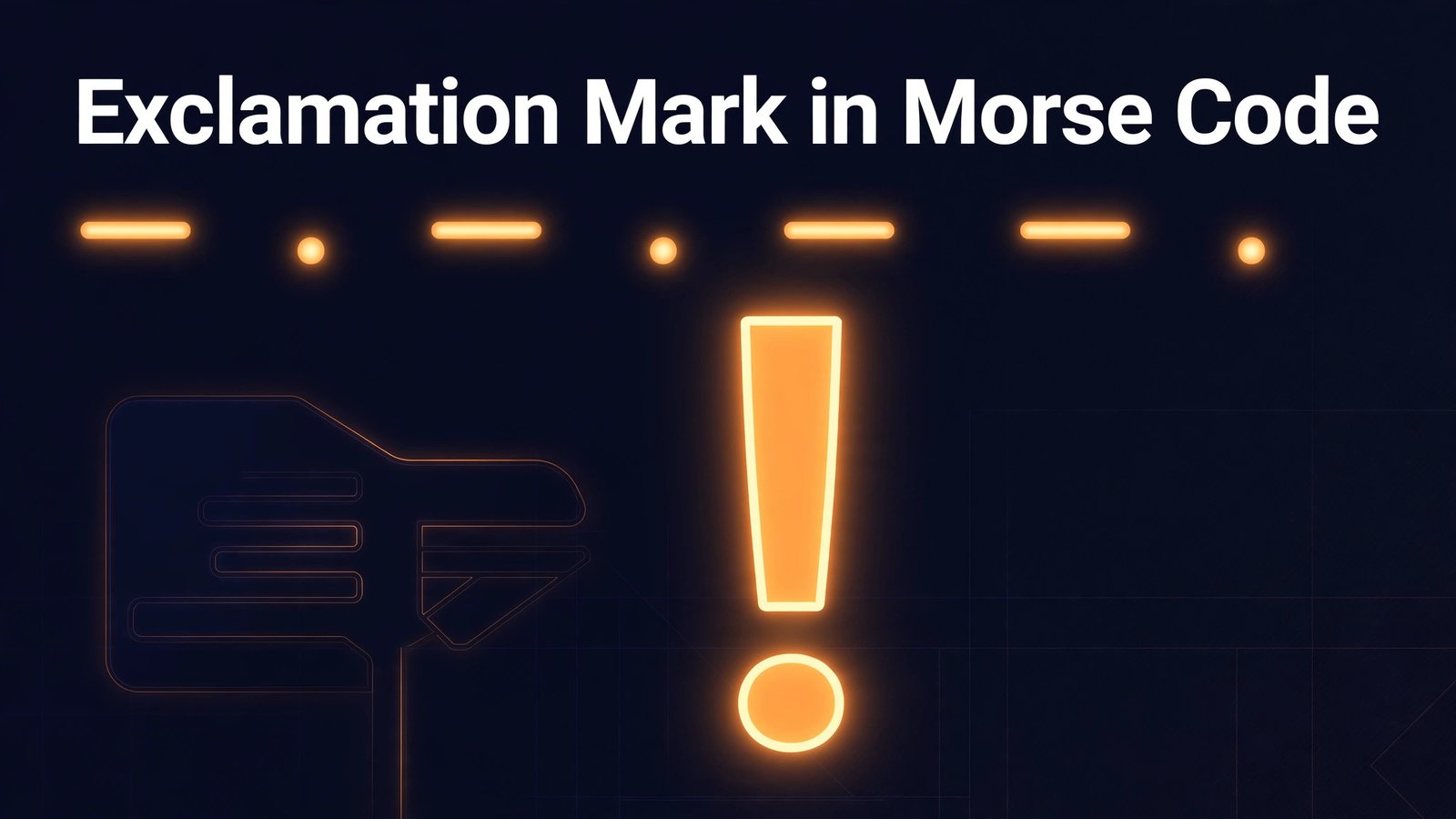
The exclamation mark has its own official code in International Morse Code: -.-.--. Like the question mark, period and comma, it belongs to the standard punctuation set defined by the ITU — even though old-time telegraphers almost never keyed it. This guide covers the pattern, its timing, how to send and recognise it, and when it is actually used.
What Is the Exclamation Mark in Morse Code?
In International Morse Code, the exclamation mark ! is represented by six signals:
-.-.--
That is: dash, dot, dash, dot, dash, dash. Memorise the rhythm — three dashes split by two dots — and you will recognise it instantly. Like all Morse characters, the pattern traces back to the code formalised by Samuel Morse, Alfred Vail and their collaborators in the 1840s, and standardised internationally through the ITU Radio Regulations.
You can hear and practise this exact pattern right now on the Morse Zone Morse code translator: type !, and the tool plays the audio while highlighting each dot and dash.
Timing Breakdown of -.-.–
Morse timing follows strict rules: a dot is 1 unit, a dash is 3 units, the gap between parts of the same character is 1 unit, the gap between characters is 3 units, and the gap between words is 7 units. Here is how the exclamation mark breaks down:
| Signal | Position | Length (units) |
|---|---|---|
- dash | 1 | 3 |
. dot | 2 | 1 |
- dash | 3 | 3 |
. dot | 4 | 1 |
- dash | 5 | 3 |
- dash | 6 | 3 |
Total: 16 units of signal plus 5 single-unit gaps, so the whole character takes 21 units — one of the longest characters in the standard set. At 20 words per minute (WPM), that is roughly half a second of audio.
How to Send the Exclamation Mark in Morse Code
With a straight key or paddle
Key dash-dot-dash-dot-dash-dash with clean 1-unit gaps between the parts. The most common beginner mistake is rushing the two dots in the middle — keep them short and crisp so the character does not blur into its neighbours. Leave a full 3-unit gap before the next character.
With a flashlight or lamp
Long flash = dash, short flash = dot. Send long, short, long, short, long, long, with brief pauses between flashes. This is the same technique covered in our guide to famous messages in Morse code, where timing discipline matters more than speed.
By tapping or knocking
Heavy tap = dash, light tap = dot. The pattern survives even through walls and water pipes — the reason Morse stayed useful in emergencies long after the telegraph faded. If you are learning from scratch, our guide on how to learn Morse code fast explains why starting at full character speed (the Farnsworth method) beats counting dots and dashes.
How to Recognise It When Decoding
The exclamation mark has a distinctive “bouncy” rhythm: dah-di-dah-di-dah-dah. It is easy to confuse with neighbouring punctuation, so use these checks:
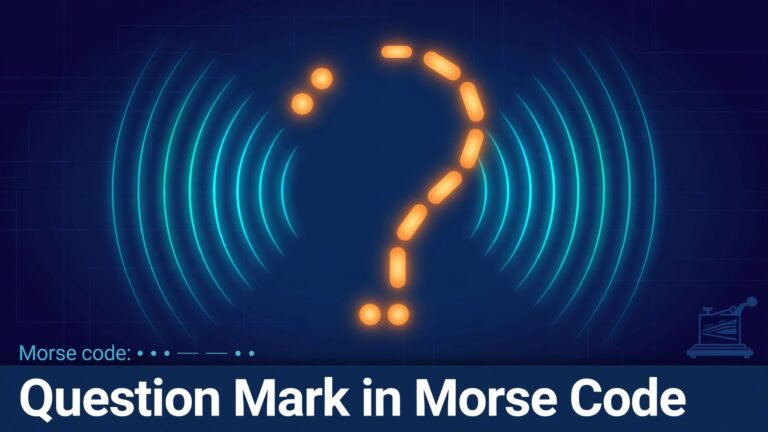
- Question mark
..--..starts with two dots; the exclamation mark starts with a dash. - Apostrophe
.----.also has six signals, but its dots and dashes are arranged differently (di-dah-dah-dah-dah-di). - Number patterns like
--...(7) sound similar in length but end with three dots, not two dashes. - Count the dashes: the exclamation mark is the only standard character with the exact sequence dash-dot-dash-dot-dash-dash.
Memory Aids for -.-.–
Six-signal characters are the hardest to memorise, so anchor the exclamation mark to something you already know:
- The “echo” trick: think of the question mark
..--..flipped — the exclamation mark starts with a dash and ends with two dashes instead of two dots. - Number anchor: the digit 2 is
..---; the exclamation mark keeps the two-dot/two-dash feel but opens with-.-.(which is also the letter C). - Mnemonic phrase: “DASH dot DASH dot DASH DASH” said out loud in rhythm, with a foot tap on each dash.
- Write it out: hand-copy
-.-.--ten times in a row, then quiz yourself an hour later. Spaced repetition is the core of the Koch method for sound-based learning.
When Is the Exclamation Mark Actually Used in Morse?
Honest answer: rarely. Classical landline and shipboard telegraphy was formal and terse — operators used “STOP” for periods and seldom expressed excitement. Ham radio operators in the amateur tradition are similarly sparing; check our guide to what 73 means in ham radio for a sense of the culture. Modern usage is mostly:
- Learning and exams: the full punctuation set, including the exclamation mark, appears in licensing study material.
- Casual on-air chat: some operators key it for emphasis in friendly ragchews.
- Craft and art projects: Morse bracelets, tattoos and wall art use it to punctuate phrases.
- Decoders and translators: software like the Morse Zone translator supports the full ITU set, so ! converts cleanly in both directions.
Exclamation Mark vs Other Morse Punctuation
The six-signal punctuation cluster is the section of the code most learners trip over. Compare them side by side:
| Punctuation | Morse pattern | Shape |
|---|---|---|
| Question mark | ..--.. | starts with two dots |
| Exclamation mark | -.-.-- | starts with a dash |
| Period | .-.-.- | alternating, ends with a dash |
| Comma | --..-- | starts with two dashes |
| Apostrophe | .----. | dots sandwich four dashes |
| Hyphen | -....- | dashes sandwich four dots |
Notice how each six-signal character is a near-mirror of another — that symmetry is deliberate, and learning them as pairs (?/!, ./,, ‘/-) halves the memorisation work.
Practice Exercise: Decode This
Try decoding this short message by ear or on paper, then check yourself with the Morse code translator:
.... .. -.-.--
Letter by letter: .... = H, .. = I, -.-.-- = ! — so the message reads “HI!”. Exclamation marks most often appear at the end of short phrases like this, which makes them easy to spot in context.
FAQ
What is the exclamation mark in Morse code?
The exclamation mark (!) in International Morse Code is -.-.--: dash, dot, dash, dot, dash, dash. It is part of the standard ITU punctuation set.
How do you type an exclamation mark in a Morse code translator?
Just type the ! character into the text field of a full-featured translator such as the Morse Zone translator. It converts to -.-.-- automatically and plays the correct audio timing.
Is the exclamation mark in American Morse code different?
Yes. American (railroad) Morse used a different code family with its own punctuation. The pattern -.-.-- belongs specifically to International Morse Code, the standard used by the ITU, amateur radio operators and modern decoders worldwide.
Why is the exclamation mark so rarely used in Morse?
Telegraph and radio traffic was historically formal and economical — operators paid by the word and wrote in terse style, so expressive punctuation simply had no place. The code exists in the standard, but old-timers keyed it almost never.
What is the easiest way to remember -.-.–?
Pair it with the question mark ..--..: the exclamation mark is its “mirror” — where the question mark starts with dots, the exclamation mark starts with a dash and ends with a double dash. Practise the two back to back until the contrast sticks.
Conclusion
The exclamation mark — -.-.-- — is one of the longest and least-used characters in International Morse Code, but it completes the standard punctuation set alongside the question mark, period and comma. Learn it as part of the six-signal punctuation cluster, anchor it to its mirrored partner the question mark, and practise at full speed with the Morse Zone Morse code translator until dah-di-dah-di-dah-dah is unmistakable.