Learning numbers in Morse code opens up a whole new layer of the code beyond the alphabet. After the letters A to Z, the natural next step for any student is the digits 0 through 9 — and the number 2 is one of the most satisfying to learn. Its pattern is elegant, its sound is distinctive, and once you know it, you can recognise it instantly in everything from ham radio call signs to maritime signals.
In this guide you will learn exactly what 2 in Morse code is, how it sounds, how to send it with correct timing, and simple memory tricks that make it stick. Try each example with our free Morse Code Translator as you read.
What Is 2 in Morse Code?
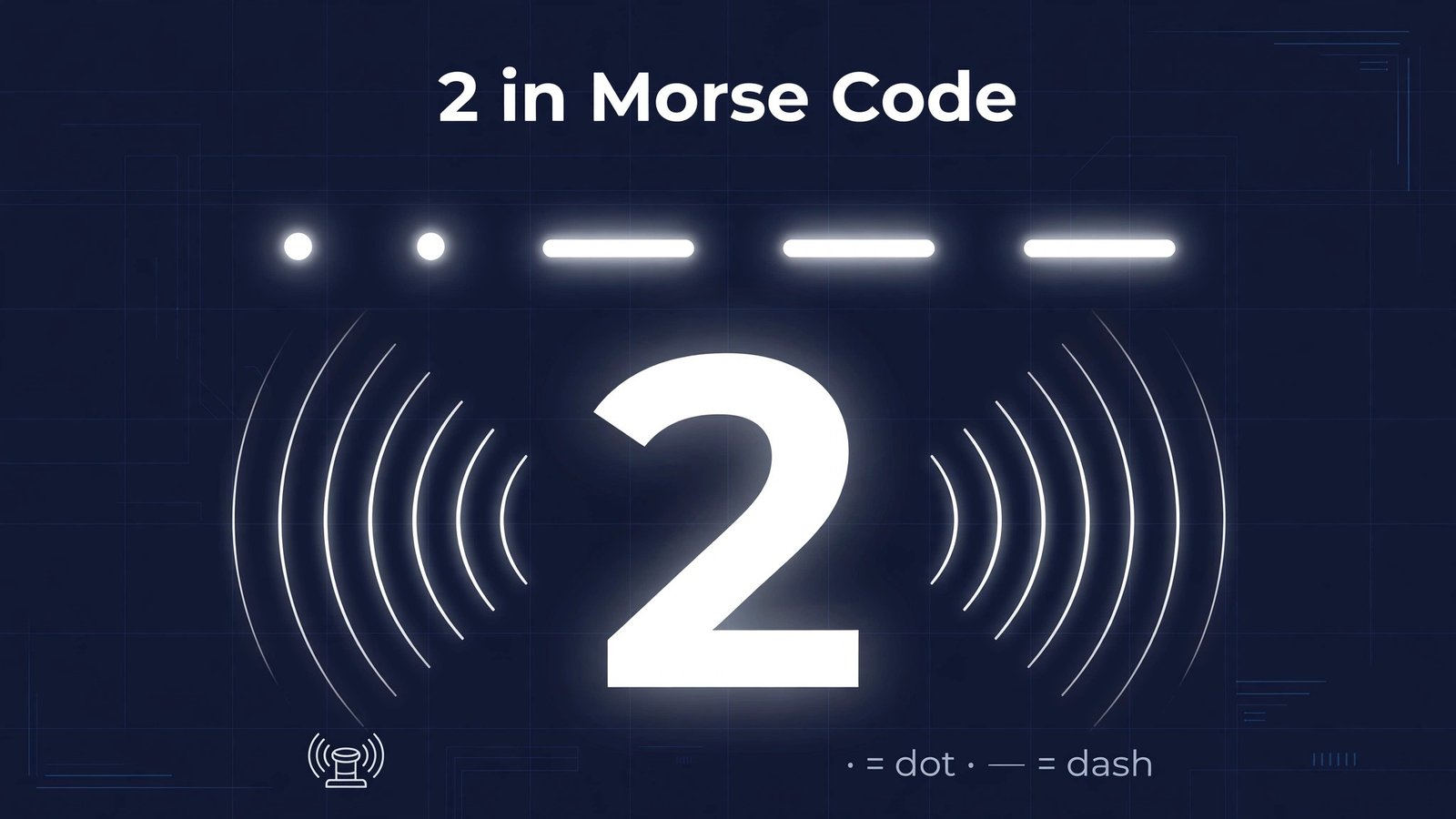
The number 2 in Morse code is ..--- — two dots followed by three dashes. Spoken out loud, that is “dit-dit-DAH-DAH-DAH”.
| Character | Morse Code | Sound |
|---|---|---|
| 2 | ..— | dit-dit-DAH-DAH-DAH |
The pattern is easy to verify. Every digit in International Morse Code uses exactly five elements — five dots and dashes combined. The number 2 balances two short marks (dots) against three long marks (dashes), which is also what makes it so recognisable by ear: two quick clicks, then three long tones.
How to Read the Pattern: Dots vs Dashes
If you are new to Morse code, here is the quick refresher:
- Dot (·) — also called a “dit”. A short signal lasting one time unit.
- Dash (—) — also called a “dah”. A long signal lasting three time units.
So ..--- breaks down as: dot (1 unit) → dot (1 unit) → dash (3 units) → dash (3 units) → dash (3 units), with a one-unit silent gap between each element. Do not skip those tiny gaps — they are part of the code, and without them the five elements blur into one long noise.
What Does 2 Sound Like in Morse Code?
In standard on-air voice procedure, operators read the digit as “dit-dit-DAH-DAH-DAH”, stressing the dashes. At slow speeds you can hear each of the five elements separately: beep-beep-BEEEP-BEEEP-BEEEP.
The character speed matters here. In amateur radio, sending speed is measured in words per minute (WPM), and contest operators often run at 25 to 35 WPM. At those speeds the digits are sent as a single rhythmic unit rather than five conscious elements, which is why learning to recognise the rhythm of ..--- — rather than counting dots and dashes — is the real skill. That listening-first approach is the heart of the Koch method, where you learn characters at full speed from day one.
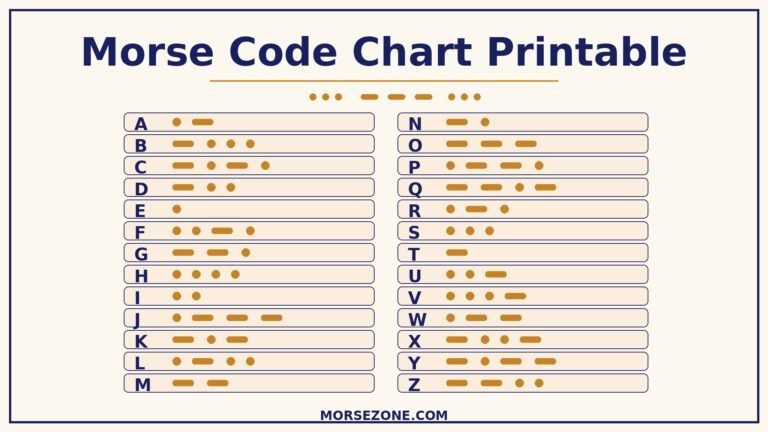
The Full Morse Code Number Pattern (0–9)
The number 2 makes much more sense once you see the whole digit system. Notice the beautiful logic: the codes count in binary-like steps, mirroring each other around 5.
| Number | Morse Code | Pattern |
|---|---|---|
| 1 | .—- | 1 dot + 4 dashes |
| 2 | ..— | 2 dots + 3 dashes |
| 3 | …– | 3 dots + 2 dashes |
| 4 | ….- | 4 dots + 1 dash |
| 5 | ….. | 5 dots |
| 6 | -…. | 1 dash + 4 dots |
| 7 | –… | 2 dashes + 3 dots |
| 8 | —.. | 3 dashes + 2 dots |
| 9 | —-. | 4 dashes + 1 dot |
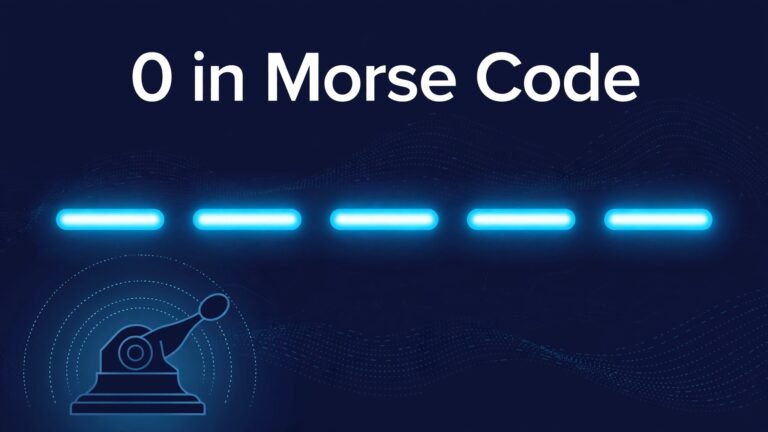
| 0 | —– | 5 dashes |
See the symmetry? Digits 1 through 4 start with dots and end with dashes; 6 through 9 mirror them, starting with dashes and ending with dots; and 5 and 0 are the two “all one kind” extremes. The number 2 sits right in the middle of the ascending half of the system. If you already learned 1 in Morse code (.----), moving to 2 is simply a matter of swapping one dash for a dot. If you are starting the series fresh, you may also want to read our guide to 0 in Morse code (-----), the opposite end of the scale.
Why Do the Numbers Look Like This? A Little History
The original code developed by Samuel Morse and Alfred Vail in the 1840s — the American Morse Code used on US railroad telegraph lines — assigned its shortest sequences to the most common letters. When the code was standardised internationally (the system we now call International Morse Code, formalised with input from the International Telecommunication Union (ITU)), the digits were given clean five-element codes so they could never be confused with shorter letter sequences.
Five elements may sound long, but there was a good reason: with only the 26 short letter codes in use, any sequence of five or fewer marks was already taken. Giving every digit exactly five elements carved out a dedicated, unambiguous space for numbers. That is also why the distress signal SOS (...---...) works so well — it is instantly recognisable as nine marks, nothing like any letter or digit. The Wikipedia article on Morse code traces this standardisation in detail.
Memory Tricks: How to Remember ..— Forever
Here are the techniques that actually work, ranked from simplest to most powerful:
- The count method. Two dots, three dashes. “Two dits, three dahs” — just count it while tapping. For 2, the count is the mnemonic.
- The mirror method. 2 is the mirror of 7.
..---vs--...— swap every dot for a dash and you get its opposite. Learn them as a pair. - The rhythm method. Clap it out: tap-tap-CLAP-CLAP-CLAP. Say it until the rhythm feels like a drumbeat. Rhythm memory outlasts visual memory.
- The staircase image. Picture the digits 1–5 as a staircase: one dot and four dashes, two dots and three dashes, and so on, climbing toward
...... The 2 is the second step. - The sound method. Use the Morse Code Translator to play
..---on repeat at 20 WPM until you can identify it without counting. This is the Koch-method shortcut: hear the whole character as one sound.
How to Send 2 in Morse Code (Correct Timing)
Sending the number correctly is about timing, not speed. The official timing rules of International Morse Code are:
- A dot lasts 1 time unit.
- A dash lasts 3 time units.
- The gap between elements of one character is 1 time unit.
- The gap between characters is 3 time units.
- The gap between words is 7 time units.
So to key ..---: short press, short press, long press, long press, long press — with a brief release between each press. Beginners usually make the dashes too short; if your “dah” is not roughly three times your “dit”, the 2 can start sounding like the letter B (-...) or a jumbled mess. Practise slowly, then speed up only when the rhythm is automatic.
If you are keying by hand, a straight key or even a pencil tapping on a desk works. Many learners also practise Morse code with a flashlight — short flash for a dot, long flash for a dash — which is a genuinely useful emergency-signalling skill, not just a party trick.
Common Mistakes to Avoid
- Rushing the dashes. Short dashes are the number-one beginner error. Exaggerate them at first; tighten up later.
- Skipping the element gaps. Without the one-unit pauses,
..---collapses into an unreadable blur. - Confusing 2 with 3 or 1. Neighbouring digits differ by only one element (
.----vs..---vs...--), so practise the 1-2-3 run as a set. - Counting instead of hearing. If you are still counting dots under pressure, you will freeze at real speed. Train recognition, not arithmetic.
Where You’ll Hear the Number 2
Digits show up everywhere in real Morse traffic. Amateur radio call signs almost always contain a number — US call signs carry digits like W1, K2, or N3 — and contest exchanges are dense with five-element digits. Maritime and aviation identifiers, emergency signal timings, and even numbers stations all rely on the digit codes. And of course, once you know 2, you are one step closer to decoding full timestamps, coordinates, and call signs by ear.
Frequently Asked Questions
What is 2 in Morse code?
2 in Morse code is ..--- — two dots followed by three dashes, sounded as “dit-dit-DAH-DAH-DAH”. Every digit in International Morse code uses exactly five elements.
How do you say “2” in Morse code out loud?
Operators voice it as “dit-dit-DAH-DAH-DAH”, stressing the three long dashes. At practice speed, clap it as tap-tap-CLAP-CLAP-CLAP.
Is 2 the mirror of 7 in Morse code?
Yes. 2 is ..--- and 7 is --... — every dot and dash is swapped. Learning them as a mirror pair is one of the fastest memory tricks.
How long is the Morse code for 2 compared to letters?
Letters use one to four elements (E is a single dot, for example — see our guide to E in Morse code), while every digit uses exactly five. That is why digits always sound “longer” than letters on the air.
Can I practise 2 in Morse code online?
Yes — type “2” (or any text containing it) into our free Morse Code Translator and press play to hear ..--- at adjustable speed. Repeating it until you recognise the rhythm without counting is the fastest way to learn.
Conclusion
The number 2 in Morse code — ..--- — is two dots and three dashes, sounded as “dit-dit-DAH-DAH-DAH”. Learn its rhythm, pair it with its mirror 7, and drill the 1-2-3 run until the pattern is automatic. From there, the rest of the digit series falls into place quickly. Keep practising with the Morse Code Translator, and the numbers will become second nature.