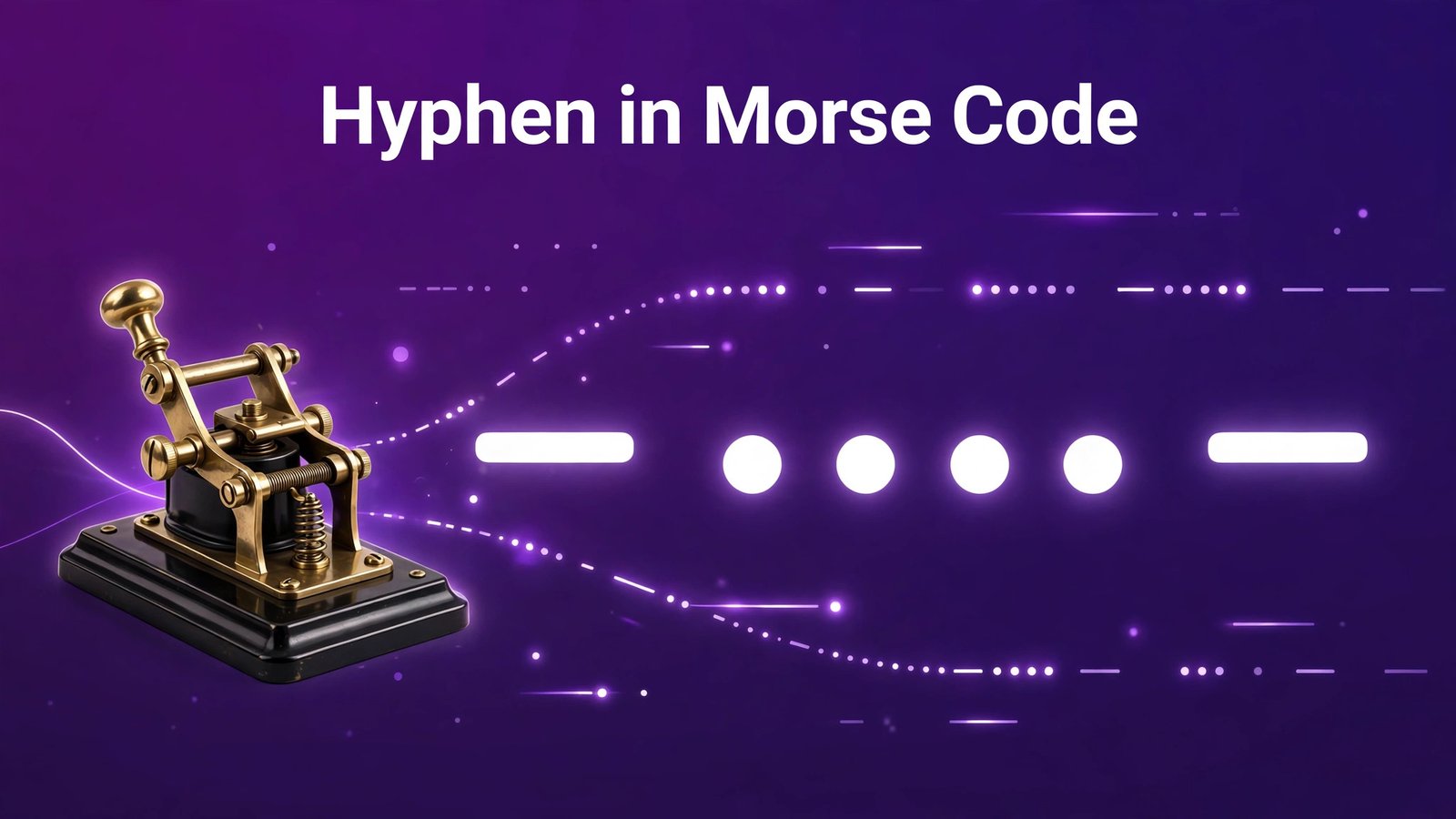
The hyphen in Morse code is -....- — dash, four dots, dash. It is the small connector that lets Morse code carry real written English: compound words like well-known, dates like 2026-11-06, and words split across the end of a line. Without it, every hyphenated word would arrive as two separate words and lose its meaning. Try it yourself: type a hyphenated word into the Morse Code Translator and listen for -....- exactly where the hyphen sits.
What is the hyphen in Morse code?
In International Morse Code, the hyphen is sent as six elements: -....-. Say it out loud as “dah-dit-dit-dit-dit-dah” — one long tone, four short ones, and a long tone to finish. The pattern is symmetrical, a dash on each end with four dots in the middle, which makes it one of the easiest punctuation marks to recognise once you have heard it a few times.
| Element | Signal | Length |
|---|---|---|
| 1 | Dash (-) | 3 time units |
| 2 | Dot (.) | 1 time unit |
| 3 | Dot (.) | 1 time unit |
| 4 | Dot (.) | 1 time unit |
| 5 | Dot (.) | 1 time unit |
| 6 | Dash (-) | 3 time units |
Sending -....- uses the same timing rules as every other Morse character, whether you are tapping a key, blinking a flashlight, or keying a buzzer:
- Dot: 1 time unit (a short tap or flash)
- Dash: 3 time units (three times as long as a dot)
- Gap between elements of one character: 1 time unit
- Gap between characters: 3 time units
- Gap between words: 7 time units
So a hyphen is: long-short-short-short-short-long, with one-unit pauses between the six elements and a three-unit pause after. At 20 words per minute (WPM), one unit is about 60 milliseconds, which makes the whole hyphen take just under a second — the same standard timing the Morse Code Translator uses when it plays audio back to you. Practice slowly first: hold the opening dash for a full three counts, tap the four dots evenly, and land the closing dash firmly. Accuracy beats speed, and the four-dot run in the middle is the part that needs the most control — rush it and the dots blur together.
How to send a hyphen in Morse code
On a straight key, the hyphen is a satisfying rhythm to send: press and hold for the opening dash, tap four quick dots, then press and hold again for the closing dash. Keep your wrist relaxed and let the dots fall at an even pace — uneven dots are the most common reason a hyphen is misread.
On a paddle or iambic keyer, send one dah with the dash paddle, four dits with the dot paddle, and one more dah. If your keyer has a memory, do not let it swallow the final dash: the closing dash is what separates the hyphen from the number 6, as explained below.
The same timing works on any signalling method. With a flashlight, a long flash, four short flashes, and a long flash spell the hyphen; with a buzzer or a whistle, a long tone, four short tones, and a long tone do the same job. The character is the timing, not the device.
How to hear (read) the hyphen
Listening for the hyphen means listening for its shape: a long tone, a quick run of four short tones, and a long tone. The rhythm sounds like “daaah-dit-dit-dit-dit-daaah”, and once you have heard it a few times you will recognise the sandwich shape — long-short-short-short-short-long — without counting.
Two memory hooks help it stick:
- The sandwich picture. See the pattern as a sandwich: two long dashes as the bread on each side, with four short dots as the filling. Dash, four dots, dash. Once you picture the shape, your hand remembers it before your brain does.
- Learn it from the number 6. The number 6 is
-....— one dash followed by four dots. The hyphen is exactly that pattern with one extra dash on the end. If you know 6, you already know five-sixths of the hyphen; just add the closing dash.
Hyphen, minus sign, and dash: is it the same pattern?
Yes. In International Morse Code, the pattern -....- does double duty: it is both the hyphen and the minus sign. The receiver tells them apart from context, not from the signal — WELL-KNOWN is clearly a hyphenated word, while 10-4 is clearly a subtraction or a separator. Written English makes the same distinction by context, and Morse code follows it.
There is no separate Morse code for the en dash (–) or the em dash (—). When an operator needs a dash in a message, the hyphen pattern is what gets sent. This is one of the simplifications of International Morse Code: the older American Morse Code of Samuel Morse and Alfred Vail had a distinct long dash, but the international system standardised on a single dash length and a single hyphen-minus character, as documented by the International Telecommunication Union (ITU).
Hyphenated words in Morse code
The hyphen earns its place in everyday words. Here are common hyphenated words written out in full, with a character gap between letters and no word gap around the hyphen — because well-known is one word, not two:
| Word | Morse code |
|---|---|
| WELL-KNOWN | .-- . .-.. .-.. -....- -.- -. --- .-- -. |
| MOTHER-IN-LAW | -- --- - .... . .-. -....- .. -. -....- .-.. .- .-- |
| TWENTY-ONE | - .-- . -. - -.-- -....- --- -. . |
| UP-TO-DATE | ..- .--. -....- - --- -....- -.. .- - . |
| CHECK-IN | -.-. .... . -.-. -.- -....- .. -. |
| SELF-TEST | ... . .-.. ..-. -....- - . ... - |
Notice how the hyphen sits inside the word with character gaps on both sides. Getting the spacing right is what turns beeps into readable language — the same spacing discipline that keeps numbers and letters unambiguous in real traffic. For a look at what fluent operators can do with the code, browse our collection of famous messages sent in Morse code, from wartime signals to space transmissions.
Hyphen vs. other Morse punctuation
Here is the hyphen alongside the punctuation marks you will meet most often, so you can compare patterns at a glance:
| Punctuation | Morse code | Sound |
|---|---|---|
| Hyphen (-) | -....- | dahdididididah |
| Period (.) | .-.-.- | didahdidahdidah |
| Comma (,) | --..-- | dahdahdididahdah |
| Question mark (?) | ..--.. | dididahdahdidit |
| Exclamation mark (!) | -.-.-- | dahdidahdahdahdit |
| Apostrophe (‘) | .----. | didahdahdahdahdit |
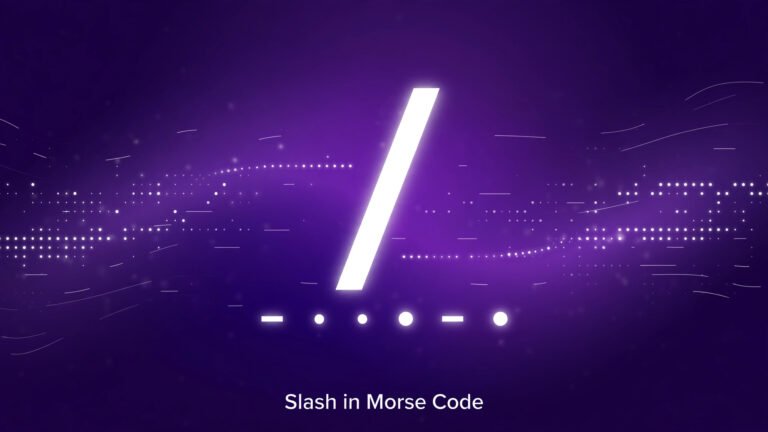
| Slash (/) | -..-. | dahdididahdit |
| Colon (:) | ---... | dahdahdahdididit |
Almost every one of these is six elements long — the slash is the shorter exception at five. The hyphen is the only one that opens with a dash, runs four dots, and closes with a dash. If you hear a long tone, a run of four short tones, and a long tone, it is the hyphen. The closest lookalike is the number 6 (-....): five elements, no closing dash. That single final dash is the whole difference, so send it deliberately. Learn the openings and the middles, and you will never mix them up. The question mark, the period, the comma, the exclamation mark, and the apostrophe each have their own guides on this site if you want to learn the full punctuation set.
Common mistakes with the hyphen
Four errors trip up almost everyone. First, dropping the final dash: send -.... instead of -....- and the receiver hears the number 6, turning WELL-KNOWN into WELL6KNOWN. Second, rushing the four dots: the middle run needs four even, distinct dots with one-unit gaps, or “ditditditdit” blurs into a single long tone and the pattern falls apart. Third, putting a word gap around the hyphen: the hyphen joins two parts of one word, so it takes character gaps on both sides, never a seven-unit word gap — a word gap splits MOTHER-IN-LAW into three separate words. Fourth, confusing it with the minus sign in numbers: in a message like 10-4, the same pattern is a separator, and only the surrounding context tells the receiver which job it is doing. Slow down, count the elements — dash, dot, dot, dot, dot, dash — and the hyphen becomes one of your most reliable characters.
Practice tips: making the hyphen automatic
The fastest way to own a new pattern is to use it in full words. Encode these with the Morse Code Translator, then decode them back by ear:
- “WELL-KNOWN.” →
.-- . .-.. .-.. -....- -.- -. --- .-- -. .-.-.- - “TWENTY-ONE.” →
- .-- . -. - -.-- -....- --- -. . .-.-.- - “CHECK-IN NOW.” →
-.-. .... . -.-. -.- -....- .. -. / -. --- .-- .-.-.- - “UP-TO-DATE.” →
..- .--. -....- - --- -....- -.. .- - . .-.-.-
Three habits make the hyphen stick. First, practise it inside real hyphenated words rather than on its own — the word gives the pattern a job to do. Second, learn it by sound at full speed with longer gaps between characters (the Koch method approach): hear “dah-dit-dit-dit-dit-dah” as one sound, not six counted pieces. Third, drill the pair that confuses everyone: send -.... (6) and -....- (hyphen) back to back until the closing dash feels automatic. A few hyphenated words a day, and within a week the pattern will feel as natural as the letters themselves — the same precision that matters in our guide to what “73” means in ham radio, where every element counts.
A brief history of the hyphen in Morse code
Punctuation marks were not part of Samuel Morse and Alfred Vail’s earliest American Morse, the code used on the 1844 Baltimore–Washington telegraph line. Early telegrams were terse and businesslike, and operators improvised with the characters they had. The full standardised punctuation set, including the hyphen, arrived with International Morse Code, the system agreed at the 1865 Paris telegraph conference and still coordinated today through the ITU (International Telecommunication Union).
The hyphen earned its place because telegrams and radiograms carried real written language — compound words, dates, and hyphenated names — and the code needed a way to join words without joining their meanings. Its symmetrical shape was no accident: a dash on each side makes the pattern easy to pick out of a stream of dots and dashes, even through static. Today the hyphen is still in daily use by amateur radio operators, in aviation beacons, and by hobbyists learning the code — a small piece of punctuation with more than a century and a half of service behind it, documented on Wikipedia’s Morse code page and in Britannica’s overview of Morse code.
FAQ: the hyphen in Morse code
What is a hyphen in Morse code?
A hyphen in International Morse Code is -....-: dash-dot-dot-dot-dot-dash, six elements long. It joins the parts of compound words, separates numbers in dates, and marks words split across a line, and it is part of the international punctuation set maintained through the ITU.
How do you remember the hyphen pattern?
Think “sandwich”: a dash on each side with four dots as the filling. It also helps to learn it from the number 6 (-....): the hyphen is the same pattern with one extra dash on the end.
Is the hyphen the same as the minus sign in Morse code?
Yes. The pattern -....- serves as both the hyphen and the minus sign in International Morse Code. Context tells the receiver which one is meant — WELL-KNOWN is a hyphen, 10-4 is a minus or separator.
How do you type a hyphen in Morse code?
Type any hyphenated word into the Morse Code Translator and it will render the hyphen as -....-, play it back in audio, and let you copy the full translation. On a key, hold for a dash, tap four dots, and hold for a dash, keeping one-unit gaps between the six elements.
What is the difference between a hyphen and a dash in Morse code?
There is no separate Morse code for the en dash or em dash. International Morse Code has one dash length and one hyphen-minus character (-....-), so a dash in a message is sent as a hyphen. The old American Morse Code had a distinct long dash, but the international system dropped it when the code was standardised.
The hyphen is small, but it is doing real work: it is what lets Morse code carry natural written English — compound words, dates, and split lines — instead of stripped-down telegram speak. Master -....-, keep the four middle dots even and the closing dash deliberate, and practise a few hyphenated words a day — within a week the “dah-dit-dit-dit-dit-dah” will feel as natural as the letters themselves.
Sources: the International Morse Code punctuation set is documented on Wikipedia’s Morse code page and in Britannica’s overview of Morse code; international standards are maintained by the International Telecommunication Union (ITU).