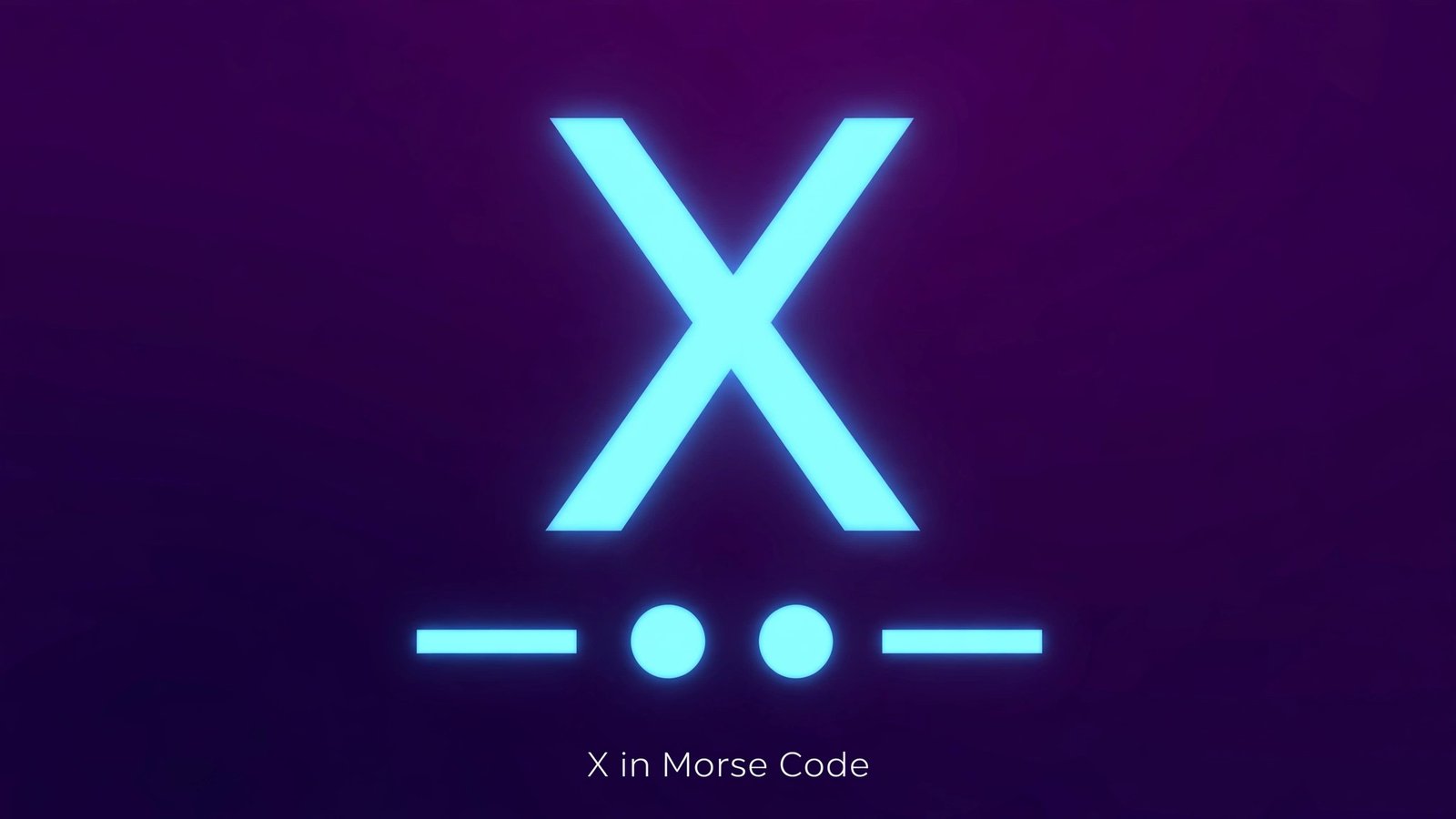
X in Morse code is dash-dot-dot-dash (-..-) — one long dah, two short dits, then a long dah to finish, sounded out as “dah-dit-dit-DAH.” It is a bold, bookended rhythm: it starts and ends on a long signal, with two quick beats tucked in the middle. In this guide you will learn exactly how to send, sound out and practise the letter X, how it differs from its close neighbour K, where it sits in the history of Morse code, and which everyday words you can spell once you know it.
If you want to hear or convert any letter instantly, the Morse Code Translator on the homepage will turn your text into audio Morse and back again — a handy companion while you work through this lesson.
What Is X in Morse Code?
In International Morse Code, the letter X is represented as:
| Letter | Morse code | Signal pattern | Spoken rhythm |
|---|---|---|---|
| X | -..- | dah-dit-dit-dah | “dah-dit-dit-DAH” |
Breaking that down:
- Dah (-) — a long signal, three time units long.
- Dit (.) — a short signal, one time unit long.
- X = dah + dit + dit + dah, with the tiny one-unit gap between each element inside the letter.
Think of X as a letter with a frame: a long signal on each side holding two short signals in the middle. That symmetry is what makes it satisfying to send — and, as you will see below, what makes it easy to confuse with K if your timing slips. X is also one of the less common letters in English, which is exactly why it gets a longer, four-element code: the original designers gave the shortest codes to the most frequent letters, and longer codes to letters like X and Z that turn up far less often.
How to Send and Sound Out the Letter X
Learn the timing rules first
Morse code is not just dots and dashes — it is a precisely timed rhythm. The international standard defines the timing every operator follows:
- A dit lasts 1 time unit.
- A dah lasts 3 time units.
- The gap between elements of one letter is 1 time unit.
- The gap between letters is 3 time units.
- The gap between words is 7 time units.
So X (-..-) is: long, short, short, long, with brief pauses — eight time units of signal plus three one-unit gaps. Tap it on a table now: TAP-tap-tap-TAP. That is the physical rhythm your hand needs to learn, whether you are keying a telegraph key, flashing a torch, or tapping a paddle. These timing relationships are defined in ITU-R Recommendation M.1677-1 for International Morse Code, as explained in this guide to how Morse code timing works.
Say it, then hear it
Operators learn letters by their sound, not by counting dots. Sound X out loud as “dah-dit-dit-DAH” — one drawn-out syllable, two clipped syllables, then a final drawn-out syllable with a little extra weight, as if you are landing the letter. Learn the rhythm of the character so your brain recognises the whole sound at once, instead of decoding dot-by-dot.
Speed in Morse is measured in words per minute (WPM). Beginners typically start around 5 WPM and work toward 12–20 WPM for comfortable conversation. At 20 WPM, the dits in X fly by in about 60 milliseconds each — fast, but your ear adapts quickly with short daily sessions. The trick with X is to keep the two middle dits light and even: if either one stretches, the whole letter starts to sound like something else.
X vs K: The Classic Mix-Up
The single most common beginner confusion is between X and K:
| Letter | Code | Pattern | Spoken |
|---|---|---|---|
| X | -..- | dah-dit-dit-dah | “dah-dit-dit-DAH” |
| K | -.- | dah-dit-dah | “dah-dit-DAH” |
X is simply K with one extra dit in the middle — which is why sloppy timing turns one into the other. If your second dit runs late, or your intra-letter gaps stretch too wide, a listening operator hears -.- and writes down K. The fix is discipline on the timing rules above: hold the opening dah for its full three units, keep both dits snappy and evenly spaced, land the closing dah firmly, and leave a clean three-unit silence before the next letter.
A useful drill is to alternate the pair out loud — “dah-dit-DAH, dah-dit-dit-DAH” — until your ear catches the extra beat instantly. Once you can tell them apart at speed, you have passed one of the real milestones of Morse listening. X’s other neighbour worth knowing is V in Morse code (…-), which shares the long finishing dah but packs three dits up front instead of X’s framed pattern. A full Morse code character chart shows X as dash-dot-dot-dash alongside every other letter, which is handy for checking pairs like this side by side.
The History of the Letter X in Morse Code
The story starts with Samuel Morse and his collaborator Alfred Vail, who developed what became known as American Morse code for the first US telegraph lines. In that early system, letters were assigned codes based partly on how often they were used — frequent letters got shorter codes, and rare letters like X got longer ones.
When the international system was standardised in 1865 (and refined at the 1912 London Radiotelegraph Convention), every letter received the clean dot-dash pattern we use today. X landed at -..-, a logical, memorable pattern that has remained unchanged for well over 150 years. That stability is part of why Morse still works as a universal language: an operator in Japan, Brazil and Germany all key -..- for X exactly the same way, with no translation needed. The International Telecommunication Union (ITU) still maintains the standard today under ITU-R M.1677-1.
X in Amateur Radio and Everyday Use
In amateur (ham) radio, Morse — operators call it CW, for “continuous wave” — is still a living, daily-used mode. The letter X shows up constantly: it appears in call signs on the bands, and on crowded HF bands a skilled operator can copy weak CW signals that voice modes cannot get through at all — which is why emergency communicators still train in it.
Beyond radio, X is the NATO phonetic alphabet word “X-ray,” used to spell the letter clearly over voice channels — so a pilot or soldier saying “X-ray” and an operator keying -..- are naming the very same letter in two different codes. And X carries a special cultural weight as a symbol: it marks a spot, stands for the unknown in algebra, and signs off a kiss at the end of a message. None of that changes its code, but it does make X one of the easiest letters to remember once you have learned it — the letter that already means “here it is” in everyday life.
Words You Can Spell with X
Once you know X, a surprising amount of everyday vocabulary opens up. Try keying these:
| Word | Morse code |
|---|---|
| FOX | ..-. — -..- |
| BOX | -… — -..- |
| NEXT | -. . -..- – |
| EXIT | . -..- .. – |
| MIX | — .. -..- |
| AXE | .- -..- . |
| SIX | … .. -..- |
| MAX | — .- -..- |
| TAXI | – .- -..- .. |
| FIX | ..-. .. -..- |
Practising with real words is far more effective than drilling isolated letters, because your brain starts recognising whole rhythms — the way “FOX” sounds as one flowing phrase rather than three separate letters. That is exactly how fluent operators read code: by rhythm, at speed. Start with FOX and BOX, where X lands at the end and its closing dah feels like a full stop, then move to NEXT and EXIT, where X sits in the middle and you have to keep going after it.
How to Practise the Letter X
Five focused minutes a day beats an hour once a week. Here is a simple routine built around X:
- Listen first (2 minutes). Use the Morse Code Translator to play -..- repeatedly, then type words from the table above and listen to them at slow speed.
- Tap it back (2 minutes). With a pen or your fingertip, tap out “dah-dit-dit-DAH” for each word, keeping the timing rules strict — and alternate X with K so your ear learns the difference.
- Test yourself (1 minute). Have the translator play random letters including X (and its trickster twin K) and write down what you hear.
Serious learners often move on to the Koch method, which teaches two letters at full target speed, then adds a third only once you are copying the first two at 90% accuracy. X is a good later addition to a Koch set: its framed long-short-short-long rhythm is distinctive once you can hear it cleanly, and learning to separate it from K early builds strong listening discipline. For a refresher on the letter before it, see W in Morse code (.–).
Frequently Asked Questions
What is X in Morse code?
X in Morse code is -..- — dash-dot-dot-dash, or dah-dit-dit-dah. It is sounded as “dah-dit-dit-DAH”: one long signal, two short signals, then one long signal.
How do you write X in Morse code?
Write X as one dash, two dots, then one dash: -..-. Leave a one-unit gap between each dot and dash within the letter, and a three-unit gap before the next letter begins.
What is the difference between X and K in Morse code?
X is -..- (dah-dit-dit-dah) and K is -.- (dah-dit-dah). X is K with one extra dit in the middle. Keep your timing strict — a full-length opening dah, two snappy, evenly spaced dits, and a firm closing dah — and the two are easy to tell apart.
How do you say “fox” in Morse code?
“FOX” in Morse code is ..-. — -..- — F, O, X. Practise it as one flowing rhythm rather than three separate letters, and check your timing against the Morse Code Translator until it feels natural.
Is Morse code still used today?
Yes. Morse (CW) remains in daily use by amateur radio operators worldwide, is still transmitted by some aviation navigation beacons, and is taught to military signallers and emergency communicators. The International Morse Code standard itself has been stable for over 150 years.
Conclusion
The letter X — -..-, “dah-dit-dit-DAH” — is a satisfying late-alphabet win for any Morse learner: bold, symmetrical, packed into everyday words like FOX, BOX and NEXT, and carrying the familiar “X-ray” of the NATO phonetic alphabet. Master its timing, learn to keep it distinct from K, and you have genuinely levelled up your ear. From here, only Y and Z remain in the letter series — work through the letters one at a time, and test yourself anytime with the Morse Code Translator. Happy keying — dah-dit-dit-DAH!