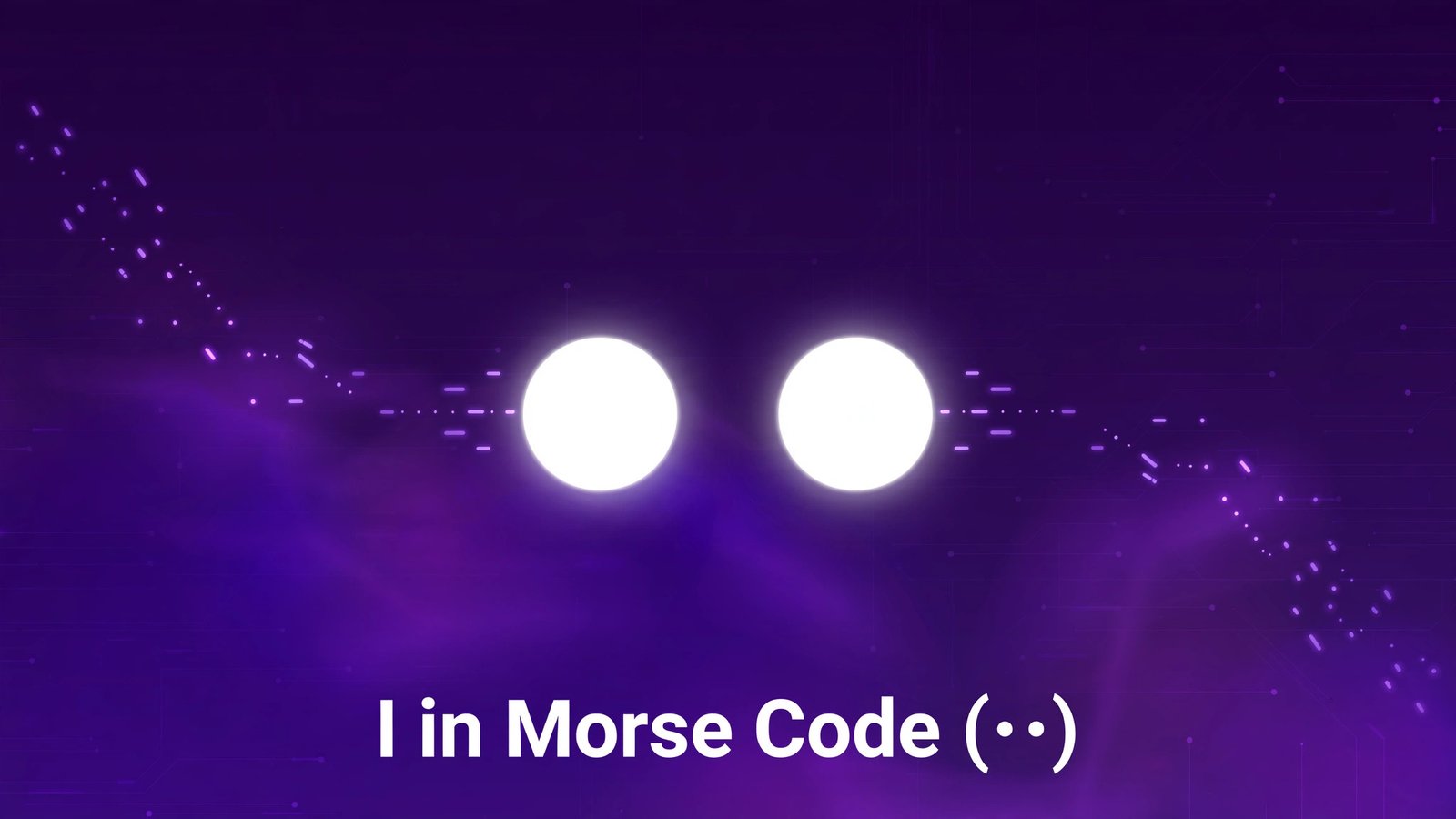
The letter I in Morse code is ·· — two quick dots, spoken “dit-dit”. It is one of the shortest letters in International Morse Code — only E is shorter — and it anchors the famous “dot family” that carries learners from one dot all the way to four. In this guide you will learn exactly how to write, key, hear, and remember I in Morse code, with timing rules, memory tricks, practice drills, and answers to the most common questions.
If you are working through the alphabet letter by letter, this guide follows the same format as our G in Morse code and E in Morse code tutorials — and you can test every example instantly with our free Morse Code Translator tool.
What Is I in Morse Code?
In International Morse Code — the standard formalised in the nineteenth century and maintained today by the International Telecommunication Union (ITU) — each letter is a unique sequence of short signals (dots, or dits) and long signals (dashes, or dahs). The letter I is encoded as:
| Letter | Morse Code | Signal Pattern | Spoken As |
|---|---|---|---|
| I | ·· | dot – dot | dit-dit |
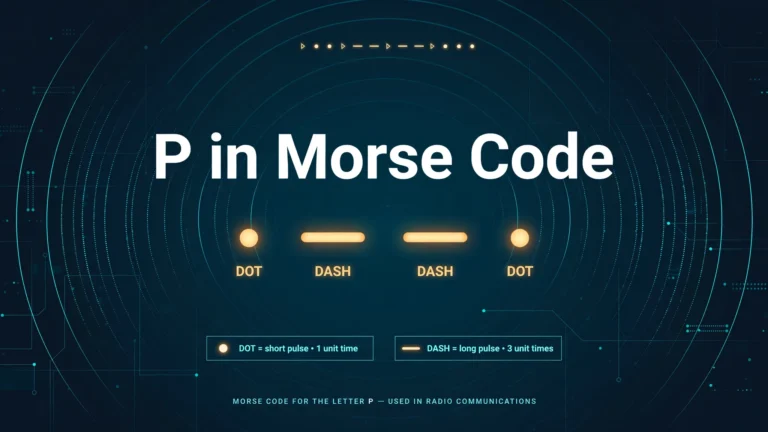
A dot lasts one time unit, and the short silence between the parts of a single letter also lasts one dot-length. So the letter I takes: dot (1) + gap (1) + dot (1) = 3 time units in total. Compare it with the rest of the dot family — the pattern scales beautifully:
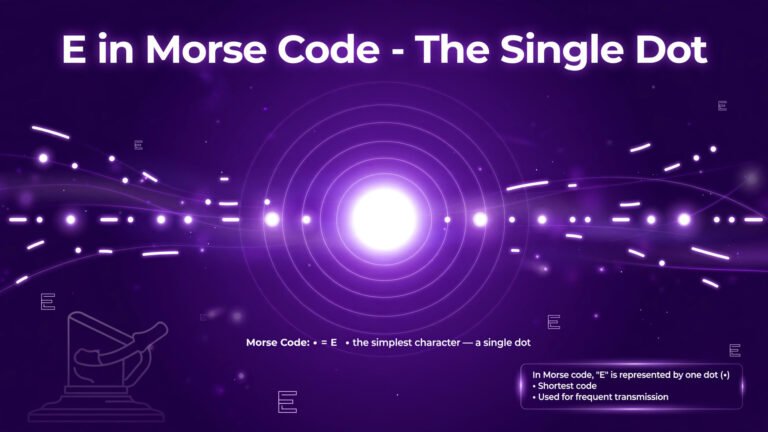
- E (·) — 1 time unit
- I (··) — 3 time units
- S (···) — 7 time units
- H (····) — 11 time units
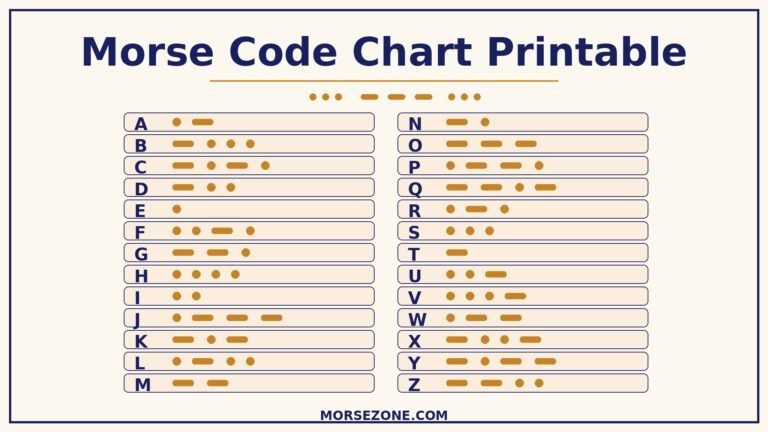
This family was no accident. When Samuel Morse and Alfred Vail developed their telegraph code in the 1830s and 1840s, they assigned the simplest patterns to the most frequently used letters — that is why E got a single dot, T a single dash, and I a pair of dots. (You can read more about the history in our Morse code references, and see how I fits into the full Morse code alphabet chart.)
How to Say and Key I
Sending Morse by hand — on a classic straight key, a telegraph sounder, or even a flashlight — is all about rhythm. For I:
- Tap quickly — dit.
- Pause briefly (one dot-length of silence — about as long as the tap itself).
- Tap quickly again — dit.
The classic beginner mistake is pausing too long between the two dots. A gap of three dot-lengths is the silence between letters, so an over-long pause turns ·· (I) into · · — the letter E sent twice. Keep the gap at one dot-length and the two taps will fuse into the single “dit-dit” unit your ear expects.
To train your ear, paste ·· into our Morse Code Translator and press play at 15, 20, and 25 WPM. At real on-air speed, nobody counts dots and dashes — operators recognise the shape of the sound, and the double-blip of I is one of the easiest shapes to lock in. This “learn the sound, not the count” principle is also the core of the Koch method, the training technique that teaches letters at full speed, two at a time.
Memory Tricks for I (··)
I belongs to the dot family: E (·), I (··), S (···), H (····). Learning them as a ladder — one dot, two dots, three dots, four dots — gives you four letters for the effort of one. Chant it while tapping your desk: “dit… dit-dit… dit-dit-dit… dit-dit-dit-dit.” Three slow repetitions and the ladder usually sticks.
Another reliable anchor: think of a heartbeat — lub-dub — and tap twice in that same quick rhythm. The letter I is simply that: two heartbeats of signal. And here is a pairing trick worth remembering: I’s code is the opening of S’s code. Learn I first and you are already one dot away from S — just add a third tap.
For a structured path through the whole alphabet, our guide on how to learn Morse code fast walks through the fastest memorisation order and daily drills.
I Beyond the Alphabet: Where the Dit-Dit Shows Up
NATO phonetic alphabet: “India”
In voice radio procedure, the letter I is spoken as “India” in the NATO phonetic alphabet, standardised in 1956 and used by aviation, maritime, and military operators worldwide. When an operator spells a word containing I over a noisy channel, “India” cuts through static far better than the bare letter — the same clarity principle that makes Morse’s sharp dit-dit so recognisable.
Amateur radio: callsigns that start with I
The ITU allocates callsign blocks to countries, and all amateur radio callsigns beginning with I belong to Italy — you will hear Italian stations signing as I0, IK, IZ, and similar. So when you catch that opening ·· at the start of a callsign, you are listening to an Italian operator. The amateur radio community — organised nationally by groups such as the ARRL — keeps these conventions alive on the air every day.
Aviation: Italian aircraft wear an I
Civil aircraft registrations are allocated by country too: American planes begin with N, French planes with F, and Italian-registered aircraft carry registrations beginning with I, for example I-ABCD. Spotters at any Italian airport read those I- registrations all day — each one, if you tapped it out, beginning with dit-dit.
Practice Words With I
The best drill is real words. Encode these with our free Morse Code Translator, listen to the audio, then try keying them yourself:
| Word | Morse Code |
|---|---|
| IN | ·· -· |
| IT | ·· - |
| HIS | ···· ·· ··· |
| SIT | ··· ·· - |
| KISS | -·- ·· ··· ··· |
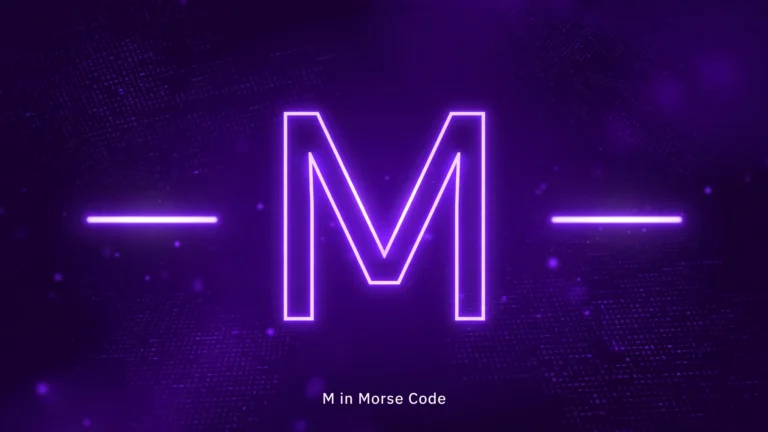
| MINI | -- ·· -· ·· |
Notice how HIS is almost pure dot-family practice: dit-dit-dit-dit, dit-dit, dit-dit-dit. Ten slow repetitions of HIS will lock the I pattern into your muscle memory faster than any flashcard. For a full reference of every character, keep our Morse code alphabet chart open in another tab while you practise.
Letters That Look (or Sound) Like I — Don’t Mix These Up
| Letter | Code | How it differs from I (··) |
|---|---|---|
| E | · | One dot fewer — a single “dit” |
| S | ··· | One dot more — “dit-dit-dit” |
| H | ···· | Two dots more — “dit-dit-dit-dit” |
| U | ··- | Starts with dit-dit, then adds a dash — the classic trap |
U is the sneakiest lookalike: at speed, the opening ·· of ··- sounds exactly like I until the final dash arrives. The trick is to listen for the ending — a clean stop after the second blip means I; a trailing long tone means U. Master this “listen to the tail” habit and the whole dot family becomes unmistakable.
Frequently Asked Questions
What is I in Morse code?
I in Morse code is ·· — two dots, spoken “dit-dit”. It is part of the International Morse Code standard maintained by the ITU, and it takes just 3 time units to send.
How do you write I in Morse code by hand?
Write two short marks (dots) with a tiny gap between them: ··. When keying it, tap, pause briefly, and tap again — keeping the gap to about one dot-length so the two dots fuse into one letter.
What does I sound like in Morse code?
It sounds like DIT-DIT — two quick tones, like a heartbeat’s lub-dub. You can hear it at any speed using our Morse Code Translator audio playback.
What is the NATO phonetic word for I?
“India.” The NATO phonetic alphabet (standardised 1956) assigns “India” to the letter I for clear voice communication in aviation, maritime, and military radio.
Why do Italian ham radio callsigns start with I?
The ITU allocates callsign blocks by country, and the I block belongs to Italy. Italian amateur stations sign callsigns like I0, IK, and IZ — so an opening dit-dit on the air usually means you are hearing Italy.
Keep Going: Master the Whole Alphabet
I is one of the easiest letters to learn — its two-dot dit-dit rhythm clicks almost instantly, and it unlocks the rest of the dot family. From here, continue with the next letters in our series (like F in Morse code), or jump to the complete Morse code alphabet chart to see how I fits among all 26 letters, 10 numerals, and common punctuation. And whenever you want to hear, send, or decode real Morse instantly, our free Morse Code Translator is one click away.