If there is one Morse code letter every beginner should learn first, it is T in Morse code: a single dash ( – ). Along with E (a single dot), T is one of only two letters in the entire International Morse Code alphabet made from one signal. It is short, unmistakable, and the building block for some of the most famous signals ever sent — including the O in SOS (… — …)‘s companion … well, more on that below. Let’s break it down.
What Is T in Morse Code?
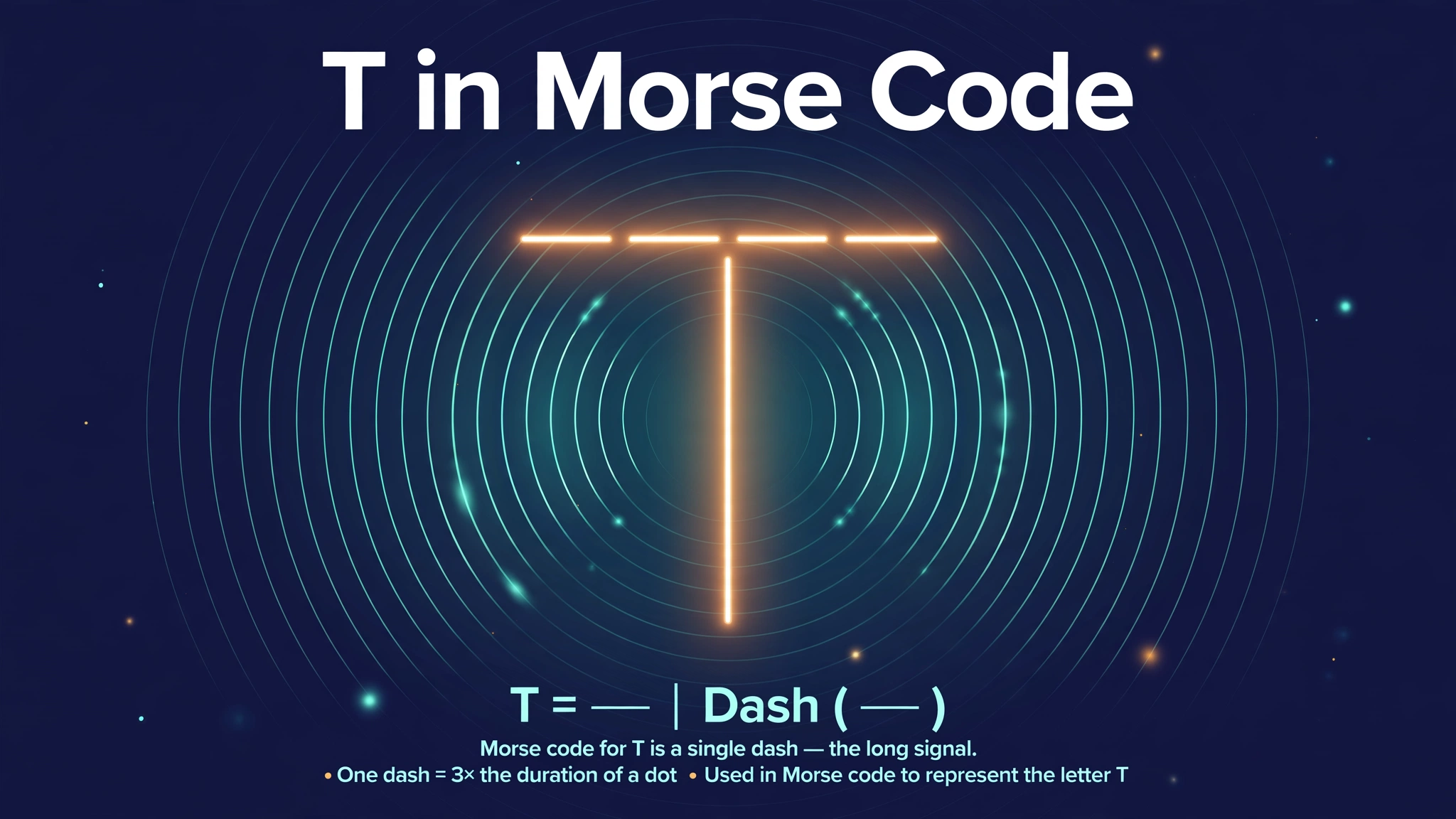
T in Morse code is represented by a single dash:
| Letter | Morse code | Signal | Spoken |
|---|---|---|---|
| T | – | One long dash | “Dah” |
A dash in Morse code is three times the length of a dot. If a dot lasts one unit of time, a dash lasts three. So when you hear a single long tone — dah — that is the letter T. In the NATO phonetic alphabet it is spoken as “Tango”, which pairs nicely with T’s Morse identity: both are one strong, unbroken sound.
How to Signal T: Tone, Light, or Tap
You can send T in Morse code with almost anything:
- Audio: one sustained beep or buzz — “dah”. Practice on a free Morse code translator by typing the letter T and listening to it.
- Flashlight: one long flash held for roughly three times the length of a quick blink.
- Knocking or tapping: one firm, longer knock. (A tap that is too short will be read as E.)
- Flags or arm signals: hold one clear extended position rather than flicking through positions.
The key is duration. A dot is a short burst; a dash is a deliberate, held signal. New learners often rush their dashes — count “one-two-three” in your head the first few times until the rhythm becomes automatic. See our F in Morse code walkthrough (··–·) to watch the two base signals — dot and dash — combine into a longer letter.
Why T and E Are the Foundation of Morse Code
Samuel Morse and his collaborator Alfred Vail designed the code with a simple insight: the most common letters should have the shortest codes. E (a dot) is the most frequent letter in English, and T is the second most frequent — so T earned the second-shortest code, a single dash. This efficiency is why a skilled operator can send SOS in Morse code — three dots, three dashes, three dots — in just seconds.
The original American Morse code (developed in the 1840s for the first US telegraph lines) was later replaced by International Morse Code, standardised by the International Telecommunication Union (ITU), which is the version T’s dash belongs to today. The Smithsonian and historical records credit Vail with much of the practical code development alongside Samuel Morse.
T in Real-World Morse Usage
1. The dash in SOS
The most famous Morse signal in history, SOS (… ––– …), puts T’s dash to work three times over. The three dashes in the middle are three T’s back-to-back. If you can signal a clean T, you are already one third of the way to sending a distress call. See our full breakdown of SOS in Morse code for the timing rules.
2. Amateur (ham) radio
T appears constantly in ham radio procedure. The prosign BT (–···–) (“break”/separator) is built from dashes like T’s, and the friendly sign-off 73 (meaning “best regards”) is sent with dashes and dots operators know by heart. Read our article on what 73 means in ham radio to see the dash at work in everyday on-air conversation.
3. Military and aviation
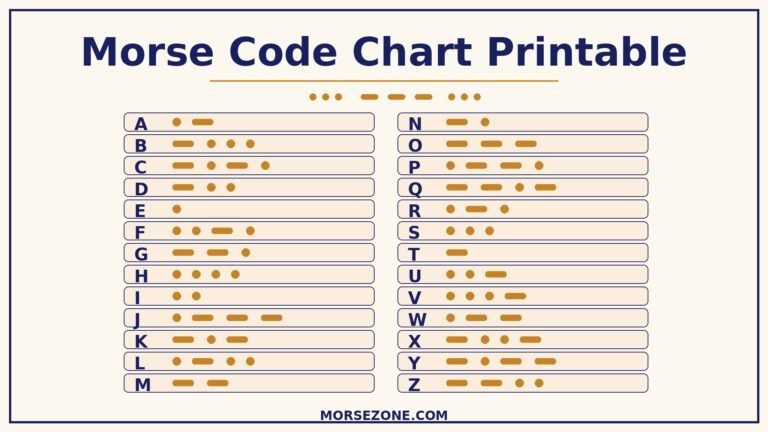
Morse code is still taught in parts of military and aviation training as a backup communication method. The single dash of T is often used in timing drills: if trainees can hold a clean, evenly-spaced dash at 20 words per minute, they have mastered the fundamental unit of all longer signals. Check the full Morse code alphabet chart to place T among its sibling letters.
4. The letter pair R and T
T (–) and R (·–·) look similar on paper, but R’s sandwich of a dash between two dots sounds completely different — “di-dah-dit”. Training T first makes R much easier to recognise, because your ear learns what a bare dash sounds like before it has to find the dash hidden inside R.
How to Hear T in Morse Audio
Morse speed is measured in words per minute (WPM), where the standard word is “PARIS”. At 5 WPM — typical beginner speed — T’s dash lasts about 0.6 seconds. At 20 WPM, the same dash flashes by in roughly 0.15 seconds. Tips for recognising it:
- Listen for length, not pitch. T is the only letter that is one continuous sound, so any lone sustained tone is almost certainly T (or part of a number — all Morse numbers begin with dashes).
- Use Farnsworth spacing: learn the dash at full speed but with longer gaps between letters, then tighten the gaps. The ARRL’s Morse learning resources recommend this for building speed without errors.
- Test yourself: type any word with T into our Morse code translator tool, play it back, and try to pick out every dash before looking at the decoded text.
Common Mistakes When Learning T
| Mistake | What happens | Fix |
|---|---|---|
| Dash too short | T gets read as E (·) | Hold for a full 3 dot-lengths; count “one-two-three” |
| No gap after the dash | T merges into the next letter | Leave a 3-unit gap between letters |
| Uneven dash length | Decoder or listener misreads timing | Practice with the audio decoder for consistent timing |
Letter spacing matters as much as the signal itself: the gap between letters is 3 units, between words 7 units. Our Morse code audio decoder is a good way to hear correctly spaced code and compare it against your own keying.
Quick Reference
| Letter | Morse | Memory aid |
|---|---|---|
| T | – | The single long “Dah” — the second-shortest letter |
| E | · | The single “Dit” — shortest letter |
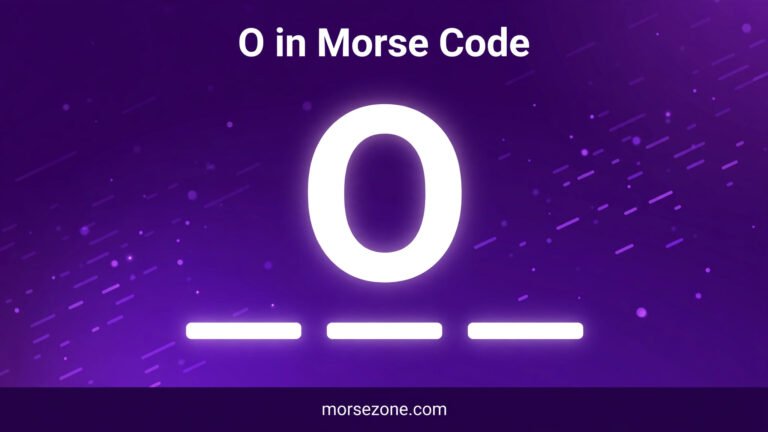
| O | ––– | Three dashes (three T’s) — SOS’s middle |
| R | ·–· | T hiding between two dots |
Frequently Asked Questions
What is T in Morse code?
T in Morse code is a single dash (–), spoken as “dah”. It is one of the two simplest letters in International Morse Code, alongside E (a single dot).
How do you write T in Morse code?
Write or type a single dash character: –. On a keyboard, the hyphen-minus key (-) is the common stand-in.
What does a single dash mean in Morse code?
A single dash on its own is the letter T. Three dashes together (–––) represent the letter O, and in the distress signal SOS the three dashes form its middle section.
How long is the dash for T in Morse code?
A dash is three times the length of a dot (3 time units). The gap between letters is also 3 units, and the gap between words is 7 units, per ITU timing standards.
Is T the easiest Morse code letter to learn?
Along with E, yes. Because T is a single signal, beginners typically learn it first — the Koch method of learning Morse starts with exactly these two letters before adding any others.
Start Practising T Today
The letter T is proof that Morse code rewards simplicity: one dash, one letter, endless uses. Type “T” into our free Morse code translator to hear it, flash it with a torch, or tap it on a table — and you have learned one of the two letters every Morse journey begins with. Next, try R in Morse code to see how T’s dash hides inside a longer letter, or browse the complete Morse code alphabet.