
Morse Code Numbers – How to Encode and Decode Numbers
As one of the oldest and most exceptionally profound communication methods to exist, Morse code uses a system of dots and dashes to relay messages. It has found utility in radio communication, emergency communication, and in secret messages. Although the average user tends to ignore Morse code numbers, they are equally crucial for communicating specific information, such as time, dates, telephone numbers, and GPS coordinates. The more you practice Morse code numbers, the better you become at encoding and decoding messages. With a Morse code translator, you are able to practice and improve your skill gradually.
What does Morse Code Numbers mean?
Morse code uses an encoded language through the art of dot and dash sequences. Each digit, from zero to nine, has its own designated sequence of dots and dashes to represent a number. The numbers have a fixed pattern that is followed consistently to represent that digit. The number sequences are a component of the greater Morse code system which encompasses letters, symbols, and punctuation. A common scenario where numbers become vital is where specific or detailed information is required, such as in technical or emergency situations.
Difference Between Letters and Numbers in Morse Code
Morse Code letters have different structures than Morse Code numbers. Morse Code letters have fewer signals in their structures than numbers. Numbers also have a easier identification because their signals have a unified structure. For example, signals representing letters gain in length. In contrast, signals representing numbers have a unified structure composed of the same number of signals of both type composed of a defined pattern of preceded signals.
Morse Code Numbers Chart (0–9)
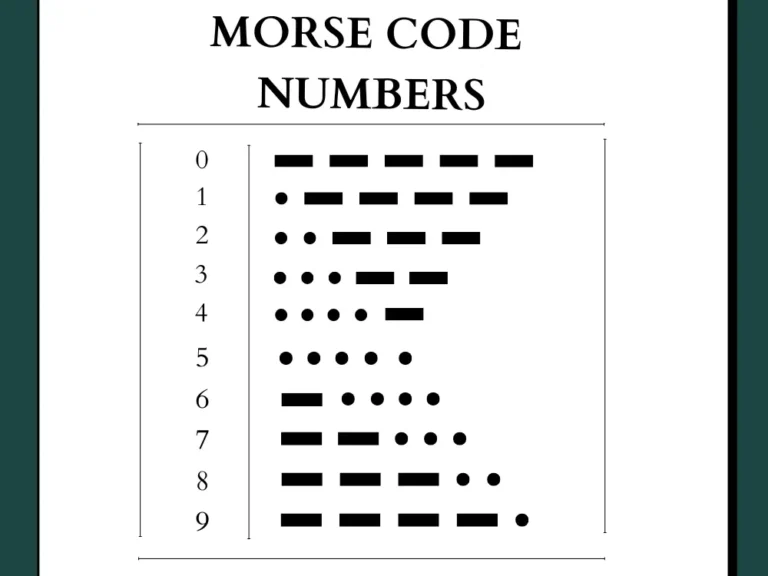
Each number in Morse Code numbers chart consists of a definite and unique pattern of dots and dashes. The separation of numbers represented in Morse Code numbers chart is also in the digits of each number as they use the same structure in their definitions. Numbers from 1 to 5 have a structure that constitutes of a rising number of composing signals of the same type of signals (i.e. all dots) while numbers from 6 to 0 have a composing structures of rising number of signals (i.e. all dashes). Codes chart have a definite and unique pattern of dots and dashes that are the same in each set.
Easier to Remember with Visual Learning
Learning visual cues facilitates the memorization of Morse code number sequences. Visualizing a ‘dot’ representing a short signal and a ‘dash’ representing a long signal assists the brain in pattern recognition. E.g., five ‘dots’ can become five short ‘clicks’, while a ‘zero’ can become five long ‘sound’ signals. These ideas help simplify the coding process by making the learning experience less overwhelming.
Tips for Beginners to Remember Numeric Codes
Learning Morse code numbers can be easier if you stick to the simple methods. You don’t have to memorize all patterns at the same time. Creating a consistent schedule is recommended to practice so the learning process becomes less overwhelming.
1. Learn the Dot and Dash System
Start by learning the rules. For simple numbers, 1, 2 3, 4, and 5, you use dots. For 6, and 7, 8, 9, and 0, you use dashes. Just following the rules can help you memorize.
2. Use Creative and Visual Memory Aids
Learning can be creative and fun. You can associate numbers with certain things to help you remember. It helps if you use creative tricks instead of just trying to rote memorise.
3.Listen to Morse Code and Read
Morse Code is learned through both sight and sound. Just listening to Morse Code can help develop your skills for aural recognition so that you can start to understand what numbers are being sent at a certain speed.
4.Try Kinaesthetic, Auditory, and Visual Methods to Learn
Learning different styles can help your learning significantly. You can look at patterns, listen to sounds, and use your fingers to tap the signals. Use whatever methods are necessary in order to make your learning easier.
5. Use Flashcards or Spaced Repetition
Flashcards help you with questions in this case Morse code, your method is to review and increase the numbers in your time intervals, and this will help you cement the information in your long-term memory.
6.Keep Your Learning Short and Consistent
Focusing for several minutes every day is better than trying to memorize for hours. Daily practice sessions are recommended to help you develop a good understanding of the fundamentals.
7. Our Morse Code Translator is Great for Practice
Morse code translators make learning easier by allowing you to convert numbers and check your answer.
8.Use Real Life Examples
Make your practice interesting by using real numbers, such as your phone number or the time. This makes it practical and gives you a better understanding of how Morse Code is used.
9.Chunking Long Numbers
When working with long numbers you will want to divide the numbers into smaller parts. This, will make encoding and decoding the numbers easier and minimizes mistakes.
10.Monitor Your Mistakes and Progress
Monitoring your practice will show improvement. When you notice mistakes, work in those areas and practice until it gets better.
11. Move On to Advanced Practice
Once you have the basics, practice at higher speed or try other variations to improve your confidence and accuracy.
Numbers in Morse Code
Learning to code numbers in Morse code refers to the practice of assigning standard numeric values to a specific pattern of ‘dots’ and ‘dashes’. Once the foundational principles of Morse code numbers are understood, this practice becomes straightforward. It has been used to convey messages across a variety of communication mediums, such as radio and signal emergencies. With sufficient practice, one can translate number values into Morse code with sufficient speed to do so without having to reference a code sheet.
How to Practice Morse Code with Numbers
In Morse code, numbers are represented by 5 signals. Divide the number into single digits, and write the Morse code equivalent of each digit. For example, the number 2 should be converted, then the 4, and so on. Finally, be sure to add a space between each digit so that the code can be deciphered easily. This method will allow you to confidently practice writing Morse code correctly.
Mistakes When Using Morse Code Digits
Beginners experience a lot of challenges as they learn Morse Code, this is normal and mistakes are to be expected. As experience and practice develop, mistakes will decrease.
1. Mixing up code for numbers and code for letters
It is easy to confuse code used for numbers with that of letters as they both use the same dots and dashes. Remember numbers use five signals, if you are counting that should help you see the difference.
2. Mistakes with Timing in Signaling
Timing can be critical in Morse Code, and if the timing of the signals are incorrect it can totally change the meaning of the message being sent. Practice with the help of a metronome to ensure your timing is correct.
3. Guidelines to Avoid Mistakes
To reduce the chances of making mistakes, learn one thing at a time and practice consistently. Set your timing and spacing carefully, and be sure to review your work with a Morse code translator. You’ll find you are able to advance more quickly and sharpen your skills.
4. Irregular Practice
Regular practice is crucial to learning Morse Code. It will be impossible to know the needed techniques when you do not practice related skills.
5.Ignoring Listening
When learning Morse Code, many read and write and forget to listen. Sound is also part of Morse code and so the listening aspect is key.
6. Overlooking Signal Spacing
Signal spacing is key just like the signals themselves. Without spacing, the numbers become hard to read.
How to Decode Morse Code Numbers
Decoding Morse code numbers means reading dot and dash patterns and converting them back into normal numbers. This skill becomes easier with practice and pattern recognition. Once you understand how numbers are structured, decoding becomes quick and simple.
Step-by-Step Guide to Reading Morse Code Numbers
Start by identifying the number of signals in a pattern. Since numbers always have five signals, this helps you recognize them quickly. Then look at the order of dots and dashes and match it with the correct number. By decoding one digit at a time, you can avoid confusion and read messages accurately.
Techniques to Quickly Recognize Patterns
Recognizing patterns quickly comes with practice. You can train your eyes to spot dot and dash sequences or train your ears to understand sound patterns. Over time, your brain will automatically identify numbers without much effort.
Tools and Apps to Decode Numbers
There are many tools available to help decode Morse code numbers. A Morse code translator is the easiest option because it gives instant results. You can also use mobile apps to practice anytime and improve your decoding skills.
Uses of Morse Code Numbers
There are not just theoretical uses of Morse code numbers. They have a number of practical applications.
1. SOS and Emergency Signaling
In emergency situations, Morse code is extremely helpful. It provides a way to communicate when more traditional methods such as telephone calls aren’t available.
2. Use in Generated Hobby and Radio
Morse code is still in use, even by many enthusiasts in radio communications. During the conversations, numbers transmit signal details and other relevant information.
3.Communication in Aviation and Military
Morse code use is common in military and aviation communication. Numbers are needed for positions, ID, and even more so in modern-day combat.
4. Contemporary Uses in Digital and Encrypted Communication
Morse code continues to be utilized in innovative ways in today’s technologies. It is incorporated into digital communications, used in security systems, and applied in assistive technologies that enable users to communicate via simple signal systems.